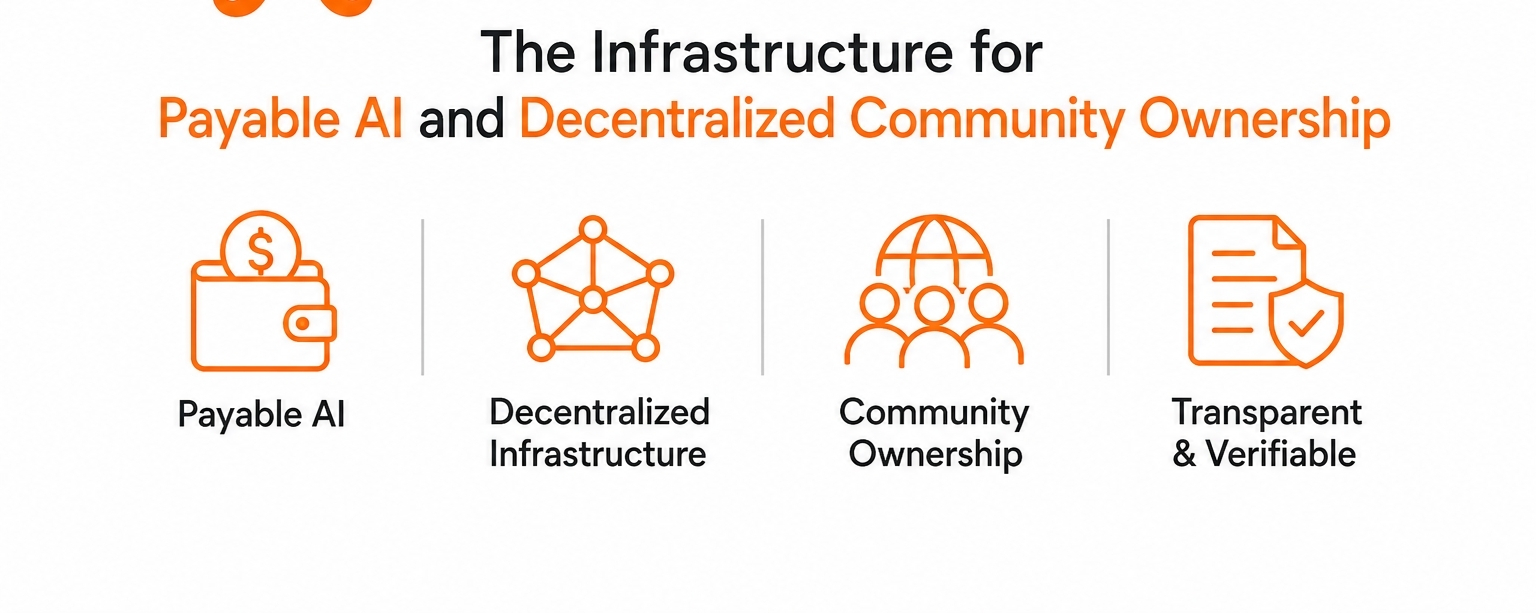
There’s a strange imbalance in the current AI economy that people rarely talk about directly. A small group of companies owns the models, controls the infrastructure, and decides how value flows. Meanwhile, the people who actually provide the raw material for AI systems — data contributors, prompt engineers, domain experts, community moderators, and even smaller developers — often disappear into the background once the system starts working.
OpenLedger is built around that imbalance. Not by trying to replace AI models themselves, but by focusing on something less visible and arguably more important: the infrastructure that determines who gets paid, who gets recognized, and who controls the system after it grows large.
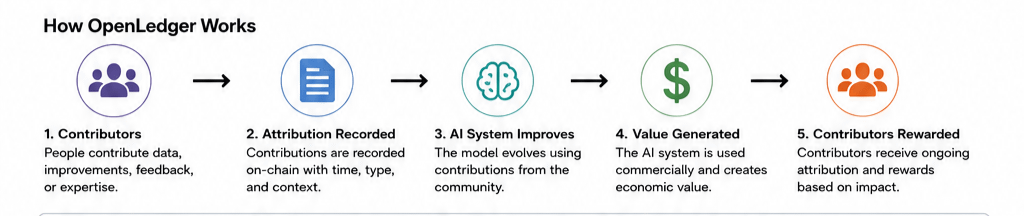
The idea behind “payable AI” sounds simple at first. If an AI model generates economic value using community-contributed data or improvements, contributors should continue receiving attribution and rewards over time. But implementing that idea is difficult because AI systems are messy. Data comes from many places. Models evolve constantly. Contributions overlap. Ownership becomes blurry almost immediately.
OpenLedger tries to solve this through blockchain-based attribution tracking. In practical terms, that means recording who contributed what, when they contributed it, and how that contribution influenced later outputs or model improvements. The system treats AI development less like a private software product and more like a shared economic network.
That sounds reasonable on paper. The tension begins when you think about scale.
Most AI systems today operate like black boxes. A dataset enters. A model trains. Results appear. If thousands of people contribute information, conversations, annotations, or refinements, separating individual influence later becomes nearly impossible. Even companies building the models often cannot clearly explain why a system generated a particular response.
OpenLedger’s infrastructure attempts to introduce traceability into that process. Instead of only storing final outputs, it tries to track the lineage of contributions across the lifecycle of an AI system. The important detail here is not transparency for philosophical reasons. It is transparency tied directly to payment and governance.
Imagine a healthcare-focused AI model trained partly on contributions from medical researchers across different regions. One group improves diagnostic accuracy for local diseases. Another contributes translated medical terminology. A third group identifies harmful biases in earlier model behavior. Under normal AI business structures, those contributors might receive a one-time contract payment, if they are paid at all.
In OpenLedger’s model, those contributions can remain connected to future value generation. If the system continues being used commercially, contributors may continue receiving economic recognition through on-chain attribution systems.
That changes incentives in subtle ways.
People often assume decentralization is mainly ideological. In reality, many decentralized systems are attempts to solve coordination problems. AI currently has a coordination problem. Valuable contributors frequently have little reason to participate long-term because ownership concentrates quickly after infrastructure scales.
OpenLedger is essentially asking whether AI can function more like a shared digital economy instead of a centralized product pipeline.
But this creates another problem almost immediately: attribution itself becomes political.
Suppose two contributors improve the same AI behavior differently. One provides higher quality data. Another builds the optimization method that makes the data useful. Who deserves more credit? What happens when contributions indirectly influence later improvements several layers away from the original work?
Traditional companies solve these disputes internally through management structures. OpenLedger tries to encode parts of that logic into infrastructure itself. That sounds cleaner than it really is.
The moment financial rewards become attached to attribution systems, people begin optimizing for visibility instead of usefulness. Communities can become competitive in unhealthy ways. Small contribution disputes may turn into governance conflicts because attribution now carries economic weight.
This is one of the more interesting tensions inside payable AI systems: transparency can improve fairness while also increasing friction.
A practical example helps clarify this.
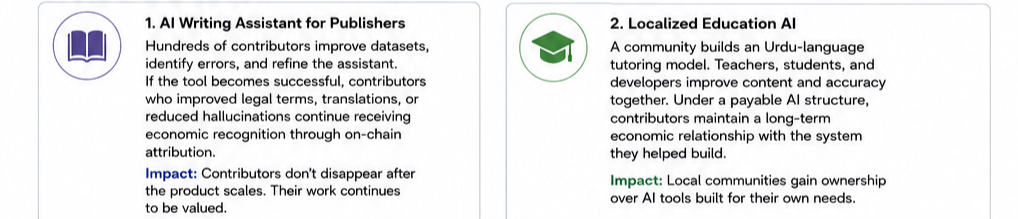
Imagine a decentralized AI writing assistant used by independent publishers. Hundreds of contributors improve language datasets over time. One contributor specializes in legal terminology. Another improves multilingual translation accuracy. Another identifies hallucination patterns in financial summaries.
If the system becomes commercially successful, OpenLedger’s infrastructure aims to maintain a persistent relationship between contributors and the value being generated. Instead of contributions disappearing into a centralized company database, they remain economically visible.
That sounds attractive, especially for smaller contributors who normally lose bargaining power once platforms scale.
But now imagine the system starts generating inaccurate financial advice that causes reputational damage. Who becomes responsible? The original dataset contributor? The model maintainer? The governance layer? The infrastructure network?
Decentralized ownership often distributes rewards more fairly. Accountability, however, becomes harder to localize.
This is where OpenLedger becomes more interesting as infrastructure than as branding. It is not only trying to decentralize AI ownership. It is also forcing difficult questions about responsibility inside distributed systems.
Another practical example appears in localized AI development.
Large AI companies tend to prioritize high-volume languages because training infrastructure is expensive. Smaller regional languages often receive weak support despite large user populations. Community-owned AI systems create a different incentive structure.
A regional education community, for instance, could collectively improve an Urdu-language tutoring model using OpenLedger’s attribution infrastructure. Teachers contribute educational corrections. Students identify confusing outputs. Developers improve reasoning performance for local curriculum standards.
Under traditional systems, much of that labor becomes unpaid platform improvement. Under a payable AI structure, contributors maintain some economic relationship to the network they helped build.
Yet even here, tradeoffs appear.
Community-governed AI systems may move slower than centralized companies. Decision-making becomes layered. Governance discussions consume time. Infrastructure overhead increases because attribution systems require verification, storage, and coordination.
There is also the uncomfortable reality that blockchain systems sometimes overestimate how much ordinary users care about governance participation. Many people simply want tools that work reliably. They do not necessarily want to vote on model incentives or attribution formulas.
OpenLedger seems aware of this tension. Much of its architecture focuses less on making every user an active governor and more on embedding attribution directly into infrastructure layers where coordination happens automatically.
That distinction matters because many earlier decentralized projects struggled under governance complexity. Systems became difficult to maintain precisely because too many operational decisions required community alignment.
Another subtle aspect of OpenLedger is that it treats data as labor rather than passive input. That shift sounds semantic, but economically it changes how AI ecosystems are framed. If data contribution is treated like labor, then attribution, compensation, and ownership become harder to ignore.
Current AI infrastructure often treats contributors as temporary fuel sources. OpenLedger is trying to build a system where contribution histories persist long after training cycles finish.
Whether that model scales sustainably is still uncertain.
Tracking attribution across evolving AI systems introduces technical overhead. Maintaining fairness across massive contributor networks introduces social overhead. Preventing manipulation introduces governance overhead. The infrastructure becomes heavier because accountability itself is computationally expensive.
Still, the underlying question OpenLedger raises is difficult to dismiss.
If AI systems increasingly depend on collective human contribution, can ownership remain permanently centralized without eventually creating structural resentment inside the ecosystems that sustain them?
The answer may depend less on ideology and more on whether infrastructure can realistically balance openness, incentives, accountability, and operational simplicity at the same time. Right now, that balance still feels fragile.