
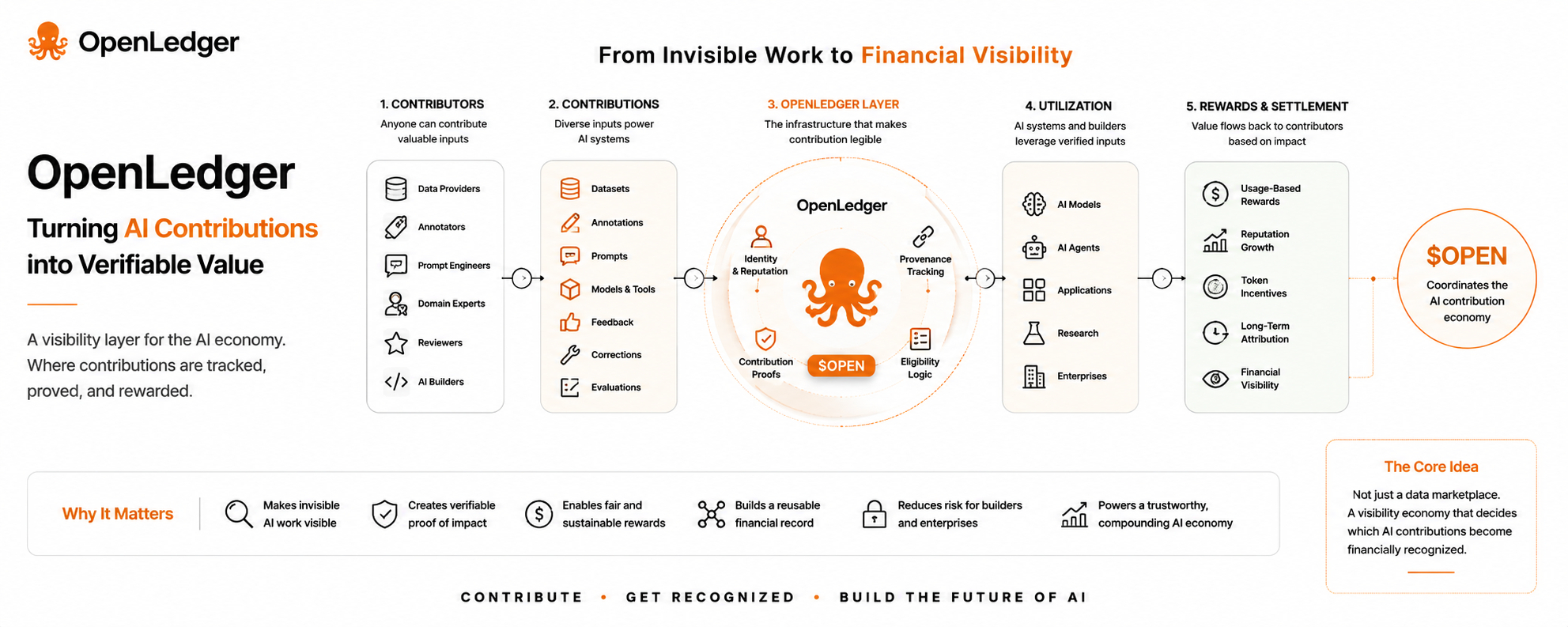

Most people will describe OpenLedger the easy way first. They will call it a data economy, an AI marketplace, or a tokenized layer for contribution. That description is not wrong, but it is incomplete in a way that matters. The more interesting question is not whether OpenLedger helps data move through a system. It is whether it helps the system decide which contributions are actually real enough to be rewarded.
That sounds subtle, but it is the whole game.
AI is built on layers of invisible work. A useful model output may come from a dataset, a correction, a prompt, a human judgment, a feedback loop, or a small adjustment that never gets credit on its own. Most of that value disappears into the machine. People can contribute to the final result without ever becoming legible inside the economy that benefited from them. OpenLedger is trying to challenge that invisibility.
That is why the project feels more important than a normal marketplace.
A marketplace connects buyers and sellers. A visibility layer does something harder. It determines whether a contribution can be tracked, proven, reused, and recognized after the fact. That is not just commerce. That is financial identity for AI labor. It means contribution is no longer just “input.” It becomes something closer to an asset with memory.
And memory is where the real tension begins.
Because once a system starts rewarding visible contribution, people will naturally try to become more visible. Some will build useful things. Others will optimize for being counted. That distinction matters. Crypto has seen this pattern many times. When incentives are clear, behavior often becomes theatrical. Activity increases, but usefulness does not always follow. OpenLedger will have to prove that it can separate meaningful contribution from polished noise.
That is where $OPEN becomes interesting.
If the token is only there to circulate inside a speculative data stack, then it is just another asset trying to find a story. But if it sits at the point where contribution becomes verifiable, reusable, and economically acknowledged, then it plays a much larger role. It stops being a payment badge and starts acting like a settlement layer for AI credit.
That is a stronger thesis, but also a harder one to defend.
Because the question is not whether the network can attract users. It is whether the network becomes depended on. Builders can try platforms. They can test models, upload data, and chase rewards. But dependence is different. Dependence means they cannot easily replace the record, the proof, or the contribution history without losing something important. That is when a protocol begins to matter as infrastructure instead of experimentation.
In that sense, OpenLedger may not be building a data economy at all.
It may be building a way for AI systems to decide what counts.
And that is a much more powerful idea. Not because it sounds bigger, but because it is harder to fake. Data can be copied. Attention can be inflated. Incentives can be gamed. But a trusted record of contribution is different. It creates a kind of economic memory. It tells the market who helped, when they helped, and why that help should still matter later.
That is the real line to watch.
Not whether OpenLedger can move data.
Whether it can turn contribution into something the market cannot ignore.