


To tell you the truth, when CreatorPad assigned us the task for OpenLedger my first gut reaction was: "oh, another AI blockchain."
It felt familiar. almost too familiar. Every week there is a new one. Al agents, Onchain automation,smart execution layers... The Ianguage starts to bIur after a while...the race for the best AI is on and everyone has its eyes on the prize.🏆 The AI has entered our lifes on all fields, the Blockchain included. I remember the previous campaign about Open Ladger on Creator Pad just moths ago, when the biggest question was more : "Can AI agents trade" and simmilar questions .In just couple months, agentic trading is alive big time , the AI blockchains are focusing on totaly diffrent problems.To regular users it all looks the same... but is it ?
I started expIoring what actually makes OpenLedger different from all the rest.
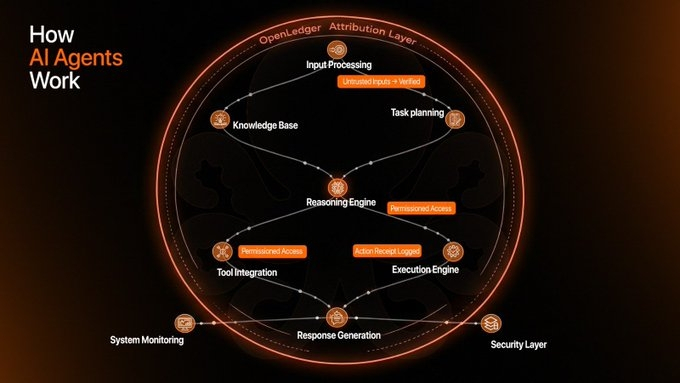
At first, t stiII looked like the same story on the surface.... AI doing tasks onchain, automation replacing manual work, yield optimization, execution layers... Nothing obviously new.
But the more I looked, the more I noticed it wasn’t trying to compete on that surface at all.
Looks as if OpenLedger is competing in a totaly diffrent way:
👉 Most AI blockchain systems I’ve seen focus on what AI can do.
🐙 OpenLedger feels more focused on what AI leaves behind.
Not just execution, but attribution. Not just output, but who contributed to that output and how value flows back to them. That shift sounds small, but it changes the entire direction of the system.
Because suddenly it’s not just “AI agents running on-chain.”
It becomes a question of ownership inside intelligence systems. And ownership in AI is very hard to proof. You need to establish :
👉 Who provided the data, who shaped the model behavior, who should be rewarded when an automated system produces value without direct human intervention.
That part stayed with me.
Then there is the execution side.
Most systems still treat AI as a tool sitting next to DeFi. Something that helps you decide or execute faster.
OpenLedger seems to push it closer to infrastructure. Not a tool layer, but a coordination layer. Workflows instead of isolated actions. Continuous execution instead of one-off automation. Systems that don’t just respond, but operate within defined constraints over time.
And that leads into something else I didn’t expect to care about at first.
Trust.
Not in a marketing sense, more in a structural one. Because once you remove constant human controI, you stop asking
“does this work once”
and start asking
“can this behave correctIy conlinuously.”
That is a very different standard.
Most systems look good in moments. Very few are designed to remain stable when attention fades.

That’s where the idea of long-term utility starts to matter more than short activity. Not because hype is bad, but because hype doesn’t prove reliability. It only proves attention.
OpenLedger, at least in the way it frames itself, feels more interested in what remains after attention moves away.
And I think that’s what changed my first impression.
It stopped feeling like “another AI blockchain.”
And started feeling like an attempt to define how automated systems should be measured when humans are no longer in every Ioop.
Not simply faster AI.
But accountable AI that can keep operating without constantly being watched.👀
🐙
