
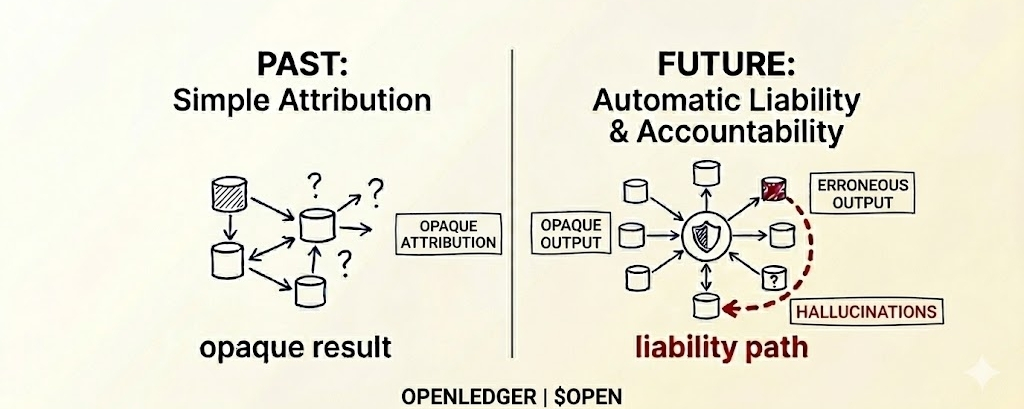
Today I was spending some quality time in the garden of my beautiful small house and looking through the data contribution flow on @OpenLedger , and it forced me to confront an uncomfortable truth about our current obsession with "decentralized AI." We often sell the dream of a frictionless, community-owned AI where anyone can upload a dataset and instantly claim their share of the value. But as I’ve been testing these modules, the reality feels far more complex, and you know what I realized? It is more interesting.

When I look at the mechanics of $OPEN and the broader #OpenLedger framework, I see a shift occurring that few are discussing. It’s not just about rewarding data; it’s about creating an infrastructure of enforceable accountability.
Sitting in this calm environment, I think about the traditional "Black Box" of AI development. We feed models massive amounts of information, and the resulting outputs are treated as proprietary magic. If a model makes a catastrophic error, the chain of responsibility is almost impossible to untangle. However, what if that couldn't happen anymore? What if the system, by its very design, requires a traceable lineage for every inference, every logic gate, and every data input?
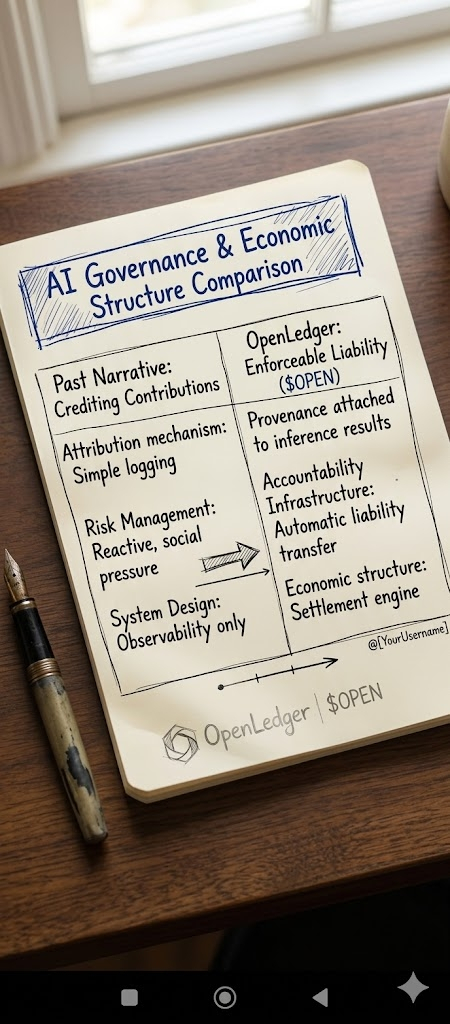
This is where the transition happens. We are moving from a world of passive data harvesting to a system of automated liability management. In the setup I tested, every contribution wasn't just stored; it was anchored. It was given a provenance that dictates how it interacts with the model. If we continue down this path, the "contribution layer" becomes the primary site of economic settlement. If an agentic system fails or misbehaves, the ledger doesn't just show that a failure happened—it maps that failure back to the specific logic or data source that triggered it.
This changes the fundamental nature of the system design. It moves us from an architecture based on observability (where we simply watch the model run) to an architecture based on economic structure (where the system programmatically enforces who is responsible for what).
The discomforting question we have to ask ourselves as creators and participants is this: Are we ready for a world where AI is not just "smart," but fully accountable? It’s a transition that trades away the "freedom" of opaque development for the "resilience" of hard, verifiable settlement. We aren't just building a decentralized network; we are building a machine that can finally be held to account.
For anyone building in this space, looking at the technical friction—as I noted in my own observations across the board—it isn't a sign of failure; it's a sign of a system trying to enforce order on chaos. It’s a leap toward a future where "trust" isn't a social construct, but a structural certainty. And that, in the long run, is what will bridge the gap between niche crypto experiments and the next era of institutional-grade intelligence.
This reflection on AI infrastructure captures why I believe the shift toward verifiable accountability is the most critical hurdle we face. It’s not just about better tech, but about finally building systems that earn our trust through transparency rather than just blind performance.