
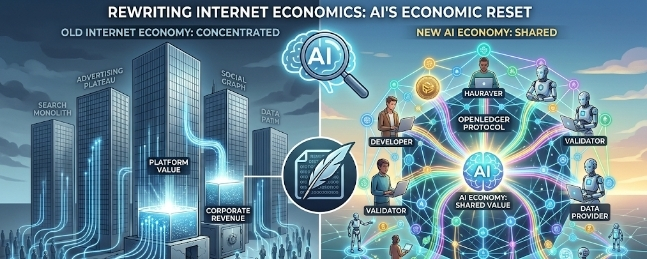
For years the web rewarded whoever controlled traffic data and attention. SEO companies scaled aggressively. Advertising platforms dominated everything. Creators spent years chasing algorithms instead of building ownership.
Now AI is changing the structure behind the entire system.
Search is moving from browsers to AI assistants. Content creation is becoming automated at scale. Even digital discovery is shifting away from traditional platforms faster than most people expected.
This is no longer just a tech transition.
It is an economic reset.
That is why OpenLedger stands out to me.
Most projects treat AI like a feature attached to crypto. OpenLedger seems focused on something deeper — building economic infrastructure designed specifically for an AI-native future.
That difference matters.
The current AI market has a growing imbalance:
Users generate data.
Developers train models.
Platforms absorb most of the value.
That model worked during the Web2 era because distribution stayed centralized. AI changes that equation completely.
If AI agents eventually become the main interface for search automation research and content then the value flow of the internet changes with them.
OpenLedger is positioning itself around that future.
The idea is simple but powerful:
AI economies should reward contributors instead of concentrating value into a few centralized systems.
Developers validators data providers and liquidity participants all become part of the same economic layer.
That is a far bigger narrative than another infrastructure chain trying to compete on speed alone.
What makes this interesting is timing.
Most crypto infrastructure still feels built for the previous market cycle:
faster transactions lower fees short-term liquidity games.
OpenLedger is aiming at ownership coordination and monetization inside AI-driven ecosystems.
That market may become massive if AI agents continue replacing traditional internet behavior.
Bullish factors:
• AI remains the strongest technology narrative globally
• Decentralized AI infrastructure is still early
• Tokenized AI economies could create entirely new incentive systems
• On-chain coordination for AI agents may become necessary over time
Bearish factors:
• AI crypto narratives are becoming crowded
• Many projects still lack meaningful adoption
• Long-term token demand remains uncertain
• Centralized AI companies already control enormous resources
Personally I think the market still underestimates how destructive AI could become for the old internet economy.
If search traffic weakens creator monetization declines and AI agents replace traditional discovery systems then new economic rails will eventually be needed.
That is where projects like OpenLedger become relevant.
The real challenge will not be attention.
It will be proving that decentralized AI economies can function better than centralized ones in real market conditions.
That is the part worth watching closely.
Do you think future AI economies should be owned by corporations or shared by the contributors building them?
