
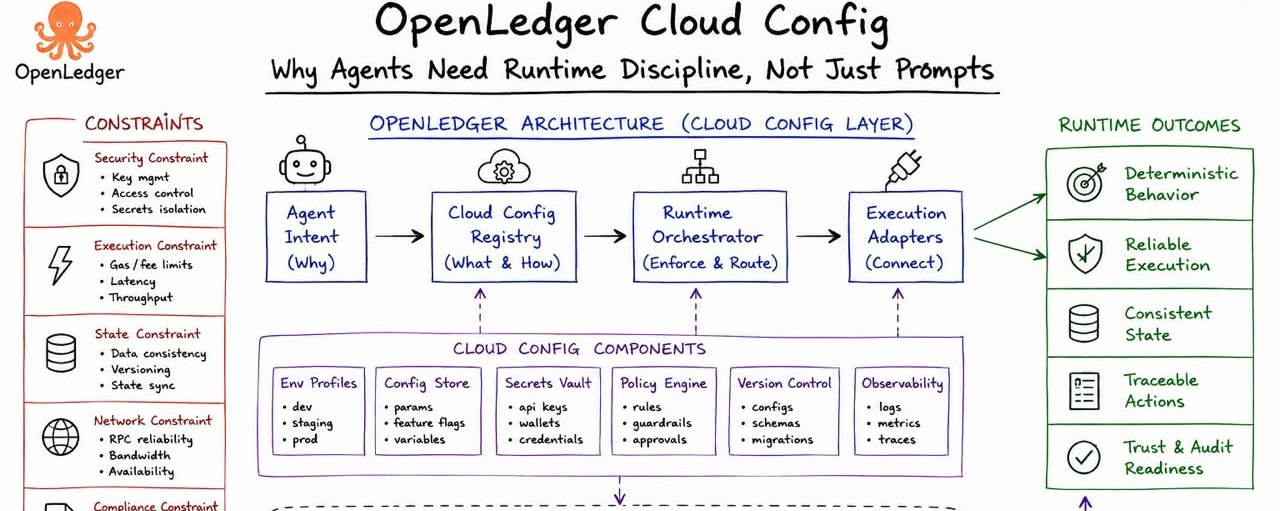
I kept thinking agent quality mostly came down to better reasoning.
Better models.
Better prompts.
Better context windows.
Spend enough time around AI infrastructure and that becomes the default mental model. If an agent performs badly, people usually assume intelligence is the missing piece.
The more time I spent looking deeper into OpenLedger, the less convinced I became that intelligence is the bottleneck.
Part of it probably comes from how AI infrastructure conversations changed over the last year. Early discussions mostly focused on capability itself. Better reasoning. Better outputs. Better agents. The assumption underneath all of it felt simple. If intelligence improves enough, systems improve automatically.
Spending more time inside OpenLedger kept pushing me away from that idea.
Autonomous systems do not live inside demos.
They live inside environments.
Environments drift faster than people expect.
APIs change. Dependencies change. Infrastructure evolves. Permissions change. Runtime conditions slowly move away from the assumptions systems were originally built around.
An agent can reason correctly and still create weak outcomes if the operating environment underneath it slowly becomes unstable.
That kept pulling me back toward Cloud Config.
Cloud Config pushed me toward that shift.
At first I looked at it like another infrastructure component. Runtime settings. Environment management. Configuration layers. Important but easy to mentally place into the "backend systems" category and move past.
The longer I sat with it, the more it felt like I was looking at one of the hidden problems autonomous systems will eventually run into.
Runtime discipline.
Not model discipline.
Runtime discipline.
That distinction stayed in my head longer than I expected.
Most people think agents fail because they think badly.
A growing number of failures happen because agents operate badly.
Those are different problems.
An agent can reason correctly and still produce weak outcomes if the operating environment around it becomes inconsistent.
A trading agent running under one configuration behaves differently from the same agent operating under another.
An execution workflow becomes unstable when environment variables drift.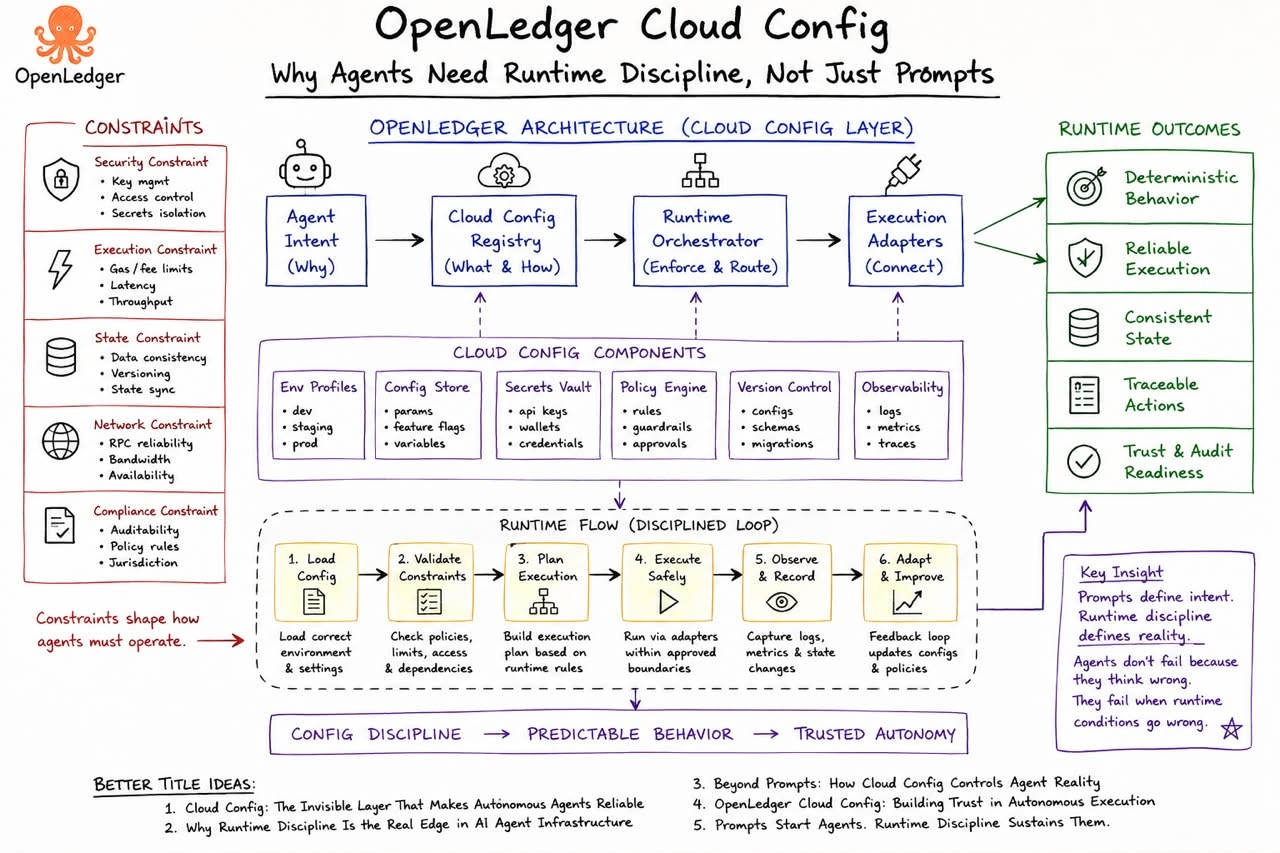
An automation pipeline becomes harder to trust when deployment conditions change between environments.
The intelligence layer remains identical.
The operating layer changes.
Output quality changes with it.
That started changing how I looked at OpenLedger.
The project increasingly feels built around reducing invisible friction that appears after intelligence already exists.
A lot of AI conversations still focus on capability growth.
Bigger models.
More reasoning.
More autonomous execution.
But the moment systems move from experiments into continuous operation, another problem appears underneath.
Consistency.
One thing Cloud Config made me think about is how much AI infrastructure still assumes stable operating conditions.
Real environments are rarely stable.
Systems evolve.
Dependencies change.
Infrastructure scales.
Agent responsibilities expand.
Variables drift.
An autonomous system working across execution layers cannot depend entirely on prompts remaining good enough forever.
Prompts create intent.
Runtime creates behavior.
That difference matters.
The more I thought through OpenLedger’s direction, the more Cloud Config stopped feeling like environment management and started feeling closer to operational discipline infrastructure.
One thing that made this feel increasingly relevant today was thinking about where AI systems are moving.
Agents are slowly leaving isolated research workflows.
They are starting to execute.
Trading systems.
Workflow coordination.
Multi-step automation.
Cross-platform actions.
Systems are starting to carry responsibility instead of only producing information.
The more execution responsibility agents carry, the harder it becomes to depend entirely on prompt quality.
Prompt quality shapes intent.
Runtime discipline shapes consistency.
That distinction stayed with me while looking deeper into OpenLedger.
The question slowly stopped becoming whether an agent can think.
It started becoming whether the system can keep operating reliably while conditions around it continue changing.
The interesting part is not configuration itself.
The interesting part is keeping execution environments reliable while autonomous systems become more complex.
That changes architecture decisions.
An agent operating continuously across research workflows, execution layers, financial environments, data systems or automation pipelines creates operational pressure.
Small inconsistencies compound.
Version mismatches compound.
Environment drift compounds.
The system technically stays alive.
Quality slowly deteriorates.
That operational deterioration feels familiar.
Not because infrastructure breaks dramatically.
Because systems slowly become harder to trust.
OpenLedger kept pulling my attention back toward that problem.
Cloud Config increasingly felt designed around reducing runtime instability before instability becomes visible enough to damage output quality.
That changes how I think about agents.
The AI conversation often assumes intelligence sits at the center.
OpenLedger increasingly pushes another idea.
Reliability becomes infrastructure.
An autonomous system that reasons extremely well but behaves inconsistently across operating environments creates friction everywhere downstream.
Execution quality changes.
Output reliability changes.
Coordination quality changes.
Trust changes.
The more autonomous systems expand, the more runtime discipline starts becoming part of intelligence quality itself.
That feels important.
Because future infrastructure competition may not happen entirely around which systems think better.
Part of it may happen around which systems remain operationally reliable while environments become increasingly complex.
Cloud Config kept making me think about that.
OpenLedger keeps pushing toward autonomous systems that do not only become more capable.
They become more stable.
That feels smaller than intelligence improvements initially.
Infrastructure shifts usually feel small before scale makes them unavoidable.
The longer I spent looking at Cloud Config inside OpenLedger, the less it felt like backend tooling.
It started feeling closer to operational infrastructure designed for a future where agents do not simply exist.
They operate continuously.
And continuous systems eventually need discipline just as much as intelligence.
