

I have spent enough years around crypto to notice a pattern that never really changes.
A new idea appears. The market gets excited. Prices move before understanding does. Suddenly everyone talks about the future like it is already guaranteed to happen.
Sometimes those stories turn into something real.
Most of the time, they fade once the excitement disappears.
That is why I have learned to slow down whenever a project becomes popular too quickly, especially when it combines two narratives the market already loves. Right now nothing attracts attention faster than artificial intelligence and blockchain. So when I saw growing interest around OpenLedger and its token OPEN, I wanted to understand whether there was something deeper behind the attention.
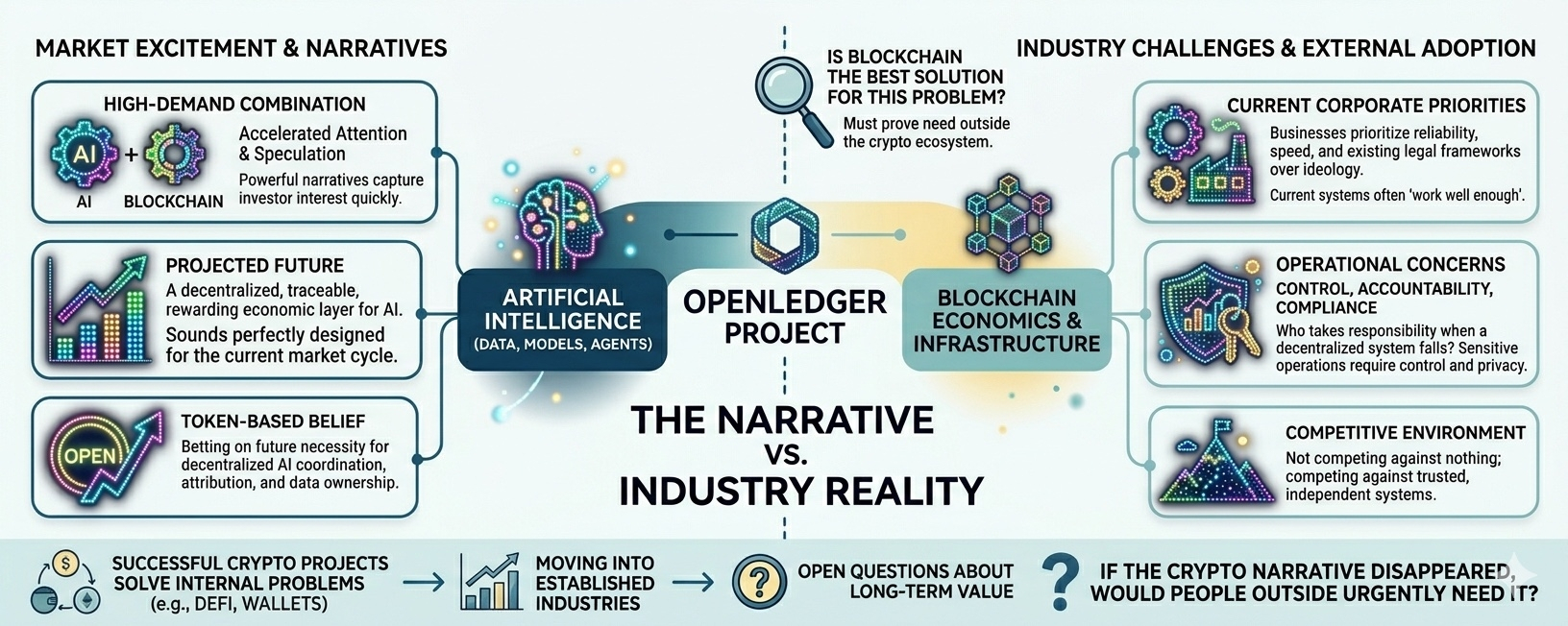
The idea behind the project sounds ambitious. OpenLedger talks about building an economic layer for AI where data, models, and autonomous agents can be tracked, rewarded, and monetized through blockchain infrastructure. On the surface, it sounds like one of those concepts that feels perfectly designed for the current market cycle.
But I have seen enough cycles to know that a strong narrative alone means very little.
So instead of following social media excitement, I tried to think about the real industries this project claims to connect with. I spent time reading opinions from people working around AI systems, automation infrastructure, and enterprise technology. What stood out to me was not hostility toward the idea. It was uncertainty.
One engineer explained something very simple that crypto investors often ignore. Most companies already operate on systems that work well enough for them. They may not be perfect, but they are fast, predictable, and easier to manage legally. Businesses usually care more about reliability than ideology.
That point stayed in my head for a while.
Crypto communities often speak as if decentralization is automatically better. But outside crypto, companies think differently. They care about control, accountability, compliance, and operational stability. If an AI system fails inside a business environment, somebody has to take responsibility for it. That becomes more complicated when infrastructure is decentralized across different participants.
There were also concerns about privacy and efficiency. Many AI systems depend on speed and tightly controlled environments. Large organizations are not always interested in moving sensitive operations into open economic networks if their current systems already perform adequately.
None of this means OpenLedger has no future.
It simply means the project has to prove something much harder than attracting speculation.
It has to prove that people outside crypto genuinely need what it is building.
That challenge is bigger than most investors realize.
When I look back at the projects that actually succeeded in crypto, most of them solved problems that already existed within crypto itself. DeFi became useful because crypto users needed better ways to trade and move capital without depending entirely on centralized platforms. Wallet infrastructure improved because self-custody users needed better tools. Those products made sense because the demand already existed naturally inside the ecosystem.
But once crypto projects move into industries that already function independently, things become more difficult. They are no longer competing against nothing. They are competing against systems companies already trust.
That is where many blockchain ideas struggle.
The deeper conversation around OpenLedger is interesting to me because the questions it raises are real. Artificial intelligence is creating enormous value from data and human contribution, yet most contributors remain invisible inside that process. Writers, developers, researchers, and open-source communities all shape AI systems without always receiving meaningful ownership or economic recognition.
That imbalance probably becomes more important over time.
So I understand why projects like OpenLedger are appearing now.
The problem is not whether the idea sounds important. The problem is whether blockchain infrastructure is truly the best solution for it.
Crypto investors often skip that part.
A token price can rise very quickly because people believe a future narrative will eventually matter. That does not mean adoption already exists in the present. Markets are very good at pricing hope long before reality catches up.
That is why I think buying OPEN today is less about current utility and more about belief. People are betting that decentralized AI infrastructure may become necessary later. They are betting that attribution systems, data ownership, and AI coordination layers could eventually evolve into major industries.
Maybe they will.
But there is still a difference between a future possibility and a present necessity.
After watching this market for years, I think that difference matters more than hype ever will.
Whenever I study projects like this, I try to ask myself one question before looking at price charts or market sentiment.
If the crypto narrative disappeared tomorrow, would people outside this industry still urgently need the product?
That question usually reveals more than the token chart ever can.