
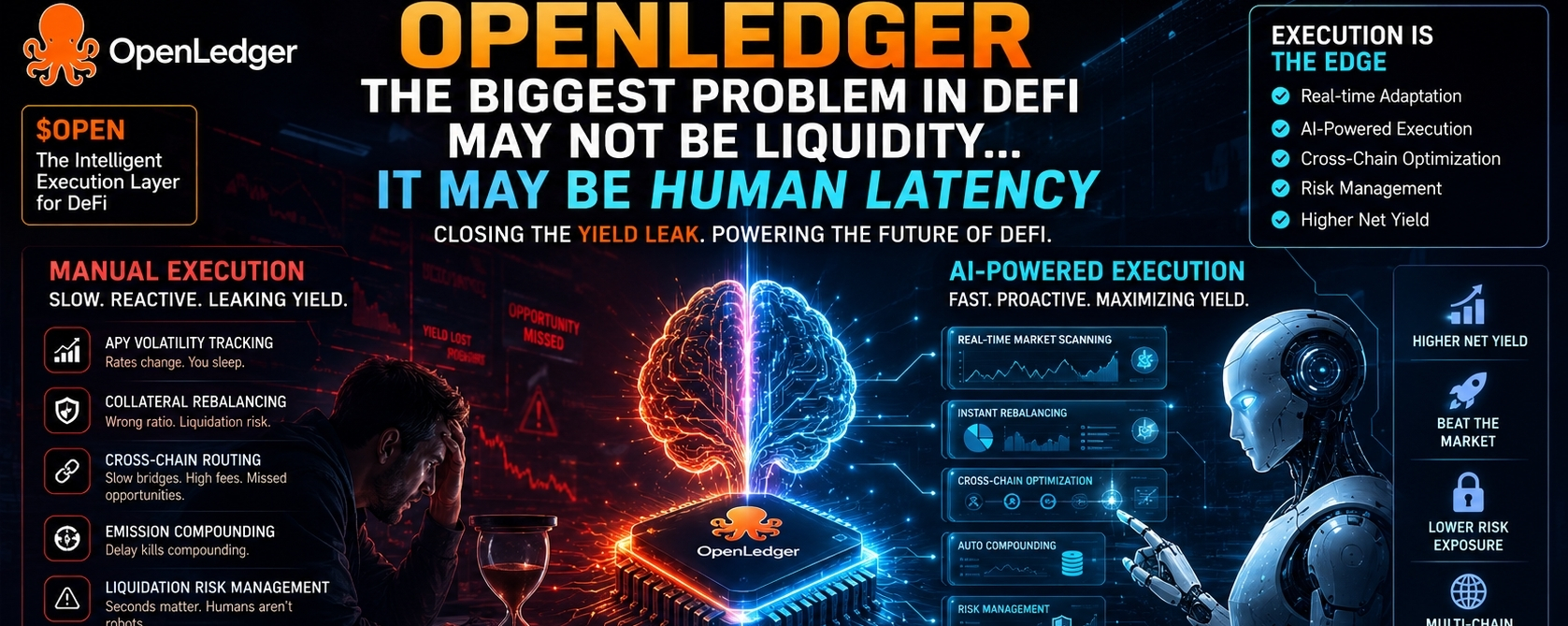
Every time i start digging deeper into @OpenLedger , i end up thinking about something most people in DeFi quietly ignore…
Maybe the market is not leaking yield because opportunities are missing.
Maybe it is leaking because humans are simply too slow.
At first this sounds exaggerated. Because in crypto, information is everywhere. Everyone already knows which pools pay more, which protocols are incentivizing liquidity, which chains are giving temporary boosts, and where capital is rotating.
So why do most users still underperform?
I kept noticing something uncomfortable…
DeFi has evolved faster than human execution capacity.
That is the real gap.
People still behave like DeFi is a dashboard problem when in reality it has become a reaction-speed problem.
And this is where the OpenLedger thesis starts becoming interesting.
Not because they are promising “higher APY”.
Thousands of protocols promise that.
What they are hinting at is much larger:
the future advantage in DeFi may belong to systems that execute faster than humans can think.
That changes everything.
Because once markets become fully onchain, global, multi-chain and 24/7, the winner is no longer the person with the best knowledge.
The winner becomes the system with the lowest execution delay.
I noticed this especially when looking at how fragmented DeFi has become.
Yield is no longer sitting in one place.
It moves constantly between lending markets, restaking layers, perp funding rates, stablecoin incentives, validator rewards, emissions programs and cross-chain liquidity campaigns.
Humans cannot continuously optimize this manually.
By the time someone reacts…
the opportunity is already diluted.
And this creates invisible capital decay.
Not dramatic losses.
Tiny inefficiencies.
Small timing gaps.
Gas inefficiencies.
Late reallocations.
Missed reward cycles.
Unoptimized collateral.
Slow bridge execution.
Individually these look small.
Collectively they become massive.
This is what i think OpenLedger is trying to frame as the hidden infrastructure problem of DeFi.
Not intelligence deficiency.
Execution deficiency.
And honestly… this framing is clever.
Because people emotionally react faster to “recovering lost money” than “creating new yield”.
That psychological angle matters.
I also think the market underestimates how brutal execution timing becomes during volatility.
When markets move aggressively, several things happen simultaneously:
Collateral ratios change.
Borrow costs spike.
Funding rates flip.
Liquidity migrates.
Incentives rotate.
Bridge congestion increases.
MEV activity expands.
Liquidation thresholds tighten.
And humans are expected to monitor all this manually?
Impossible at scale.
That is why the concept of an autonomous execution layer becomes important.
Not just automation…
but adaptive automation.
A system that constantly observes onchain conditions and reallocates capital before humans even realize conditions changed.
This is where AI narratives start colliding with DeFi infrastructure.
And honestly, most projects talking about AI still feel cosmetic to me.
But OpenLedger seems to be positioning AI less as a chatbot layer and more as an execution coordination layer.
That distinction matters a lot.
Because if AI is only producing analysis…
humans remain the bottleneck.
But if AI starts handling execution itself…
then the entire market structure changes.
Now another thing i keep thinking about is how this affects smaller users.
Right now, sophisticated execution is mostly available to whales, quant firms and advanced funds running custom infrastructure.
Retail users usually arrive late.
They bridge late.
Compound late.
Exit late.
Rebalance late.
Everything happens after the optimal window.
So if OpenLedger is truly building infrastructure that compresses execution latency for normal users…
then they are not just optimizing yield.
They are compressing the advantage gap between institutions and individuals.
That becomes much bigger than a DeFi tool.
It becomes market-access infrastructure.
But this is also exactly where skepticism should begin.
Because conceptually strong systems often collapse under real market conditions.
Cross-chain execution sounds beautiful until bridges congest.
Automated strategies sound efficient until gas spikes destroy profitability.
AI coordination sounds revolutionary until models fail during black swan volatility.
And DeFi has a history of elegant theories breaking in chaotic environments.
So i m not fully convinced yet.
But i also think ignoring this category completely would be a mistake.
Because the next evolution of DeFi may not come from inventing new financial products.
It may come from removing human delay from existing ones.
That is the part i keep observing.
Not the token.
Not the hype.
The infrastructure logic underneath it.
Because if execution itself becomes the product…
then the protocols controlling execution layers may quietly become the most important layer in crypto.
And if that happens…
the biggest alpha in DeFi will no longer belong to people who understand markets best.
It will belong to systems that react first.