

I was sitting outside a pharmacy waiting for my younger cousin to finish buying medicine for his mother when I opened the OpenLedger announcement again on my phone. It was late evening. The traffic noise was constant. A fruit seller nearby kept shouting prices every few minutes while motorcycles squeezed through spaces that honestly didn’t look wide enough to fit anything.
I almost ignored the announcement completely.
Crypto launches have started sounding the same lately. Every project says AI. Every project says infrastructure. Every project says automation, coordination, scalability, intelligent systems. After a while the words stop meaning anything because everybody is chasing the same attention cycle.
But one line inside OpenLedger’s Algebra integration update made me stop scrolling.
They said every step of the AI agent’s process, from decision-making to routing and final settlement, would be recorded on-chain and remain verifiable.
At first that sounded impressive.
Then it started sounding risky.
Because the more I thought about it, the more I realized OpenLedger is making a choice most DeFi projects usually avoid.
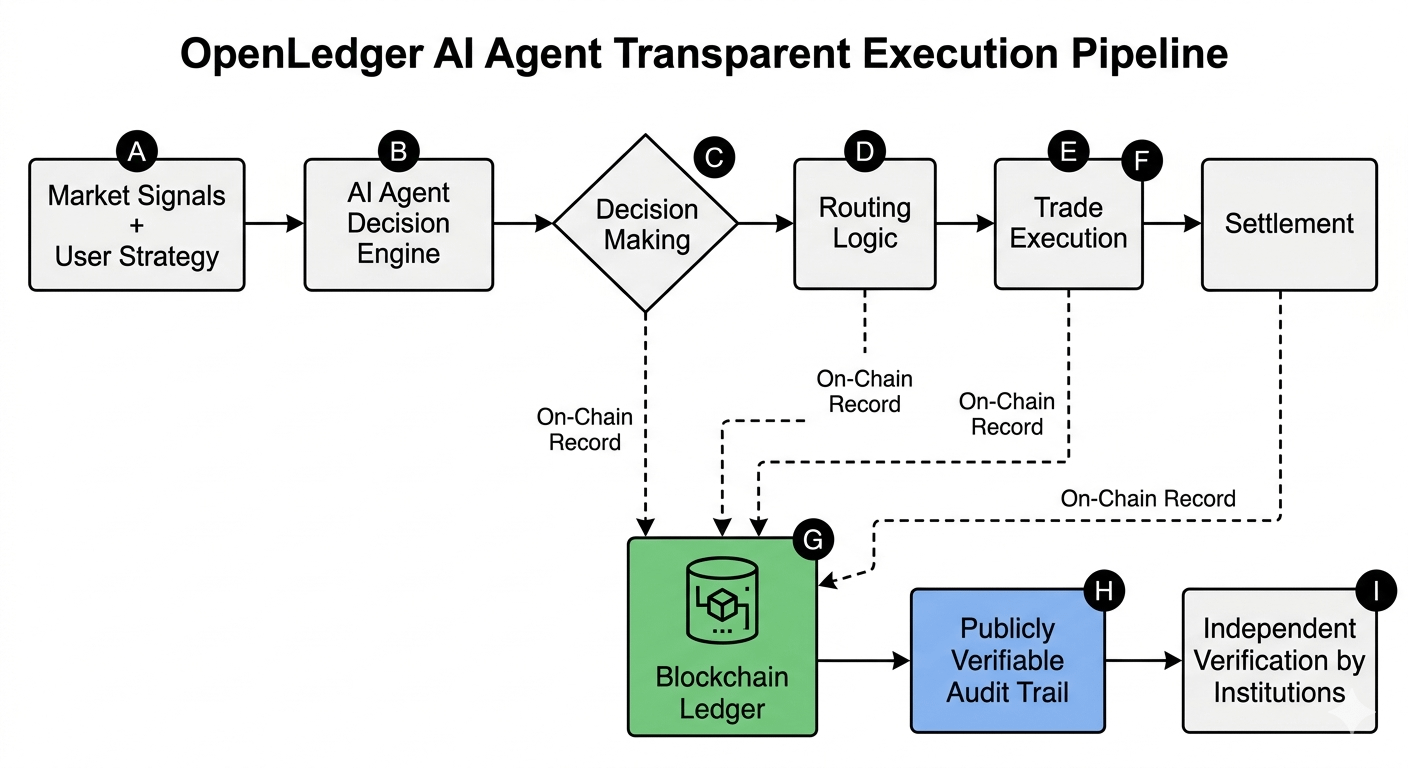
They are choosing transparency over secrecy.
And in financial markets, that is not a small decision.
Most serious trading systems are intentionally hidden. Hedge funds don’t reveal execution logic publicly. Quant firms don’t publish how their models react to signals. The reason is simple: once markets understand your behavior, they start trading against you.
Crypto already works like this.
Bots monitor transactions constantly. MEV systems look for predictable execution paths. Traders study routing behavior searching for weaknesses.
The market punishes visibility very quickly.
That’s why OpenLedger’s approach caught my attention differently from the usual AI narratives floating around right now.
The project is not pretending transparency has no downside. It clearly does. Public execution trails create attack surfaces naturally. If routing logic becomes too predictable, somebody eventually tries exploiting it.
But OpenLedger seems to believe something more important is happening underneath DeFi right now.
The industry is reaching a point where opacity itself is becoming a problem.
And honestly, I think they’re right about that.
Most AI systems in DeFi today operate like black boxes. Users deposit funds into automated strategies without fully understanding how decisions are being made behind the scenes. If profits happen, nobody complains much. If losses happen, explanations usually arrive afterward, often incomplete.
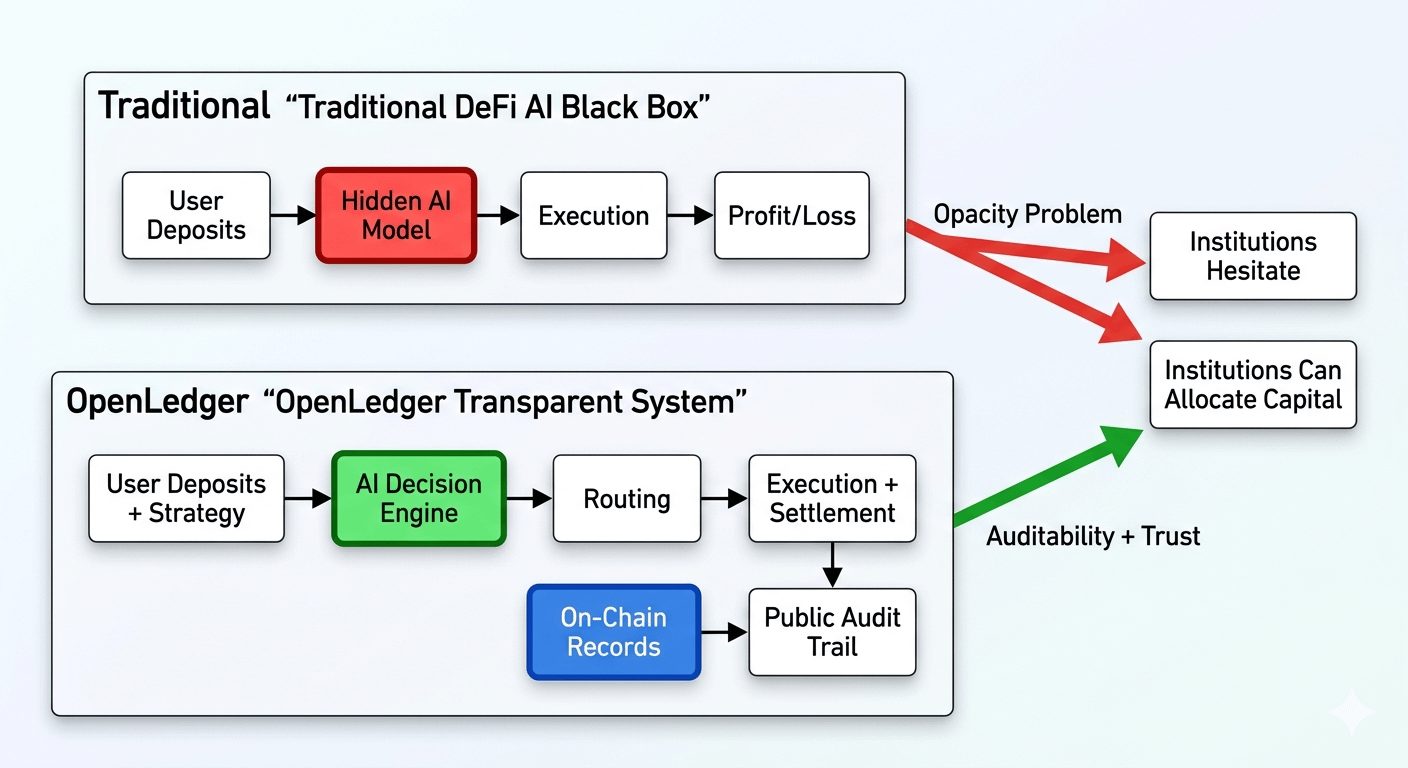
That model works while the ecosystem stays mostly retail-driven.
But institutional money does not move like retail money.
A hedge fund, family office, or regulated asset manager cannot simply allocate serious capital into systems they cannot audit properly later. They need records. They need traceability. They need to understand why decisions happened, not just whether those decisions made money temporarily.
That’s the part many crypto-native users underestimate.
Traditional finance runs on accountability almost as much as it runs on capital.
Every major decision needs an explanation attached to it.
And that’s where OpenLedger’s architecture starts making more sense.
The project is building around auditability instead of secrecy.
Every action leaves a trail. Every routing decision becomes inspectable. Every settlement can be reconstructed later.
That doesn’t eliminate risk. Nothing in finance eliminates risk.
But it changes the nature of trust.
Instead of asking users to blindly trust a hidden system, OpenLedger seems to be building infrastructure where behavior itself becomes visible enough to verify independently.
That’s a very different philosophy from most AI projects in DeFi right now.
And honestly, I think it points toward a larger shift happening quietly inside crypto.
For years, DeFi mostly optimized around speed and permissionless access. Fast execution mattered more than explainability. As long as systems worked during bull markets, people rarely questioned what was happening underneath.
But autonomous systems handling financial decisions create a different level of responsibility.
Once AI agents start moving large amounts of capital automatically, transparency stops feeling like a marketing feature and starts feeling like infrastructure.
Especially for institutions.
Because institutions care less about exciting narratives and more about operational certainty. They need systems where actions can be audited after the fact. They need evidence that strategies followed disclosed rules. They need accountability structures strong enough to survive legal and regulatory scrutiny.
Most DeFi systems still aren’t built for that world.
OpenLedger appears to be preparing for it anyway.
That’s why I think many people are misunderstanding the project completely. The market still treats it like another AI token story because crypto always reduces complicated infrastructure into simple narratives people can trade emotionally.
But OpenLedger feels less like a speculative AI product and more like an attempt to build trust layers for autonomous finance.
That distinction matters.
The Algebra integration itself is important because it pushes this philosophy directly into execution. The system is not just automating trades. It is creating permanent records around how those trades happen.
That changes the relationship between automation and accountability.
And honestly, I think that becomes extremely important later.
Because financial systems eventually reach a scale where trust cannot depend on personalities anymore. It has to depend on architecture.
When markets become stressful, nobody cares how confident founders sounded during interviews. People care whether the system behaves predictably under pressure.
That’s when infrastructure reveals what it was actually designed for.
The interesting thing about OpenLedger is that the project seems willing to accept certain disadvantages now in exchange for long-term credibility later.
Transparency creates vulnerabilities. Public systems attract adversaries. Predictable behavior can be studied and exploited.
Those risks are real.
But OpenLedger appears to believe the larger opportunity comes from building systems institutions can eventually justify trusting at scale.
And honestly, that feels like a more serious bet than simply chasing another AI trend.
Because the future of DeFi probably does not belong only to whoever builds the fastest systems.
It belongs to whoever builds systems people are willing to trust with meaningful capital once automation becomes normal.
That’s a much harder problem to solve.
And I think OpenLedger understands that better than most projects people are talking about right now.