
For the past few weeks, I have been digging into a project that keeps popping up in serious AI and crypto conversations: OpenLedger.
On the surface, it promises to fix one of artificial intelligence’s biggest problems the fact that most AI models are black boxes, using data without ever crediting or paying the original creators.
But I am a researcher at heart. I do not trust promises.
I needed to know: who is actually behind this? And why are some of the smartest people in tech betting millions on it?
Let me start with the money.
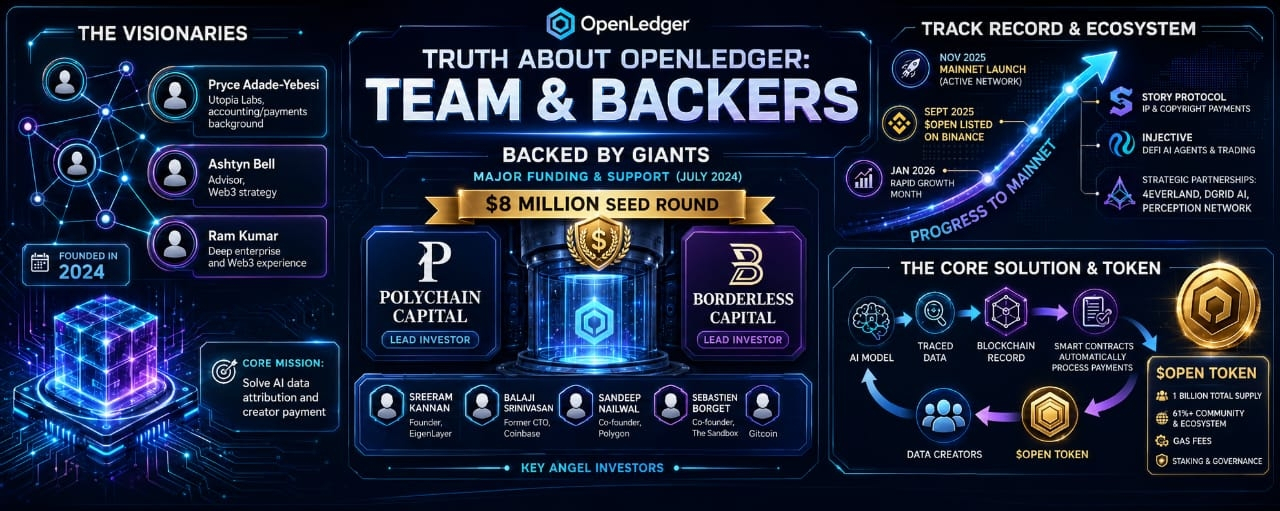
In July 2024, OpenLedger raised eight million dollars in seed funding.
That alone is impressive, but what caught my eye was who led the round: Polychain Capital and Borderless Capital.
These are not random crypto funds.
Polychain has backed some of the most successful blockchain networks in history.
Borderless focuses on the kind of Web3 infrastructure that actually changes how the internet works.
When they both put money into a young project, I pay attention.
But the real surprise came when I looked at the list of angel investors.
I saw Sreeram Kannan the founder of EigenLayer, one of the most important projects in crypto right now.
I saw Balaji Srinivasan, the former chief technology officer of Coinbase.
I saw Sandeep Nailwal, the co founder of Polygon.
Three people who have already shaped the last decade of blockchain innovation.
All of them backing OpenLedger.
Also on the list: Sebastien Borget from The Sandbox and Scott Moore from Gitcoin.
I sat back and thought this is not a normal startup.
This is a signal.
So who is the actual team?
I learned that OpenLedger was founded in 2024 by Pryce Adade Yebesi, Ashtyn Bell, and Ram Kumar.
Pryce previously built accounting products at his stablecoin payments company Utopia Labs.
Ashtyn was his advisor.
Ram brings deep Web3 and enterprise experience.
Together, they saw the same broken pattern I have observed for years: artificial intelligence developers spend months cleaning and labeling data, but the moment a model is sold or used, the original data contributors get nothing.
No credit. No payment. Nothing.
That is exactly what OpenLedger fixes.
I spent time understanding their core feature, which they call "proof of attribution."
Every dataset, model, and AI output is recorded on the blockchain.
If an AI gives you an answer, you can trace that answer back to the original data creators.
Then smart contracts automatically pay them using the project’s token, OPEN.
As a researcher, I love systems that close the loop. This is not just transparency it is economics.
Now let me share the recent updates that convinced me this project is real.
In November 2025, the OpenLedger mainnet launched.
That is a live network, not a whitepaper.
The $OPEN token has a total supply of one billion, and over sixty one percent is reserved for community rewards and ecosystem growth.
Most projects talk about decentralization OpenLedger built it into the tokenomics.
Then January 2026 happened. I saw four major announcements in a single month.
First, OpenLedger partnered with Story Protocol to enable automatic copyright payments for AI training.
We are talking about the eighty trillion dollar global intellectual property market.
Second, they integrated with Injective, allowing autonomous AI agents to trade and manage liquidity on a high speed DeFi chain.
Third and fourth, they announced strategic partnerships with 4EVERLAND, DGrid AI, and Perception Network to expand decentralized computing and AI transparency.
And just before all of that, in September 2025, the OPEN token was listed on Binance.
What does the token actually do?
I broke it down. You need OPEN for gas fees on the network.
You stake OPEN to help secure the protocol and earn rewards.
You use OPEN to vote on governance proposals.
And most importantly, OPEN is the reward for anyone who contributes data or builds models.
Without it, the entire incentive economy collapses that is by design.
After all my digging, here is my honest conclusion.
OpenLedger is not another hype project. It has a credible team, a working mainnet, and backers who have already changed the tech world.
But more than that, it solves a problem I have personally struggled with as a researcher: how do we make artificial intelligence accountable?
How do we ensure that the people whose data trains these powerful models finally get paid?
OpenLedger has built the first real answer I have seen.
The network is live. The token is trading.
The partnerships are multiplying.
If you care about a future where AI is transparent and fair, I strongly suggest you keep both eyes on OpenLedger.
I know I will.
