
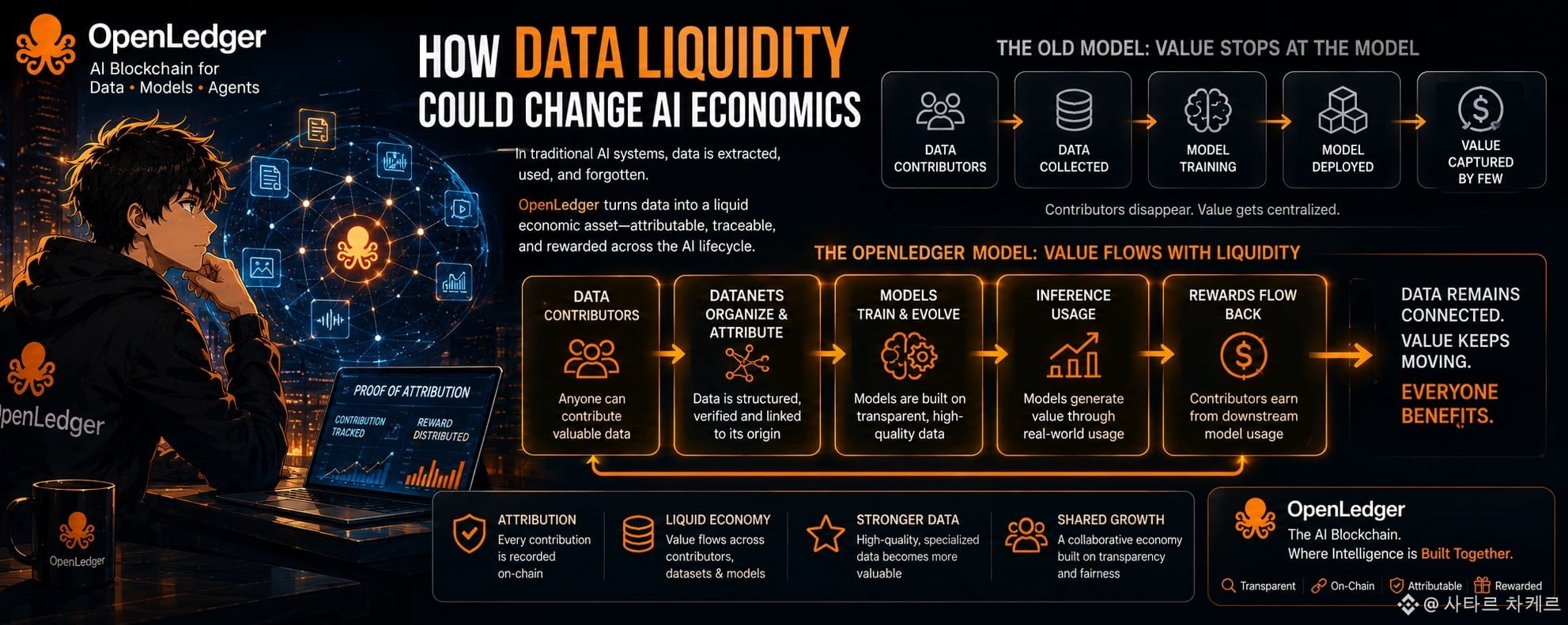
Most AI systems today treat data like a disposable input. Platforms collect information models train on it outputs improve and the economic connection to contributors slowly disappears. The value remains inside the system but the people and datasets helping create that value become increasingly difficult to trace.
That creates an interesting imbalance.
Data powers the entire AI economy.
But data itself rarely remains economically connected to the future value it generates.
OpenLedger seems to approach this differently through Proof of Attribution and its broader AI native infrastructure. Instead of treating data as something absorbed once and forgotten the system attempts to keep contributions attributable traceable and economically active across the lifecycle of AI usage.
That changes the role of data completely.
Data starts behaving less like passive infrastructure and more like liquid economic value.
The idea of data liquidity becomes important because liquidity determines whether value can continue moving through a system instead of getting trapped at one layer. In traditional AI systems value often concentrates around model owners and platforms. But if attribution remains connected to inference activity contributors can theoretically stay tied to downstream value creation long after a model is deployed.
Structurally that creates a very different kind of AI economy.
Participation becomes visible.
Specialized expertise becomes monetizable.
