
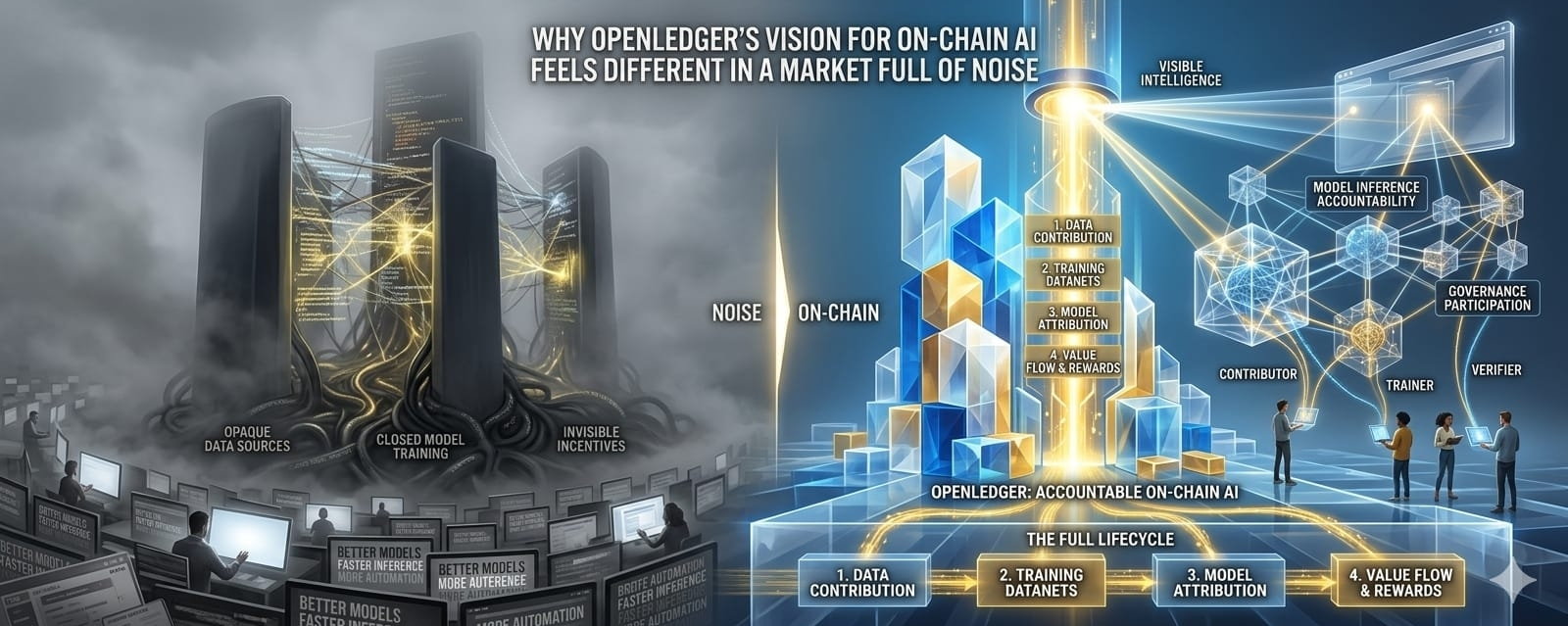
AI is moving fast, but the uncomfortable question is not how fast the models are getting. The real question is what gets buried every time an output appears on the screen. A user sees one clean answer, one smooth agent action, one instant result, but behind that moment is an entire hidden chain of data, contributors, training decisions, infrastructure, incentives, and ownership. Most AI projects want that chain to disappear because the illusion works better when nobody asks too many questions. OpenLedger feels different because it is not just staring at the output. It is staring at the trail behind it.
That is where the idea becomes interesting. If AI keeps becoming an economic engine, then inference is no longer just a technical event. It becomes a value event. A model does something, an agent executes something, a workflow creates revenue, and suddenly the question becomes much bigger than performance. Who helped create the intelligence behind that action? Which dataset shaped it? Which contributor deserves attribution? Where does the value actually flow after the output is used again and again? Most AI systems avoid that question completely. OpenLedger seems to drag it into the open.
This is the part that feels almost uncomfortable in a good way. Crypto was supposed to care about transparency, but AI has pushed many people back into accepting invisible systems as long as the results look powerful. OpenLedger is basically challenging that tradeoff. It is saying the lifecycle matters: data creation, datanets, training, inference, attribution, rewards, and governance should not live in separate shadows. They should be connected enough that the system can be observed, questioned, and economically tracked.
But this is not a clean victory story. Open systems always attract chaos. Rewards bring spam. Public contribution brings low-quality submissions. Governance can shrink into a small group. Metrics can be gamed. Synthetic data can poison incentives. The same transparency that builds trust can also become a map for exploitation. That is why OpenLedger’s challenge is not just technical. It is structural. It has to prove that on-chain AI accounting can create real accountability without becoming another system people learn how to manipulate.
Still, the direction matters. Centralized AI also has coordination problems; it just hides them behind polished products and closed infrastructure. OpenLedger is trying to expose the machinery instead of pretending it does not exist. Maybe that friction becomes its weakness. Maybe it becomes its moat. But in a market obsessed with faster agents and smarter outputs, OpenLedger is asking a sharper question: when AI creates value, should the trail behind that value remain invisible?
That is why this feels less like another AI narrative and more like a pressure test for the future of machine intelligence. If AI agents are going to trade, build, automate, manage assets, and generate economic outcomes, then accountability cannot stay optional forever. OpenLedger is not just putting AI on-chain. It is trying to turn every meaningful output into something with memory, lineage, and consequence.
