
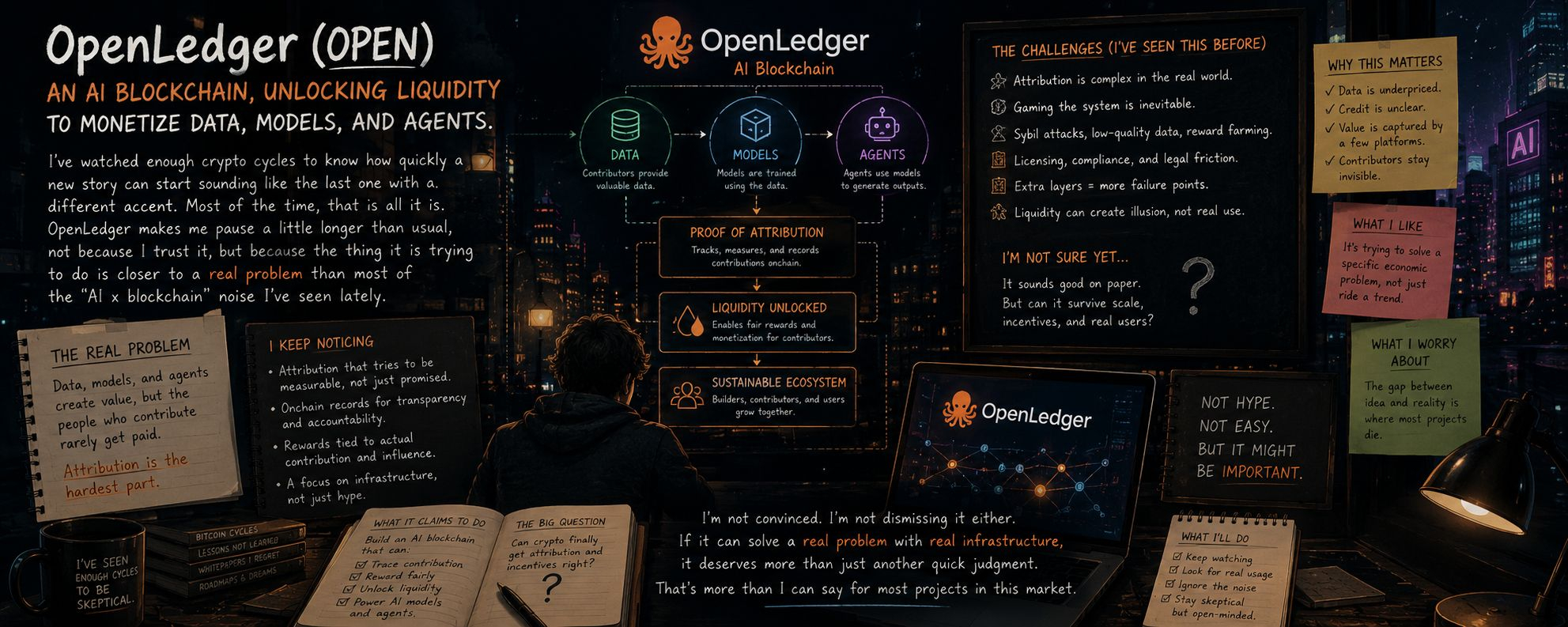

I’ve been around this market long enough to know when a new project is just wearing better clothes than the last one. Most of the time, that is all it is. Different branding, same hunger. Different language, same old promise that this time the technology will finally fix the thing crypto has been failing to fix for years. So when I look at OpenLedger, I do not come to it excited. I come to it tired. But I also come to it with enough attention left to notice when something is slightly less fake than the usual noise.
What catches me is that it is not only trying to sound big. It is trying to sound specific. Data, models, agents, attribution, liquidity. Those are not new words, but they are at least pointed in a direction that makes sense. I’ve seen a lot of projects in this space talk in circles about decentralized intelligence or onchain AI like those phrases alone should be enough to create conviction. They usually are not. They mostly just create a fog that people can project onto. OpenLedger feels a little different because it seems to be aiming at the ugly part of the problem, the part people usually skip over when they are making a pitch.
That ugly part is attribution. Who actually contributed value? Who should get paid? What part of an output came from which source? That is where the nice story starts to wobble. It always does. I’ve seen this before with data marketplaces, with creator economies, with token systems that promised to reward participation more fairly than the old platforms ever did. The idea sounds obvious until real people enter the system and start behaving like real people, which means they will optimize, distort, farm, and test every weak edge they can find.
So I’m interested in OpenLedger, but not in a clean, comfortable way. More in the way I get interested when I see a project wrestling with a problem that has not gone away just because the last few attempts were clumsy. The value of data is real. The value of models is real. The value of agents may end up being real too, although that word has been thrown around so carelessly lately that I have to slow down when I hear it. But the hard question is never whether value exists. The hard question is whether it can be tracked in a way that survives contact with incentives.
That’s where my skepticism lives. Not in the idea itself, but in the distance between the idea and the market around it. Crypto loves to talk about liquidity as if it were the same thing as usefulness. It is not. Liquidity can make a thing easy to trade without making it worth much. It can create motion without meaning. So when a project says it wants to unlock liquidity around data or AI assets, I hear both the opportunity and the risk. There is always a temptation to make the asset more tradable before it is actually more useful, and that usually ends the same way.
Still, I do not want to pretend the whole thing is just another empty cycle trade. There is something a bit more grounded here than the usual AI token story. OpenLedger seems to understand that the real issue is not simply building models, but building a system where contribution can be observed, recorded, and rewarded without completely breaking under complexity. That is not a flashy problem. It is a stubborn one. And stubborn problems are often the only ones worth paying attention to.
I’ve seen enough cycles now to trust very little that sounds too polished. The market has a habit of turning serious ideas into easy slogans, and then wondering why the thing never works the way the slogan promised. That is usually where I start losing interest. A lot of projects do not fail because they were obviously bad. They fail because they became too interested in being understood quickly. They flattened themselves into a story people could repeat. After that, the work starts to drift.
OpenLedger has not drifted for me yet, mostly because it still feels like it is pointing at a real tension in the world rather than simply attaching itself to one. Data is still underpriced, credit is still vague, and the people who create value in AI systems are still too often invisible. If crypto is ever going to matter beyond speculation, it will probably be in these uncomfortable gaps where ownership is unclear and incentives are broken. That does not mean every project trying to work there will succeed. Most will not. But the category itself is not nonsense, and I think that matters.
So my honest feeling is somewhere between curiosity and caution. I do not trust the market language around it, because I never trust the market language around anything anymore. But I can admit that this is one of those projects I keep noticing after I close the tab. That usually means something. Not necessarily that it will work. Just that it is touching a problem that is hard enough, and real enough, to still be on my mind later.
