
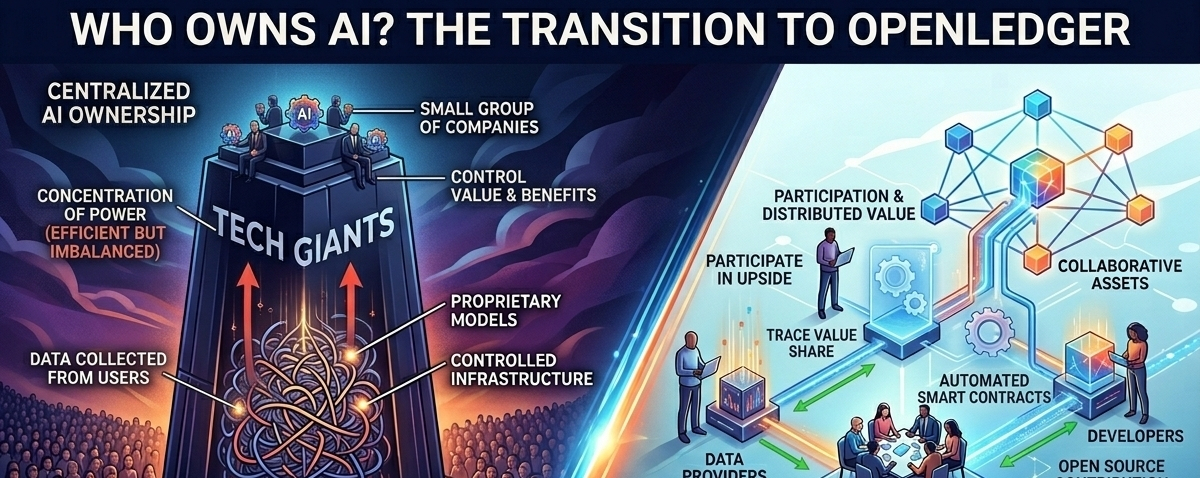
Ownership in the age of artificial intelligence is becoming one of the most important questions in technology. Not because AI is new, but because its impact is now unavoidable. It shapes decisions, generates content, powers businesses, and increasingly defines how value is created online. Yet behind all this progress sits an uncomfortable reality. The majority of AI systems today are controlled by a small group of companies that own the data, the models, and the infrastructure. This concentration of power is efficient, but it raises deeper questions about fairness, access, and who truly benefits from the intelligence being built.
For years, the structure has remained relatively consistent. Users generate data through everyday activity. Platforms collect and refine that data. AI models are trained on it, improved behind closed systems, and then deployed at scale. The value flows upward. While users benefit from the services, they rarely participate in the economic upside. Developers and researchers contribute innovation, but ownership remains centralized. This model has driven rapid growth, but it also creates imbalance.
This is where new frameworks like OpenLedger begin to shift the conversation. The idea is not just to build better AI, but to rethink how ownership and value are distributed. OpenLedger represents a move toward systems where contributions are visible, verifiable, and rewarded. Instead of a closed pipeline, it introduces an open economic layer where data providers, model builders, and users can all play a role in shaping outcomes and sharing value.
At its core, the concept challenges a long-standing assumption that intelligence must be controlled to be effective. Open systems suggest the opposite. When contributors are aligned through incentives and transparency, innovation can expand rather than fragment. Data becomes something people can actively choose to contribute, knowing it has traceable value. Models become collaborative assets rather than isolated products. The entire lifecycle of AI shifts from extraction to participation.
One of the most important changes here is how data is treated. In traditional systems, data is absorbed into a platform and loses its identity. In an open ledger-based environment, data can be tracked, attributed, and even monetized over time. This creates a direct link between contribution and reward. If a dataset improves a model or drives outcomes, its contributors can benefit continuously, not just once. This introduces a new kind of economic relationship between individuals and the systems they power.
The role of developers also evolves in this landscape. Instead of building within the boundaries of a single platform, they can contribute to shared ecosystems where their work has broader reach and longer-term value. Incentive mechanisms, often token-based, can reward not only initial creation but ongoing impact. This changes the motivation structure. Building useful, scalable, and widely adopted systems becomes more valuable than simply building proprietary ones.
What makes OpenLedger particularly relevant is its ability to coordinate these interactions. Through programmable systems, value distribution can be automated and transparent. Smart contracts can define how rewards are allocated, how contributions are verified, and how governance decisions are made. This reduces reliance on central authorities and replaces it with rules that are visible to all participants. Trust shifts from institutions to systems.
However, this transition is not simple. Open systems introduce new challenges that cannot be ignored. Ensuring data quality in a decentralized environment is complex. Without proper validation, systems risk being flooded with low-quality or harmful inputs. Mechanisms like staking, reputation scoring, and peer review are being explored, but they are still evolving. Balancing openness with reliability remains a key challenge.
Scalability is another issue that sits at the center of this conversation. AI requires significant computational resources, and integrating that with decentralized infrastructure is technically demanding. Hybrid approaches are emerging, where heavy processing happens off-chain while coordination and verification remain on-chain. This balance is critical to making these systems practical without losing the benefits of transparency.
There are also deeper ethical considerations. As ownership becomes more distributed, questions around privacy and consent become more visible. Just because data can be monetized does not mean it should be without clear permission. Open systems must be designed with safeguards that protect individuals while still enabling participation. The goal is not to replace one form of imbalance with another, but to create a system that is both fair and sustainable.
Despite these challenges, the direction is clear. The conversation around AI is moving beyond capability and into control. Who owns the models, who benefits from their outputs, and who has a say in how they evolve are no longer secondary questions. They are becoming central to how the next phase of technology is built. OpenLedger represents one approach to addressing these questions by aligning incentives across all participants rather than concentrating them.
In the short term, adoption will likely be gradual. Centralized systems are deeply established and continue to offer efficiency and scale. But as awareness grows around data ownership and value distribution, alternative models will gain traction. Early adopters, particularly those who understand both AI and decentralized systems, will play a key role in shaping these networks. Their contributions will define not just the technology, but the economic structures behind it.
Over the longer term, the implications are significant. If open, on-chain coordination models succeed, they could redefine digital ownership. Intelligence would no longer be something controlled by a few entities, but something built and maintained by networks of contributors. Value would flow more dynamically, rewarding participation and impact rather than just control. This could lead to a more inclusive and innovative ecosystem where opportunities are not limited by access to centralized platforms.
The fight for AI ownership is not just about technology. It is about redefining how value is created and shared in a digital world. OpenLedger and similar frameworks are early signals of this shift. They challenge the idea that intelligence must be centralized and instead offer a path toward systems that are open, transparent, and economically aligned with the people who contribute to them.
As this transition unfolds, one thing becomes increasingly clear. The question is no longer whether AI will shape the future, but who will own that future. The answer will depend on the systems we build today, the incentives we design, and the willingness to move from extraction toward participate.
