
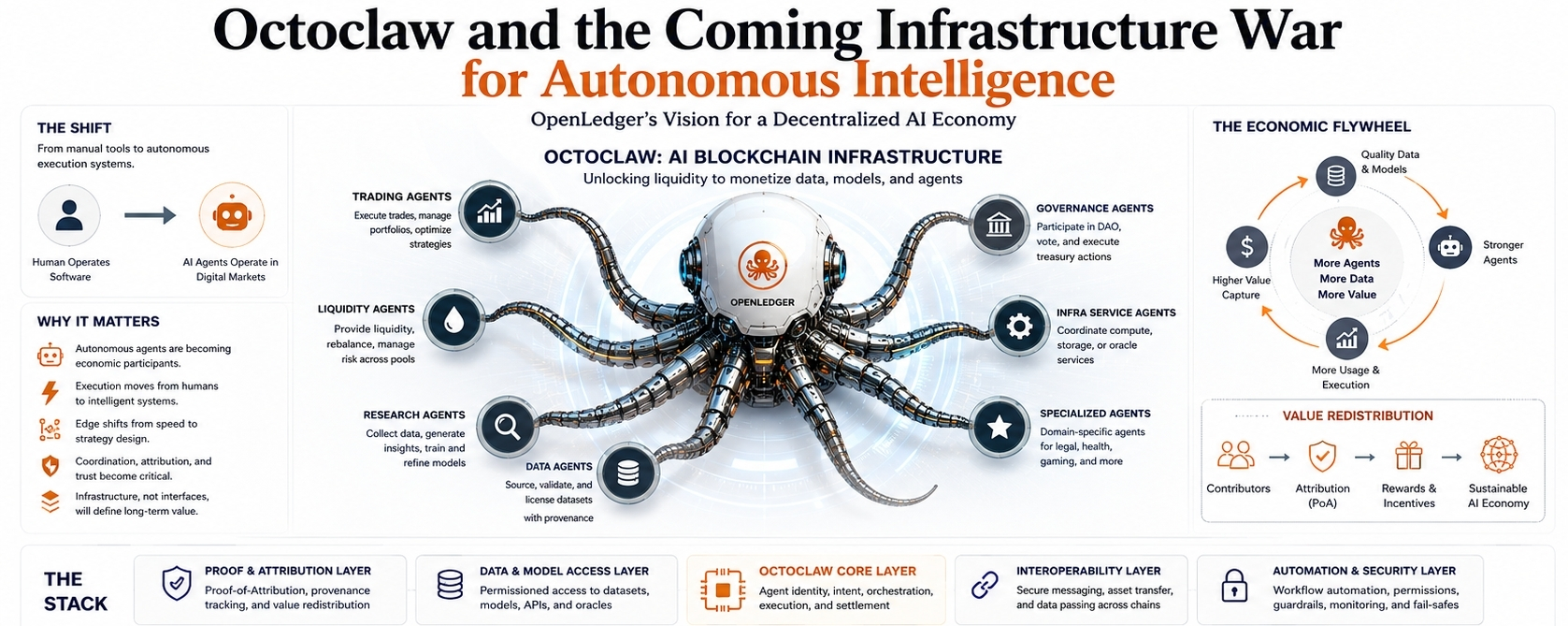
There’s a strange pattern that repeats itself every cycle in crypto.
Markets become obsessed with interfaces while the real structural shifts happen underneath them, mostly unnoticed, buried in architecture decisions, coordination layers, incentive systems, and middleware that nobody outside a small technical circle cares about until suddenly everything depends on it. In 2020 it was automated market makers quietly replacing order books in large parts of decentralized finance before most traders fully understood what liquidity abstraction meant. In 2021 it was modular scaling discussions happening while the broader market chased profile pictures and token emissions. And now, somewhere beneath the noise surrounding AI agents, consumer chatbots, and speculative token narratives, another infrastructure transition appears to be unfolding.
That transition is not really about AI applications themselves.
It is about ownership, coordination, execution, and economic alignment around intelligence.
That’s where things start to get interesting.
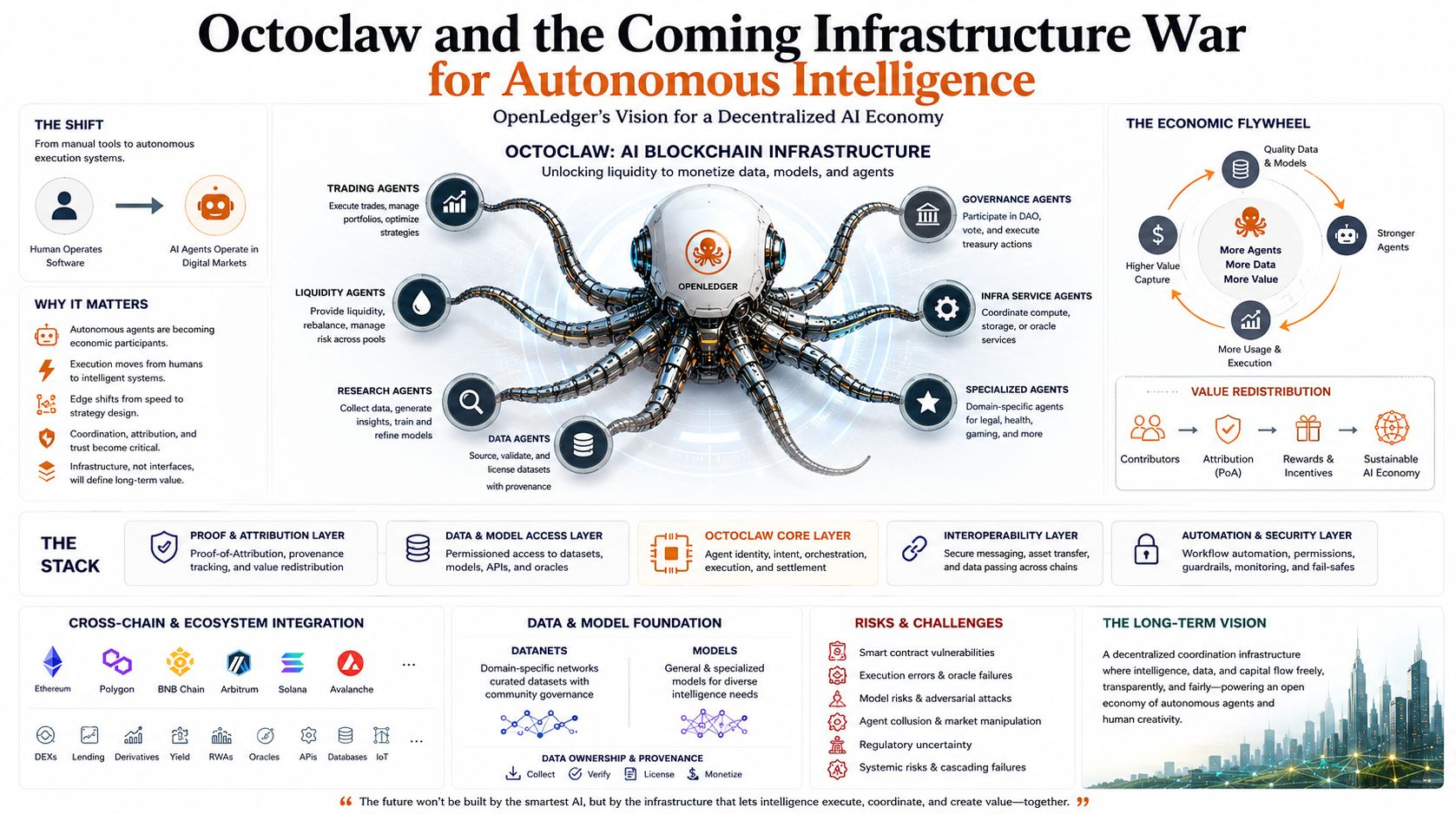
Over the past year, the phrase “AI blockchain” has started appearing more frequently across crypto discussions, usually attached to projects attempting to merge decentralized infrastructure with machine learning systems. Most of these narratives collapse into familiar patterns almost immediately. A token gets attached to an API marketplace. Some inference layer is branded as decentralized intelligence. Marketing decks mention agents, data, and autonomous economies while the actual architecture remains vague. The market reacts predictably because crypto has trained participants to front-run narratives before infrastructure matures.
But OpenLedger’s positioning around Octoclaw feels different in one important way: the project appears less focused on presenting AI as an application layer and more focused on treating AI coordination itself as infrastructure.
And honestly, that shifts the entire perspective.
Because once you stop viewing AI merely as a chatbot interface and start viewing it as an autonomous execution system interacting with financial rails, datasets, blockchains, and digital markets simultaneously, the conversation changes completely. Suddenly the core problem is no longer generating text or images. The core problem becomes coordination. Attribution. Verification. Incentive alignment. Cross-system execution. Trust assumptions. Economic ownership of intelligence itself.
Most people underestimate what’s happening at the infrastructure layer.
The launch of Octoclaw seems to sit directly inside that transition.
From what I’ve observed, Octoclaw is less interesting as a singular product release and more interesting as a signal of where decentralized AI systems are heading structurally. The broader implication is that AI agents are slowly evolving beyond informational systems into operational actors capable of executing workflows across fragmented environments. That distinction matters enormously.
Historically, software mostly waited for humans to initiate actions. Humans interpreted information, decided on strategies, clicked buttons, signed transactions, monitored risks, and adjusted behavior manually. Even algorithmic trading systems still relied heavily on centralized infrastructure stacks controlled by firms with privileged data pipelines and execution environments.
AI agents begin changing that relationship.
An agent does not merely provide information. It interprets objectives, evaluates conditions, selects actions, and increasingly interacts directly with execution environments. In crypto markets specifically, this creates an entirely different operational paradigm because blockchains already function as programmable financial settlement layers. Once AI systems can reliably interact with those layers autonomously, the distinction between software and economic participant starts blurring.
This is where the real question begins.
If autonomous AI systems become capable of deploying capital, coordinating liquidity, executing trades, managing yield strategies, sourcing information, negotiating services, or even commissioning other agents, what kind of infrastructure becomes necessary underneath that economy?
Centralized systems can technically handle many of these tasks today. OpenAI, Anthropic, Google, and other major AI labs already operate at scales that decentralized competitors cannot currently match in raw model performance. That part is obvious. Centralized AI systems dominate because training frontier models requires enormous computational concentration, proprietary datasets, and vertically integrated infrastructure pipelines.
But dominance in intelligence generation is not necessarily the same thing as dominance in economic coordination.
And crypto historically emerges wherever coordination problems become too large for closed systems to manage efficiently.
That’s why OpenLedger’s emphasis on liquidity for data, models, and agents deserves attention beyond simple token speculation. The deeper thesis appears to revolve around transforming AI components into economically composable primitives. Datasets become productive assets. Models become monetizable infrastructure. Agents become participants within programmable economic networks.
In theory, that sounds elegant.
In practice, it becomes extremely complicated.
Because the moment AI systems begin operating autonomously across on-chain environments, the entire risk surface expands dramatically. Smart contract exploits already cost billions without autonomous agents involved. Execution errors already occur constantly across DeFi systems despite human oversight. Most decentralized infrastructure still struggles with fragmented security assumptions, unreliable oracle dependencies, governance weaknesses, and cross-chain vulnerabilities.
Now imagine autonomous agents coordinating across those environments continuously.
An AI trading agent managing liquidity positions across multiple chains could theoretically optimize yield opportunities far faster than human traders. But what happens when market conditions shift unexpectedly? What happens when a protocol dependency fails? What happens when manipulated data feeds distort agent behavior? What happens when multiple agents converge on similar strategies simultaneously and amplify systemic volatility?
These are not hypothetical edge cases anymore.
This is why I think discussions around autonomous AI agents often feel strangely incomplete. The market tends to focus on capability while underestimating execution risk. But infrastructure systems are defined less by ideal conditions and more by failure handling. Especially in finance.
And decentralized finance is still fundamentally adversarial.
Every execution environment eventually becomes contested. Every profitable strategy becomes crowded. Every exploitable weakness gets discovered. Human traders understand this intuitively because markets train participants through loss. AI systems operating autonomously will need equivalent mechanisms for adaptive risk evaluation, reputation assessment, and probabilistic reasoning under uncertainty.
That is a far more difficult infrastructure challenge than simply building another AI application layer.
Octoclaw appears to recognize this broader transition toward multi-chain autonomous coordination. The architecture discussions surrounding agent workflows, interoperability, and automation suggest an attempt to move beyond static blockchain functionality into dynamic execution infrastructure.
The significance here is subtle but important.
Crypto infrastructure historically evolved around human interaction models. Wallets, exchanges, bridges, governance systems, and DeFi protocols were primarily designed for manual operation. Even when automation existed, it usually required technical expertise or centralized tooling.
But autonomous agents require entirely different infrastructure assumptions.
Agents need persistent memory, verifiable execution pathways, interoperable identity systems, secure permission structures, real-time data access, incentive alignment, and reliable coordination frameworks across fragmented ecosystems. They require environments where decisions can be executed trustlessly while preserving accountability and attribution.
That last point matters more than most people realize.
Because one of the largest unresolved tensions in AI today revolves around data ownership and attribution economics. Centralized AI companies have accumulated massive advantages partly because the internet historically treated data as an extractable resource rather than an economically attributable asset. Models were trained on enormous public datasets with limited transparency regarding provenance, contributor compensation, or downstream value distribution.
Now that generative AI systems are becoming commercially dominant, those unresolved ownership questions are resurfacing aggressively.
Who owns training data?
Who deserves compensation when models generate economic value from collective information?
How do contributors verify usage?
How do decentralized systems prevent extraction without attribution?
This is where OpenLedger’s discussions around Proof-of-Attribution frameworks become structurally interesting. Not because attribution itself is a new idea, but because decentralized infrastructure may provide one of the few environments where attribution can be economically enforced at scale without relying entirely on centralized intermediaries.
And honestly, this could become one of the defining economic questions of the next decade.
The current AI economy is heavily asymmetric. A relatively small number of centralized entities capture enormous value while contributors to underlying datasets, niche domain expertise, and distributed knowledge networks receive limited participation in downstream economics. Decentralized AI infrastructure attempts to rebalance that relationship by embedding attribution and incentive mechanisms directly into coordination layers.
Whether that vision succeeds remains uncertain.
But the direction itself feels inevitable.
Because as AI systems become more powerful, the economic value of specialized data increases dramatically. Generalized models eventually encounter diminishing returns without high-quality domain-specific information. That creates demand for what OpenLedger describes as “Datanets” — specialized networks built around curated datasets, contextual intelligence, and niche model ecosystems.
Most people still think AI competition will primarily revolve around who builds the single largest model.
I’m increasingly unconvinced.
The more likely outcome may involve layered ecosystems where generalized intelligence handles broad reasoning while domain-specific systems provide specialized operational depth. Financial intelligence. Legal analysis. Medical diagnostics. Supply chain coordination. Scientific research. Autonomous market-making. Each vertical develops its own optimized datasets, incentive systems, and execution environments.
And that creates space for decentralized coordination infrastructure.
Ethereum compatibility becomes strategically important in this context because interoperability matters more than isolation once systems begin coordinating across chains and applications simultaneously. The future probably does not belong to entirely isolated AI ecosystems. It belongs to infrastructure capable of integrating fragmented environments into coherent execution frameworks.
OpenLedger’s alignment with Ethereum-compatible infrastructure suggests an awareness of this reality. The existing crypto ecosystem already contains liquidity, developer communities, settlement systems, and composability primitives that autonomous agents will likely need access to. Building parallel infrastructure without interoperability would severely limit network effects.
Still, compatibility alone is not enough.
Execution quality matters.
Security matters.
Reliability matters.
And infrastructure markets are brutal because users rarely tolerate persistent failure at scale.
This is where skepticism becomes necessary.
Crypto has a long history of ambitious infrastructure visions collapsing under operational complexity. Cross-chain systems remain notoriously vulnerable. Autonomous execution introduces unpredictable edge cases. Governance coordination becomes difficult under adversarial incentives. Decentralized systems often sacrifice efficiency for openness, while AI development increasingly rewards scale concentration and capital intensity.
There’s also a deeper philosophical contradiction emerging between decentralization and modern AI economics.
Training advanced models currently benefits enormously from centralized coordination. Massive compute clusters, vertically integrated hardware supply chains, proprietary optimization techniques, and concentrated capital all create strong gravitational forces toward centralization. Even open-source AI movements often depend indirectly on centralized infrastructure providers.
So the real question may not be whether decentralized AI completely replaces centralized AI.
It probably won’t.
The more realistic scenario is coexistence.
Centralized systems may continue dominating frontier model development while decentralized infrastructure captures coordination, attribution, execution, and specialized domain economies around those systems. In that world, projects like OpenLedger function less as direct competitors to large AI labs and more as economic coordination layers surrounding increasingly autonomous intelligence networks.
That distinction changes how these systems should be evaluated.
Not as isolated AI companies.
But as infrastructure economies.
And infrastructure economies tend to compound slowly before becoming indispensable.
There’s another dimension here that traders understand instinctively but technologists sometimes overlook: automation fundamentally changes where edge exists in markets.
Historically, trading advantage often came from speed. Faster information access. Faster execution. Lower latency. Better market connectivity. High-frequency firms built entire empires around microsecond advantages because markets rewarded execution efficiency directly.
But autonomous AI systems compress those advantages rapidly.
If execution becomes increasingly commoditized through intelligent agents, the source of edge shifts upward into strategy design, contextual reasoning, and objective formulation. Humans become architects of systems rather than direct operators inside them.
That transition is already visible.
The most sophisticated traders increasingly focus less on clicking buttons and more on designing adaptive frameworks capable of responding dynamically to changing market conditions. AI agents accelerate that shift dramatically because they can monitor cross-chain environments continuously, rebalance positions algorithmically, evaluate sentiment flows, track liquidity fragmentation, and coordinate execution strategies far beyond human cognitive bandwidth.
In that environment, infrastructure supporting reliable autonomous coordination becomes extraordinarily valuable.
But it also becomes systemically dangerous.
Because tightly coupled autonomous systems can create cascading failures very quickly.
Traditional finance already provides examples of algorithmic feedback loops destabilizing markets under stress conditions. Flash crashes, liquidity collapses, and automated liquidation spirals all demonstrate how interconnected execution systems amplify volatility. Autonomous on-chain agents operating continuously across decentralized environments could intensify those dynamics substantially.
This is where trust assumptions become critical.
How are agent permissions managed?
How are execution boundaries enforced?
How are failures isolated?
How are malicious behaviors prevented?
How are models audited?
Who bears liability when autonomous systems cause financial harm?
Regulators are nowhere near prepared for these questions.
And honestly, neither is the industry.
The regulatory uncertainty surrounding AI and blockchain convergence may become one of the largest barriers to mainstream adoption. Data rights frameworks remain fragmented globally. AI liability laws are still evolving. Autonomous financial execution introduces entirely new legal ambiguities around accountability, governance, and systemic risk exposure.
Yet regulatory ambiguity does not stop infrastructure transitions.
It rarely ever has.
The internet expanded before digital governance frameworks matured. Crypto markets emerged before securities regulators fully understood decentralized networks. AI systems scaled globally before policymakers grasped the implications of generative intelligence.
Infrastructure tends to evolve first. Regulation catches up afterward.
Sometimes painfully.
That’s partly why projects like OpenLedger feel simultaneously early and inevitable at the same time. The current implementation details may change. Specific architectures may fail. Some economic assumptions may prove unsustainable. Certain coordination mechanisms may break under real-world conditions.
But the broader trajectory seems difficult to avoid.
AI systems are becoming agents.
Agents require coordination layers.
Coordination layers require economic infrastructure.
Economic infrastructure eventually requires ownership, attribution, incentives, security, and interoperability.
That naturally converges toward blockchain systems whether markets fully recognize it yet or not.
The deeper implication is that decentralized AI infrastructure may ultimately matter less because of ideology and more because of scale complexity. Once intelligence becomes economically active across open digital environments, centralized coordination alone may become too brittle, opaque, or extractive to support sustainable long-term participation.
Especially when value creation depends on distributed contributors.
And this is where OpenLedger’s positioning becomes more nuanced than many market observers initially assume. The project appears less focused on selling a speculative vision of AI replacing humans and more focused on building coordination infrastructure for increasingly autonomous digital economies.
That’s a very different thesis.
A harder thesis too.
Because infrastructure projects are judged not by narratives but by resilience. By uptime. By developer adoption. By security performance. By execution consistency over years rather than months. Markets often reward storytelling early while infrastructure only earns trust gradually through operational reliability.
There’s enormous execution risk here.
The decentralized AI sector remains immature. Agent reliability is still inconsistent. Cross-chain coordination remains vulnerable. Incentive systems can easily become misaligned. Token economics often distort infrastructure priorities. Governance fragmentation creates operational inefficiencies. And competitive pressure from centralized AI providers remains overwhelming.
None of that disappears simply because the narrative sounds compelling.
But even acknowledging those realities, it still feels like something meaningful is shifting underneath the surface.
The launch of Octoclaw reflects a broader realization beginning to spread through both crypto and AI circles: the future economic layer of intelligence probably will not look like today’s software markets. Intelligence is becoming dynamic, persistent, autonomous, and increasingly transactional. Systems will negotiate with systems. Agents will coordinate with agents. Data itself will behave more like productive capital than static information storage.
And once that transition accelerates, the infrastructure beneath it becomes extraordinarily important.
That doesn’t guarantee OpenLedger succeeds.
Far from it.
Early infrastructure projects often carry the burden of timing. Being directionally correct too early can look identical to failure for years. Markets frequently overestimate short-term adoption while underestimating long-term structural change. The internet itself experienced that paradox repeatedly. So did cloud computing. So did open-source software.
The difficult part is distinguishing between narratives that merely sound futuristic and architectures that genuinely align with emerging economic realities.
I think that’s why Octoclaw deserves careful attention even from skeptical observers.
Not because it guarantees a decentralized AI future.
But because it exposes where the pressure points are forming.
Coordination.
Attribution.
Autonomous execution.
Cross-chain interoperability.
Economic ownership of intelligence.
Infrastructure for agent-based markets.
Those themes keep resurfacing independently across multiple sectors because they reflect real structural tensions emerging underneath the current AI boom.
And perhaps the most important observation is this: the battle over AI may ultimately become less about who builds the smartest model and more about who controls the coordination infrastructure surrounding intelligence itself.
That possibility changes everything.
Because infrastructure layers tend to outlast applications.
They shape incentives.
They shape access.
They shape power distribution.
And they quietly determine who participates in the economic systems built above them.
Right now, most of the world still interacts with AI primarily through interfaces — chat windows, image generators, productivity tools, recommendation engines. But underneath those interfaces, a much larger reorganization may already be starting. One where intelligence becomes composable, autonomous, economically active, and deeply integrated into programmable financial systems.
If that future arrives, decentralized coordination may stop feeling experimental and start feeling necessary.
Or perhaps the opposite happens.
Perhaps centralized AI systems absorb enough infrastructure control to maintain dominance indefinitely. Perhaps decentralized coordination proves too slow, too fragmented, or too operationally fragile to compete at scale. Perhaps regulatory pressure suffocates open agent economies before they mature. Perhaps users simply prefer convenience over ownership once again.
That uncertainty is real.
And maybe that uncertainty is the most honest place to end.
Because infrastructure transitions are rarely obvious while they’re happening. They look messy, fragmented, overhyped, underbuilt, and contradictory in real time. Only later do certain architectural decisions reveal themselves as foundational.
For now, Octoclaw feels less like a final answer and more like an early signal emerging from the edge of a much larger transformation still trying to define itself.
