
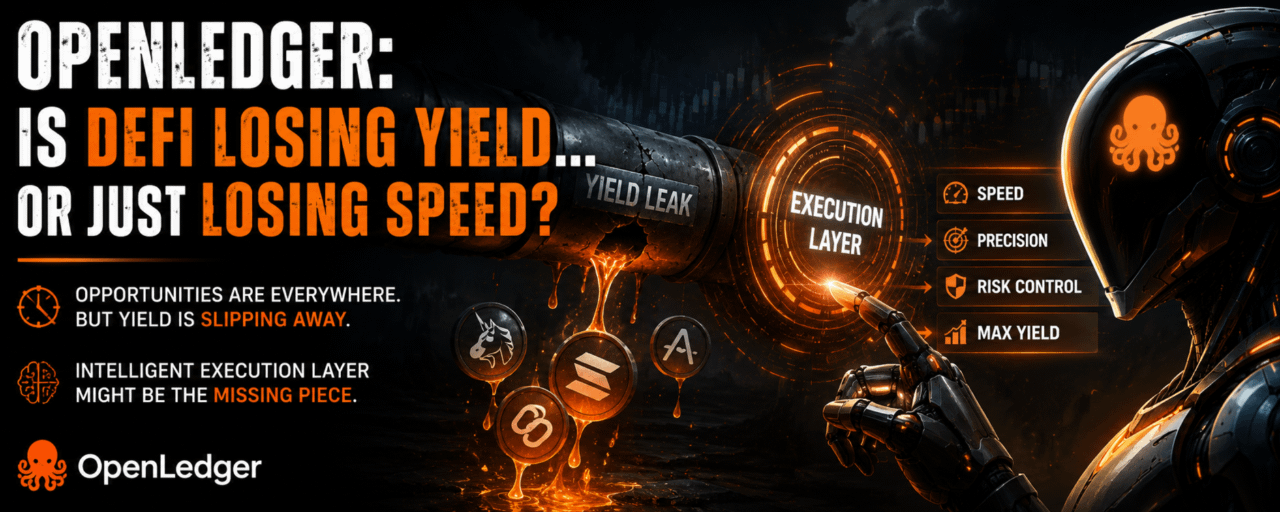

I was thinking about OpenLedger again... and honestly, the more I look at it, the more I feel the real DeFi problem is not always about lack of opportunity. The opportunity is already there. Pools are there. APYs are there. Bridges are there. Vaults are there. Strategies are also there. Still somehow, users miss the best moves.
And this is where the whole thing becomes interesting to me. Maybe the problem is not that people don’t know where yield is. Maybe the problem is that they can’t move fast enough to catch it...
That is what I understand from the “yield leak” idea. Yield leak simply means possible profit is slipping away before users can capture it. Not because they are dumb. Not because they don’t understand DeFi. But because DeFi don’t wait for anyone.
The market moves while you sleep. Rates change while you are busy. Collateral ratios shift while you are eating. A better pool opens while you are still checking gas fees like a normal stressed human. And by the time you finally decide to act... the opportunity is already half-dead.
Very relaxing system.
This is where OpenLedger’s execution-layer idea starts making sense to me. DeFi has always been sold like a knowledge game. Find the best APY, choose the right pool, manage the risk, compound the reward, and move capital smartly. But in reality, knowledge alone is not enough.
You may know exactly what to do, but if you cannot execute at the right time, the market does not care. DeFi is not waiting with a cup of tea saying, “No worries bro, take your time.”
This is why I think OpenLedger’s angle is not just about higher yield. It is about lost yield. That framing is important because earning more sounds like a promise... but recovering what users are already losing sounds like a real pain point. And pain points usually build stronger narratives than random hype.
When I break the problem down in my own way, I see few places where this yield leak actually happens.
First, APY changes too fast. One protocol gives better yield today. Another one becomes better tomorrow. Sometimes the difference appears only for a short window. A human cannot sit 24/7 and monitor every chain, every pool, every vault, and every reward emission. Unless that human has no life, no sleep, and maybe no happiness also.
Second, collateral management is a silent killer. People talk about yield, but they forget how brutal liquidation can be. If your collateral ratio is not maintained properly, one fast market move can wipe out the whole position. And this is not something you can fix “later.” Later is sometimes too late...
Third, cross-chain movement is messy. On paper, moving liquidity from one chain to another sounds simple. In real life, it becomes bridge fees, timing issues, slippage, failed transactions, delays, risk, and that beautiful feeling of wondering whether your funds are stuck forever.
Fourth, compounding is not automatic for most users. Rewards come in, but to maximize yield, they need to be claimed, swapped, and reinvested. Delay reduces the compounding effect. But doing this constantly is not practical. Also, gas fees love ruining good plans. As always.
Fifth, pool rotation is harder than it sounds. Capital should move where it is treated best. But the best pool today may not be the best pool tomorrow. So the user needs to observe, compare, calculate, move, and manage risk again and again.
This is where I pause... because this is exactly the type of problem where automation starts looking less like luxury and more like infrastructure. OpenLedger seems to be pointing toward that direction: an intelligent execution layer that can watch, decide, and act faster than humans.
Not just “show me the best option.”
More like “execute the right action when conditions change.”
That is a different level. Because if DeFi becomes more automated, then the advantage shifts. The winner may not be the person who knows the most. The winner may be the system that executes the fastest and manages risk the cleanest.
Manual DeFi feels like driving a racing car while checking five maps, three fuel meters, two weather apps, and one liquidation warning at the same time. Possible? Yes. Comfortable? Not really.
This is why the execution-layer narrative feels strong to me. If OpenLedger can connect AI agents, verifiable execution, and DeFi strategy automation, then it is not only solving a user convenience problem. It is going after one of DeFi’s most annoying hidden losses: the gap between knowing and doing.
And that gap is expensive...
But I also do not want to make it sound too perfect, because this is crypto. And in crypto, every “revolution” comes with a small mountain of risk hiding behind the marketing banner.
Automated execution sounds amazing until something executes badly. AI strategy sounds smart until the model reads the market wrong. Cross-chain routing sounds efficient until bridges, fees, slippage, or liquidity depth make the “best move” not so best anymore.
So yes, the idea is strong. But the execution has to be clean. Really clean. Because if an intelligent execution layer makes wrong decisions, users will not care how beautiful the thesis was. They will only care that their funds got cooked by a smart-sounding machine.
That is why I am not blindly convinced. But I am definitely watching...
OpenLedger’s “yield leak” framing is clever. It does not try to tell users that DeFi lacks opportunity. It says the opportunity already exists, but humans are too slow, too busy, and too limited to capture it properly. And honestly, that sounds painfully true.
DeFi is 24/7. Humans are not. Markets move instantly. Humans hesitate. Yield shifts constantly. Humans check later. That difference creates leakage.
So the real question becomes: can OpenLedger help close that gap with an execution layer that is fast, intelligent, and verifiable?
If yes, then this is bigger than just chasing APY. It becomes a shift from manual DeFi to automated DeFi. From watching opportunities to capturing them. From knowing the move to executing the move.
And that is why I think this theme is worth paying attention to. Sometimes the biggest opportunity is not creating a new yield source. Sometimes it is stopping the old yield from leaking away.
For now, I am not calling it a guaranteed revolution. That would be too easy. I am calling it a serious thesis with a real problem behind it.
And in DeFi, real problems matter more than loud promises.
The market already has enough noise...
What it needs now is execution.