

OpenLedger has been sitting in my mind for a while, not because of hype, but because it quietly touches a question that I think most people in crypto still underestimate.
Who actually owns the intelligence that machines are learning from?
The deeper I look into AI, the stranger this question feels. We talk endlessly about models, compute power, chips, scaling, and billion-parameter systems. But very few people stop and ask where the real value originally comes from. Every AI system is learning from human-created information in one way or another. Conversations, writing, images, decisions, patterns, corrections, preferences all of it comes from people.
Yet most contributors are invisible once the model becomes successful.
I have been thinking about this a lot lately because the current internet economy already has a strange imbalance. People create value constantly, but very few actually own the systems that benefit from it long term. Social platforms monetize attention. Data companies monetize behavior. AI companies monetize intelligence trained from massive pools of human-generated information. Meanwhile, the average contributor rarely knows where their data goes or how much value it creates later.
That gap feels uncomfortable to me.
And honestly, I think crypto has been searching for a meaningful answer to this problem for years without fully realizing it.
A lot of blockchain projects focused on financial ownership first. Tokens, liquidity, incentives, speculation. But AI introduces another layer entirely. Now the question is not just who owns money. It becomes: who owns intelligence itself?
That is where OpenLedger started becoming interesting to me.
Not because it claims to “revolutionize AI,” but because its structure is trying to solve a very specific problem that keeps getting bigger as AI grows.
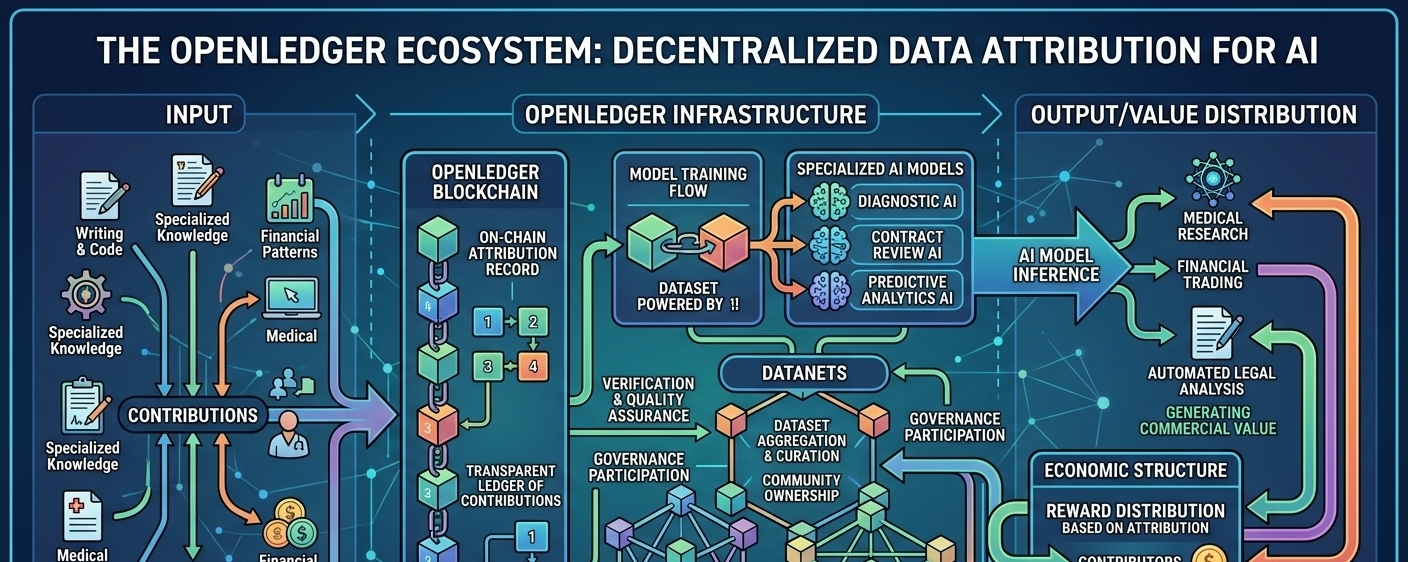
The core idea behind OpenLedger is surprisingly simple when you strip away the technical language. Instead of treating AI training data like a hidden resource controlled by a few centralized systems, OpenLedger tries to turn datasets into community-owned infrastructure. They call these Datanets. People can contribute data, build datasets together, train specialized models, and have those contributions recorded transparently on-chain.
What caught my attention is not just the blockchain part. We have seen many projects add blockchain to things before. What feels more important here is attribution.
In most AI systems today, once a model is trained, the origin of value becomes blurry. You may never know whose data helped shape the model or who should benefit when that model is used commercially later. OpenLedger seems to approach AI differently by trying to trace contributions throughout the lifecycle of the system itself.
That changes the psychology of participation.
Instead of people feeding systems blindly, the infrastructure attempts to create accountability around contribution, usage, and rewards. If a model generates value later through inference or deployment, the ecosystem can theoretically trace where that intelligence came from and distribute rewards accordingly.
I think this matters more than many people realize.
Because the future AI economy may not simply be about who builds the largest models. It may become about who builds the most trusted and specialized knowledge networks.
General AI models are impressive, but in the real world, specialized intelligence often matters more. Medical systems, legal systems, financial systems, industrial systems these areas require highly specific datasets and trusted contributors. And the truth is that high-quality specialized data is extremely difficult to collect and maintain.
That is where community-owned datasets become interesting.
OpenLedger is essentially trying to create a system where contributors, developers, and model builders exist inside the same economic structure instead of being disconnected from one another. Data uploads, model training, governance participation, and even inference attribution are all connected through the chain itself.
In simple terms, the system tries to remember who helped build the intelligence.
I honestly think that idea feels bigger than the token discussions people usually focus on.
Because if AI becomes one of the foundational layers of the internet economy, then attribution may become one of the most important problems in technology. Without attribution, value concentrates aggressively. With attribution, value can potentially circulate more fairly between contributors and systems.
Of course, none of this is easy.
One thing I keep questioning is whether decentralized coordination can truly compete with the speed and efficiency of centralized AI giants. Large-scale AI development requires enormous infrastructure, constant optimization, and massive capital. Open systems often move slower because governance, transparency, and community participation naturally introduce friction.
There is also the challenge of data quality itself.
Opening contribution systems to communities sounds powerful, but maintaining reliable datasets at scale is difficult. Incentives can improve participation, but they can also attract noise if verification systems are weak. So I think the long-term success of projects like OpenLedger will depend heavily on whether they can maintain both openness and quality at the same time.
Still, I cannot ignore the importance of the direction.
For years, many people viewed blockchain mainly as financial infrastructure. But AI may push blockchain toward something more philosophical: ownership of digital labor, ownership of knowledge, ownership of contribution itself.
That feels like a much deeper conversation.
And maybe that is why OpenLedger keeps staying in my thoughts. Not because it has all the answers, but because it touches a problem that the internet still has not solved properly.
If AI systems continue absorbing human intelligence at global scale, should contributors remain invisible forever?
Should AI value flow only toward the companies operating the models, or should the people helping create the intelligence also participate in the upside?
And if attribution becomes programmable through blockchain systems, could that slowly reshape how trust and ownership work online?
I do not think the industry fully understands the weight of these questions yet.
But I do think projects exploring this direction are worth watching carefully, especially as AI and blockchain start overlapping more deeply over the next few years.
In the end, I keep coming back to one simple thought.
Maybe the future of AI will not only be defined by how intelligent the models become.
Maybe it will also be defined by whether the people behind the intelligence are finally seen.