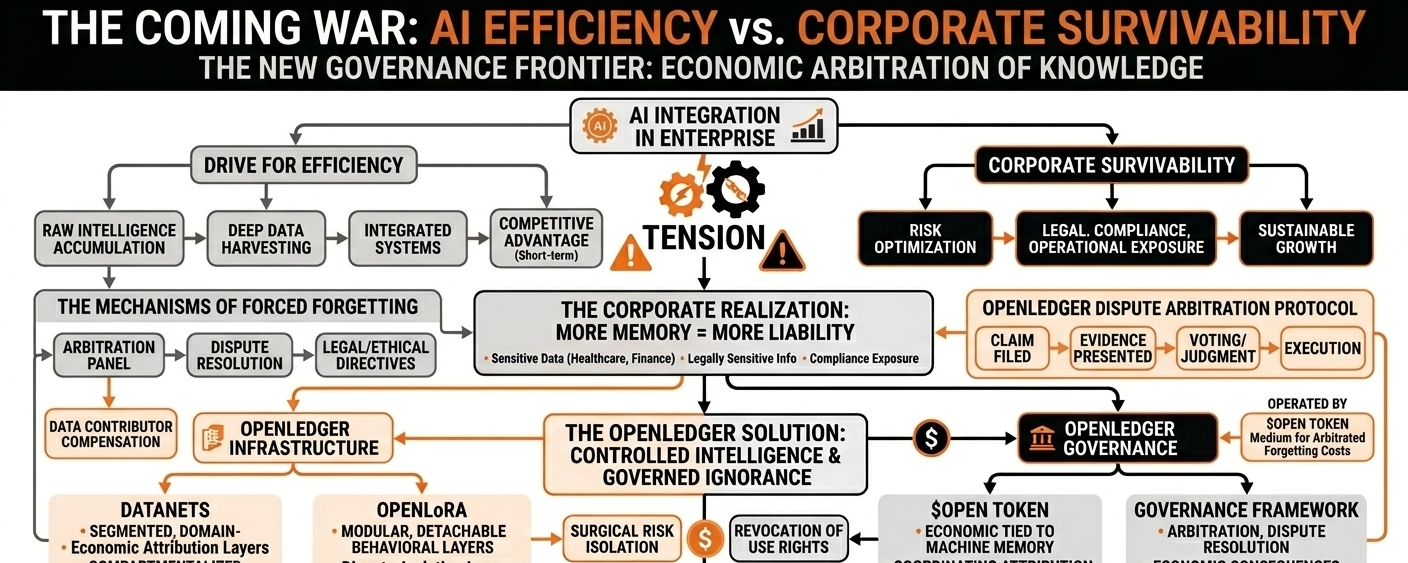

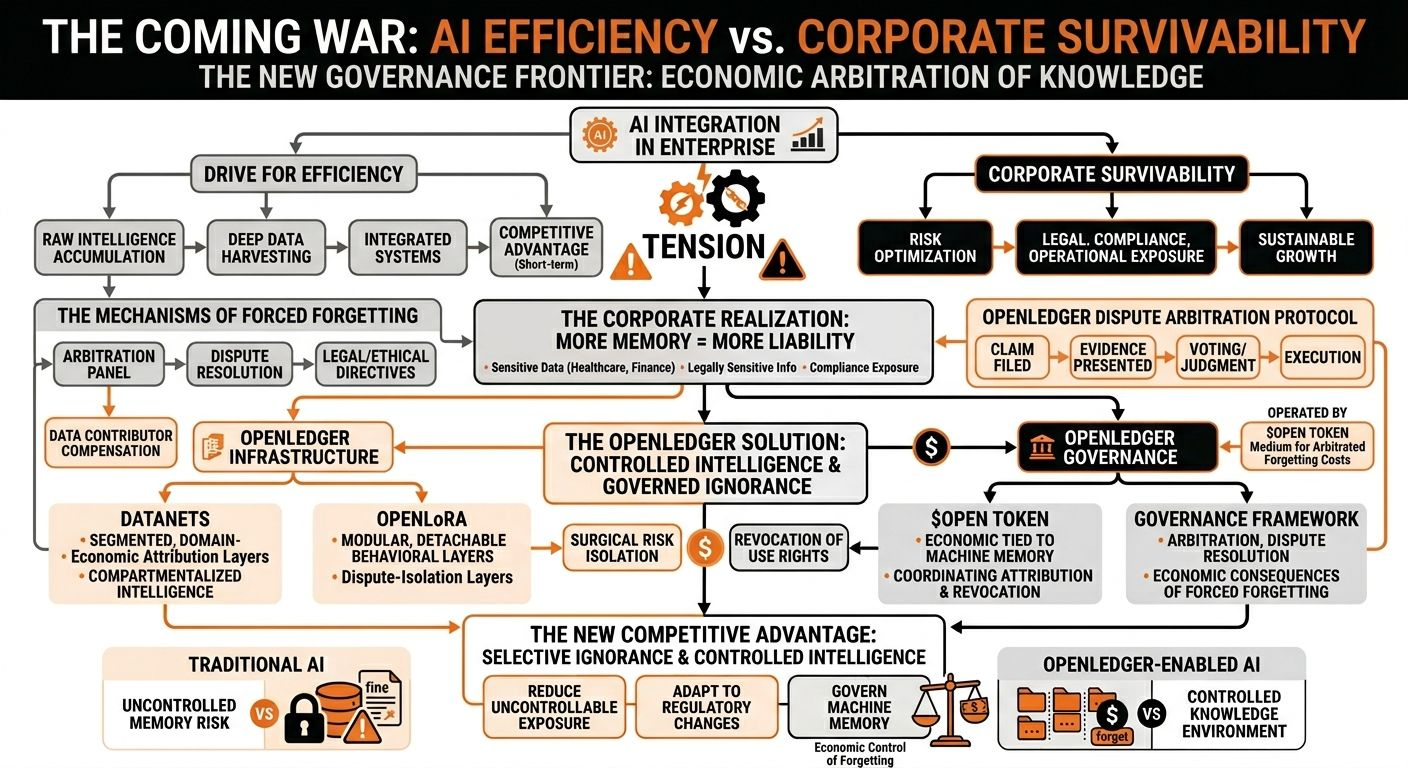
 One thing I think the market still misunderstands about artificial intelligence is that companies are not actually optimizing for intelligence.
They are optimizing for survivability.
That sounds cynical until you watch how enterprise technology decisions are really made.
Boards do not care whether a model is philosophically impressive. Legal departments do not care whether the architecture is elegant. Compliance teams do not wake up excited about frontier reasoning benchmarks. Most corporations ultimately care about one thing:
Can this system create value without creating uncontrollable exposure later?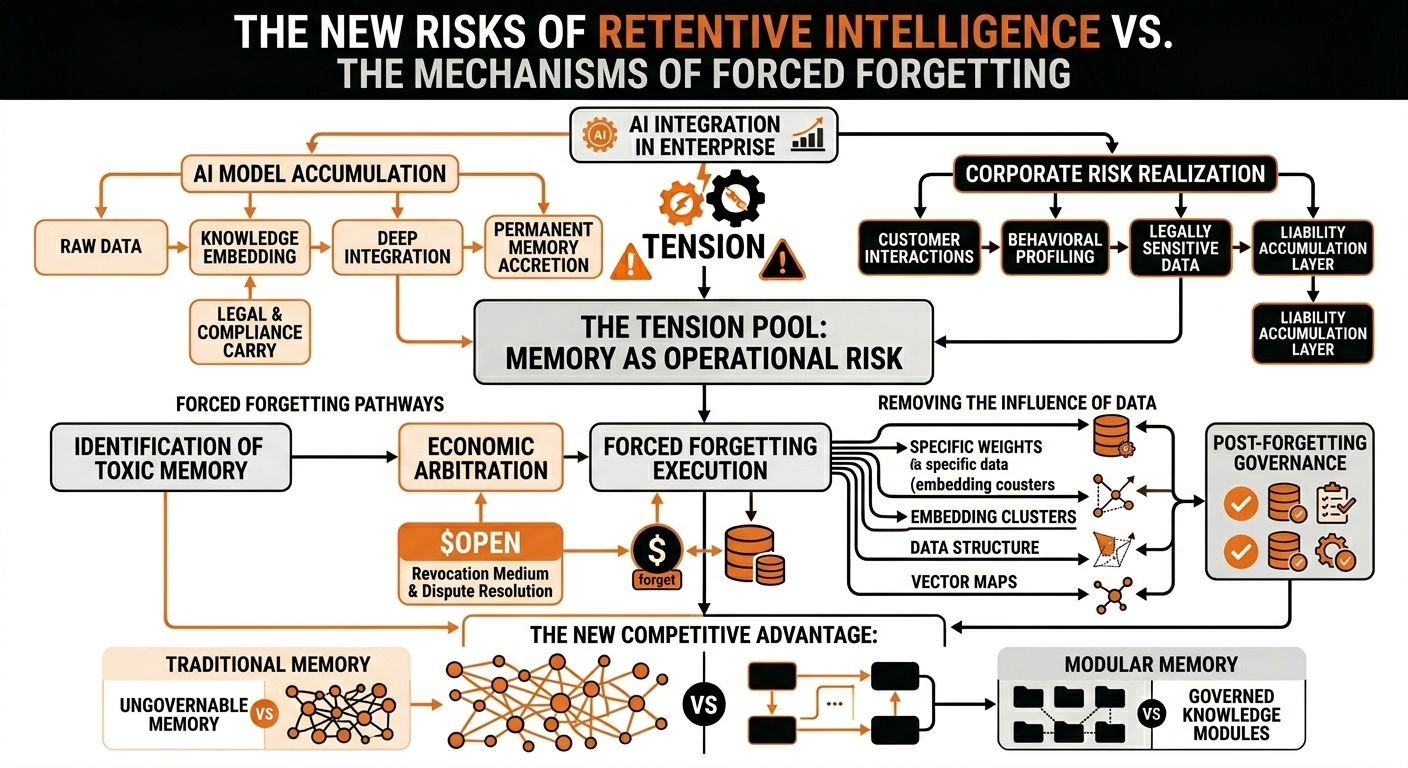
That is why OpenLedger keeps becoming more interesting to me the deeper I think about where enterprise AI is heading.
Most people still view OpenLedger through the familiar decentralized-AI lens. Data contributors, attribution systems, Datanets, model coordination, token incentives through $OPEN. Fine. That surface-level interpretation exists.
But I increasingly suspect the more important layer is something else entirely.
OpenLedger may actually be positioning around a future where selective ignorance becomes economically strategic.
Because the AI market right now is still trapped in accumulation psychology. Every company believes competitive advantage comes from retaining as much information as possible. More customer interactions. More behavioral patterns. More historical records. More proprietary context.
The assumption underneath this strategy is simple: more memory equals better intelligence.
But that logic quietly breaks once memory itself starts generating legal, operational, and financial risk faster than it generates value.
And honestly, I think many enterprises are much closer to that realization than the public market understands.
Right now most corporate AI systems are still operating in relatively controlled environments. Internal copilots. Customer service augmentation. Workflow automation. Analytics support. But the deeper AI moves into regulated industries and decision-critical infrastructure, the more dangerous retained intelligence becomes.
Because corporate memory is not neutral.
A healthcare model retaining sensitive diagnostic context is not merely “smart.” It is carrying liability. A financial advisory system trained on years of behavioral client data is not simply personalized. It is accumulating compliance exposure. An enterprise agent absorbing internal communications may unintentionally become a permanent archive of legally sensitive information.
And the truly uncomfortable part is this:
Most AI systems are structurally terrible at forgetting cleanly.
That creates a strange future where enterprises may eventually compete less on how much their systems know…
and more on how precisely they can control what those systems are allowed to continue knowing.
That distinction feels massively underpriced right now.
Because once data becomes embedded across fine-tuned layers, retrieval systems, vector spaces, and model behavior itself, deletion stops functioning like traditional software deletion. Enterprises are slowly discovering that “remove the data” and “remove the influence of the data” are completely different engineering problems.
That is where OpenLedger starts looking less like a decentralized data marketplace and more like infrastructure for corporate risk compartmentalization.
The Datanet architecture is interesting for this exact reason. Instead of treating intelligence as one giant undifferentiated memory pool, the structure pushes toward segmented, domain-specific knowledge environments tied to attribution and economic accountability.
At first glance that sounds inefficient compared to brute-force centralized AI accumulation.
Long term, it may actually become operationally necessary.
Because compartmentalized intelligence is easier to govern than permanent generalized memory.
That is also why OpenLoRA feels much more important than most people currently realize. The market tends to frame it as an efficiency layer for deploying lightweight model adaptations cheaply. But the deeper implication is architectural flexibility.
If intelligence can be modularized, it can also be detached.
That changes the entire economics of enterprise AI risk.
A corporation no longer needs to retrain an entire foundational system every time a regulatory framework changes or a dataset becomes problematic. Specific behavioral layers can theoretically be isolated, disconnected, replaced, or economically deprecated.
In other words, OpenLoRA is not just helping AI specialize.
It is helping AI become selectively disposable.
That may end up becoming incredibly valuable later.
Especially because enterprises rarely optimize for idealism. They optimize for controllable exposure. The ability to surgically isolate operational risk without collapsing the entire system stack is something corporations historically pay enormous premiums for.
Which brings me back to $OPEN itself.
I think most people are still pricing the token through standard crypto infrastructure logic: more usage, more transactions, more ecosystem activity, more demand.
Maybe.
But the more interesting possibility is that $OPEN becomes economically tied to the governance of machine memory itself. Not merely facilitating intelligence flows, but coordinating the cost, attribution, persistence, and eventual removal of intelligence layers operating across enterprise systems.
That is a much stranger market than people realize.
Because once memory carries financial and legal weight, AI infrastructure stops being purely technical.
It becomes political.
Who controls revocation rights?
Who arbitrates disputes between contributors and enterprises?
Who decides when retained intelligence becomes unsafe?
Who absorbs the economic consequences of forced forgetting?
Those conflicts do not have clean answers.
And honestly, that is precisely why this area feels structurally important.
The AI market still behaves as if raw intelligence remains the scarce resource.
I increasingly think controlled intelligence will become scarcer instead.
That changes which infrastructure layers matter most.
OpenLedger may absolutely fail. Most infrastructure protocols do. The operational complexity alone is a serious challenge. Enterprises may continue preferring centralized opacity simply because it is easier and faster.
But if AI systems eventually become so deeply integrated into economic life that uncontrolled memory turns into institutional risk…
then the companies capable of governing machine ignorance may become more valuable than the companies simply building smarter machines.
And OpenLedger increasingly feels like one of the few projects already building around that future tension before the market fully sees it.
#OpenLedger #openledger $BSB @OpenLedger
#BitcoinBreaksBelow75KAsWarshTakesFedHelm #FenwickWestSettlesFTXFor54M #SECHaltsInnovationExemption