
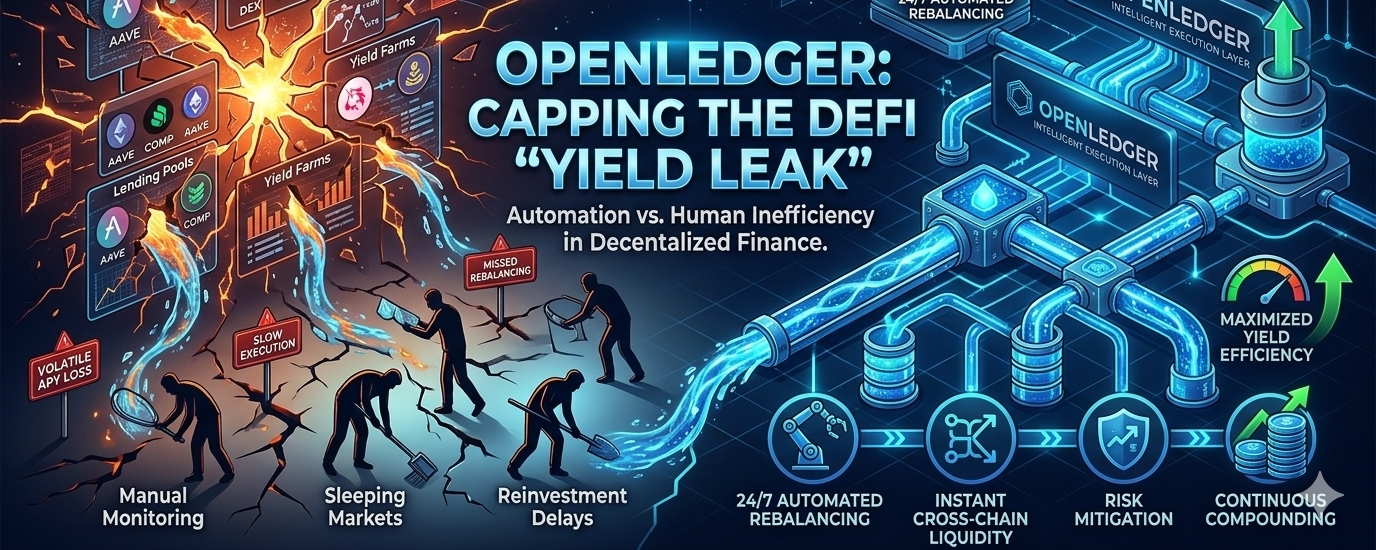
There’s something about OpenLedger that keeps pulling my attention back, not because it is loud or aggressively hyped, but because the core idea behind it touches a problem that most people in DeFi already experience without properly naming it. The deeper I looked into it, the more I felt the issue is not actually about finding opportunities anymore. That stage is almost over. Information moves too fast now, dashboards are everywhere, analytics tools already expose the best pools, highest APYs, farming strategies, and chain opportunities in real time. Almost everyone knows where yields exist. But despite all this visibility, people still continuously lose potential profits every single day. That gap between “knowing” and “capturing” is where the entire OpenLedger narrative becomes interesting.
The phrase that stayed in my head was “yield leak.” At first, it sounds like another trendy crypto term, but when you really think about it, it explains one of the biggest invisible inefficiencies inside DeFi. The leak is not happening because users are unintelligent. It happens because DeFi operates continuously while humans do not. Markets shift while people sleep. APYs rotate before users even notice. Reward emissions lose efficiency because reinvestment is delayed. Collateral positions become dangerous within minutes during volatility. Cross-chain liquidity opportunities disappear before manual execution can react. This creates a strange reality where users technically understand what should be done, but still fail to execute at the speed the system requires.
That is where OpenLedger seems to be positioning itself differently. Instead of selling a fantasy about discovering “new yield,” it quietly builds around the idea that existing yield is already leaking out of the system because human execution is naturally slow. And honestly, that framing feels smarter than most DeFi narratives I have seen recently. Recovering lost efficiency sounds far more realistic than inventing magical returns from nowhere.
When I started breaking the problem down mentally, the picture became even clearer. Take APY volatility alone. Rates across protocols change constantly depending on liquidity conditions, borrowing demand, emissions, and market behavior. A pool that gives attractive returns in the morning may become average a few hours later. Humans cannot realistically monitor this all day every day. Then comes collateral management, which is probably one of the most brutal parts of DeFi. If leverage positions are not adjusted at the right moment, liquidation becomes unavoidable. Markets do not wait for people to wake up, check notifications, or manually rebalance positions. In volatile conditions, seconds matter more than analysis.
Cross-chain liquidity movement creates another layer of friction. In theory, shifting capital between ecosystems to chase better yield sounds simple. In reality, it is messy, expensive, slow, and often stressful. Bridges introduce risk, gas costs reduce efficiency, and timing delays ruin opportunities. Add emission compounding into the equation and the situation becomes even more obvious. Reward tokens only maximize efficiency if they are continuously reinvested. Every delay weakens compounding power, but humans cannot sit behind screens all day harvesting and reallocating rewards manually.
This is where OpenLedger’s bigger idea starts becoming visible to me. It feels less like a normal DeFi protocol and more like an attempt to create an intelligent execution layer underneath DeFi itself. A system capable of monitoring opportunities, managing risk, reallocating liquidity, rebalancing positions, and executing actions automatically without depending on human timing. And whether people realize it or not, that is potentially a much bigger narrative than simply “higher yield.”
Because if execution becomes automated properly, then the structure of DeFi changes completely. The advantage no longer belongs to the person with the best knowledge. Information is already everywhere now. The real edge becomes execution speed, consistency, and automation. The ability to react instantly while humans hesitate, sleep, or get distracted. In many ways, DeFi is slowly evolving from a knowledge game into an execution game.
But this is also the exact point where I become cautious.
Crypto is full of ideas that sound revolutionary until they collide with real market conditions. Building a seamless execution layer across fragmented ecosystems is not easy. Slippage, gas spikes, bridge failures, smart contract risks, liquidity fragmentation, and unpredictable volatility make automation extremely difficult in practice. The theory behind automated execution sounds clean, but real-world crypto infrastructure is chaotic. One weak point in the system and the entire experience breaks apart.
Still, I cannot ignore the fact that the underlying problem itself is very real. Most users are already leaking value without even realizing it. They lose efficiency through delayed actions, emotional decisions, poor timing, missed rebalancing, and manual execution limitations. OpenLedger seems to understand that the future opportunity may not come from creating more complexity, but from removing human inefficiency from systems that already exist.
And honestly, that is why I am paying attention without fully jumping into blind conviction. The logic behind the thesis feels strong. The problem feels authentic. The direction makes sense. But execution is everything here. If the automation layer is not smooth, reliable, and invisible to the user, then the entire narrative risks becoming another beautiful theory that never truly works at scale.
For now, I see OpenLedger sitting in that very dangerous and very interesting middle zone where strong ideas meet uncertain reality. Not something I would blindly worship, but definitely not something I would casually dismiss either. Because sometimes the biggest transformations in DeFi do not come from the loudest trends. They come from solving the quiet structural problems everyone already experiences but rarely talks about openly. And if there is one thing crypto repeatedly teaches, it is that overconfidence usually destroys people faster than skepticism ever will.
