
I remember a moment when I went back to review a few on chain actions I had made earlier, just to understand them better. Nothing had failed. Everything had executed correctly. But the more I tried to trace the full path, the more I realized how quickly clarity can disappear once a network has been under real usage.
At first glance, crypto systems feel clean. You see inputs, you see outputs, you see confirmations. But when activity increases, the middle layer the part where everything is coordinated and verified starts getting harder to read. And that is where I started paying more attention.
In my experience watching networks evolve, the real limitation is not only throughput. It is also traceability under pressure. When multiple actions, users, and systems interact at once, understanding how something happened becomes as important as whether it happened.
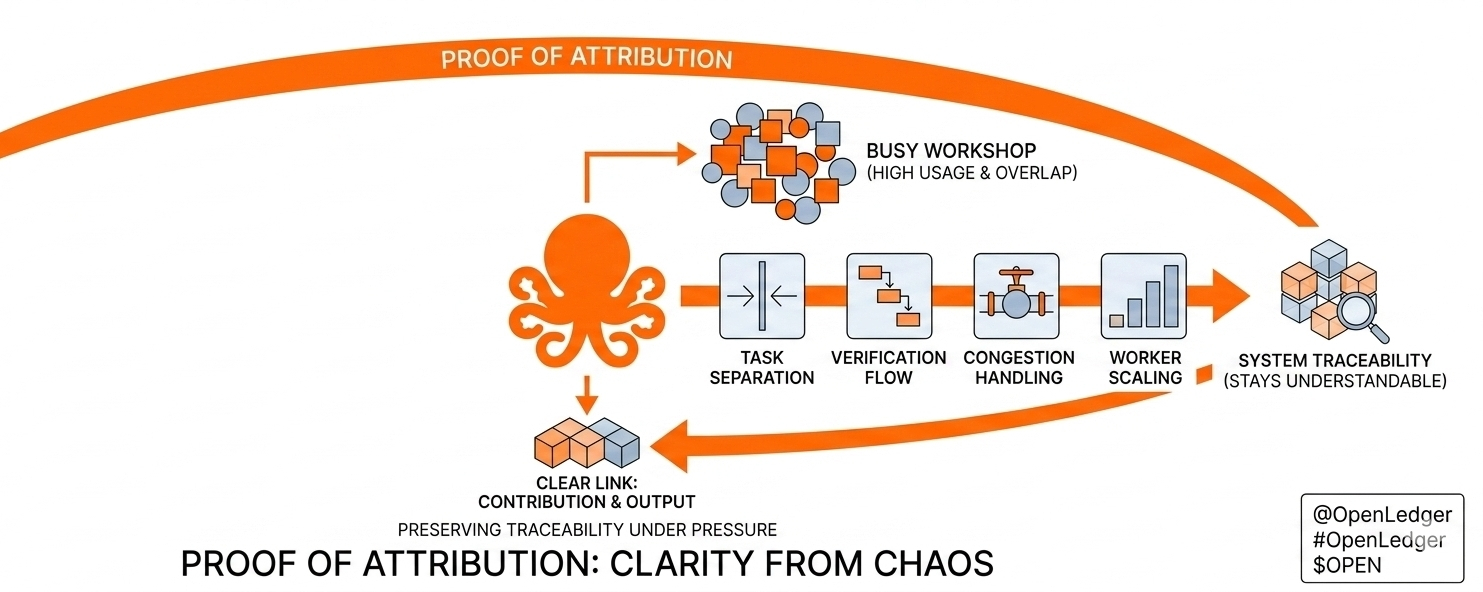
I often think about it like a busy workshop where several people are building the same structure at the same time. When it is quiet, you can easily see who is doing what. But when it gets crowded and tasks overlap, even a well built result becomes harder to break down into clear contributions.
From a system perspective, that gap is what attribution tries to solve.
What caught my attention is how @OpenLedger approaches this through Proof of Attribution. What interests me more is not the name itself, but the idea of preserving a clear link between contribution, computation, and output even when systems are no longer operating in simple, linear conditions.
What I noticed is that this depends heavily on structure: scheduling, task separation, verification flow, congestion handling, and worker scaling all quietly shape whether attribution remains readable under load. Even the balance between ordering and parallelism matters, because too much of either can break clarity in different ways.
And then there is backpressure, which I see as a quiet test of design. A system that handles pressure well does not collapse into confusion. It distributes load and keeps its internal logic intact.
A reliable system is not the one that only performs well in calm conditions. It is the one that stays understandable when everything becomes busy.
Good infrastructure doesn’t just produce results. It keeps them traceable.