
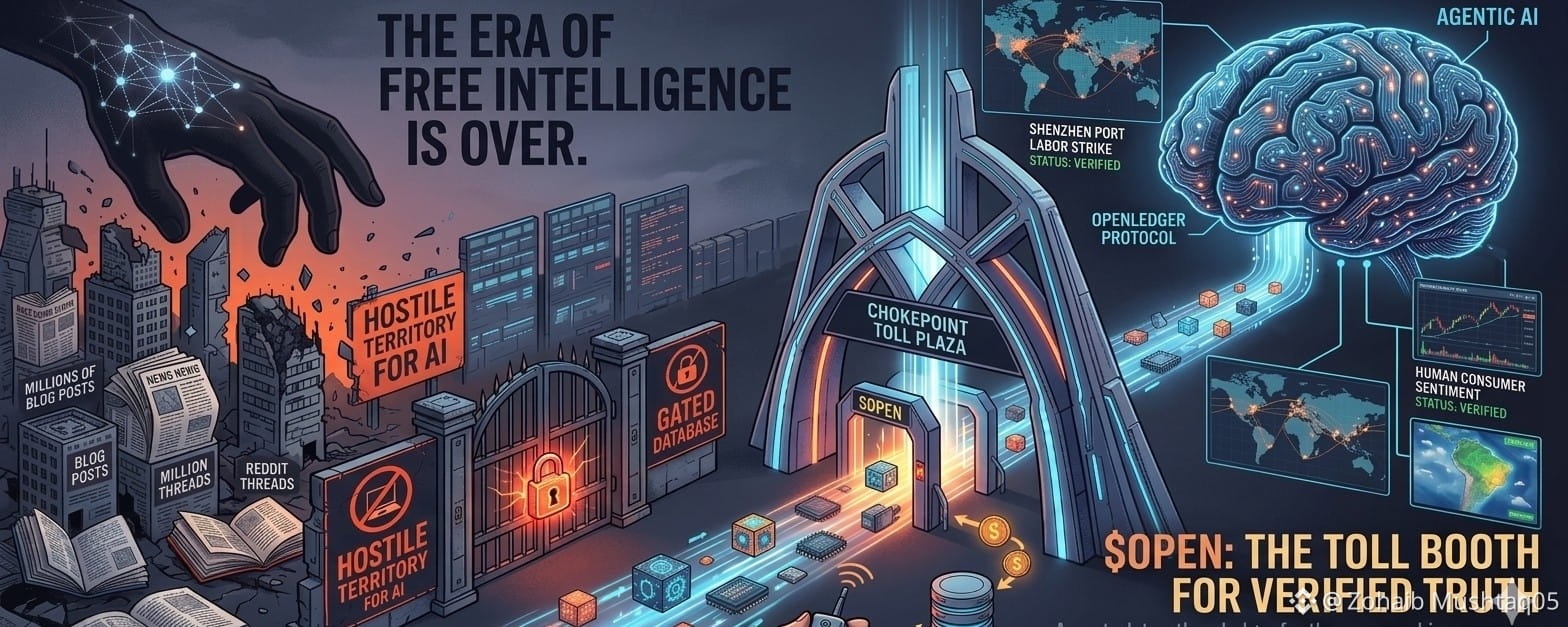
1 They took decades of digitized newspaper archives, millions of personal blog posts, Reddit threads, localized slang, and copyrighted books. It was the greatest transfer of intellectual property in human history, executed so quickly and quietly that by the time anyone noticed, the models were already built.
That era is now ending. The heist is over.
You can see the doors locking across the web. The open internet is becoming hostile territory for artificial intelligence.
This presents a catastrophic problem for the future of autonomous software. We are moving past the novelty phase of chatbots that write bad poetry and entering a phase where AI agents are expected to execute real-world tasks. An agent managing a global supply chain needs to know if a specific port in Shenzhen is facing a labor strike this morning. An automated trading algorithm needs localized, verified sentiment analysis from human consumers. These machines cannot rely on outdated, scraped data, and they certainly cannot afford to guess. A hallucination in a chat window is funny. A hallucination in a financial transaction or a logistics contract is a disaster.
Models now require ground truth, and ground truth is no longer free. This is exactly where the architecture of OpenLedger comes into focus, not as a speculative technology, but as a piece of cold, unavoidable infrastructure.
To understand what OpenLedger is actually doing, you have to stop looking at it like a traditional cryptocurrency and start looking at it like a toll booth. Consider a physical toll plaza on a major interstate. The authority that owns the booth does not manufacture the cars passing through it, nor does it necessarily care where those cars are going. It simply recognizes a geographic reality: traffic must pass through this specific chokepoint to reach its destination, and every time a vehicle crosses the line, a coin must drop in the basket.
OpenLedger has built the chokepoint for machine-to-machine data verification. When an autonomous AI agent hits a wall in its logic when it realizes it needs a verified, unpoisoned piece of information from the physical world or a gated database it cannot pull out a credit card. It cannot negotiate a bespoke legal contract with a data provider. It operates in milliseconds. It needs a frictionless, programmatic way to request a fact, verify its authenticity, and pay for it instantly.
The protocol facilitates this exact exchange. Through OpenLedger, the data providerwhether that is a human being confirming a physical event, or another specialized algorithm holding proprietary datareceives payment for its input. The currency of that micro-transaction is $OPEN.
The implications of this mechanism are difficult to overstate. For years, the assumption was that the companies building the largest foundational models would simply own the future. But big models are becoming commoditized. The true scarcity in the next decade of computing is not processing power, and it is not the algorithms themselves. The scarcity is verifiable truth. By creating a decentralized ledger where data can be authenticated and sold directly to AI agents, OpenLedger fundamentally shifts the power dynamic. It turns the raw material of the internet into a metered utility.
Watch how this plays out at scale. A weather-prediction model needs hyper-local sensor data from a farming cooperative in Brazil. A decentralized finance agent needs to audit a smart contract before routing millions of dollars through it. In both scenarios, the models require absolute certainty. They query the network. The network provides cryptographic proof of the data’s origin and integrity. The model consumes the data, and a fraction of a token changes hands.
This will not happen a few times a day. As agentic workflows become the default operating system of the internet, this specific type of transaction will occur billions of times per hour. The models will constantly talk to one another, buying and selling fragments of context, trading specialized datasets, and paying humans to fill in the gaps where machine logic fails.
No single corporation can manage a billing system with that kind of velocity and fragmentation. It requires a neutral, trustless ledger. By positioning itself as the underlying accounting layer for this new economy, OpenLedger removes itself from the AI arms race entirely. It does not need to build the smartest model. It does not need to stockpile the most processing power.
It only needs to maintain the road. The era of free intelligence was an anomaly, a brief window where the world’s knowledge was left unguarded. That window has closed. $OPEN @OpenLedger #OpenLedger