
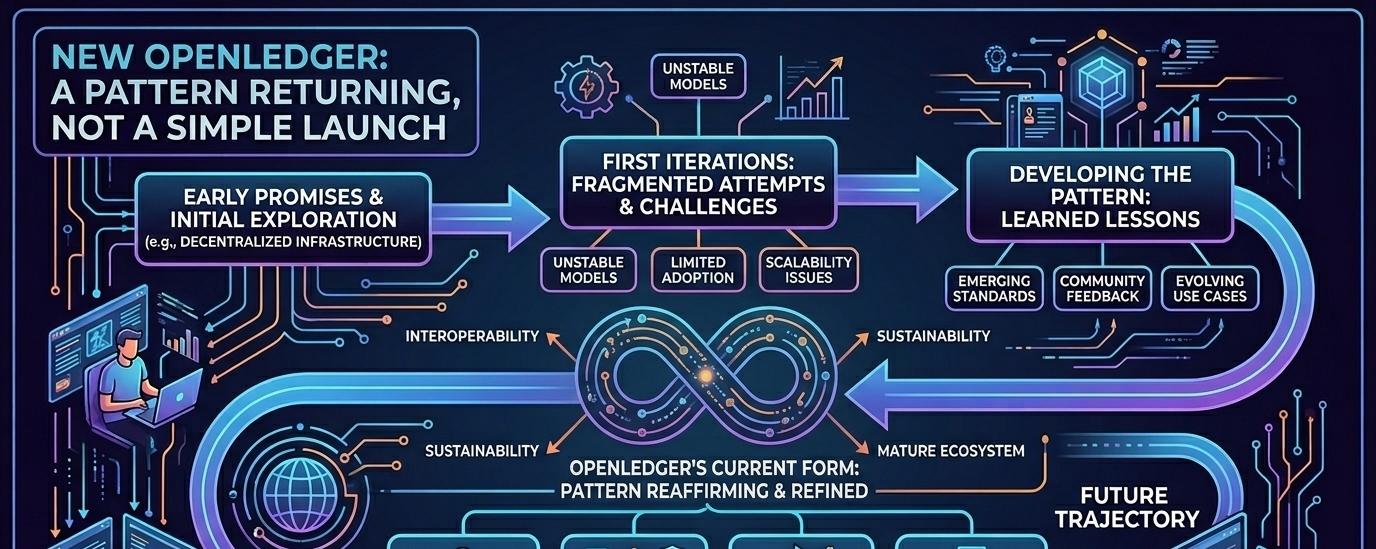
I’m watching another architecture arrive carrying the language of permanence again, I’m looking at the way people repeat words like liquidity, intelligence, coordination, ownership, as if repetition itself slowly transforms uncertainty into infrastructure, I’ve seen this atmosphere before, not exactly the same but familiar enough that I notice my reactions changing instead of accelerating, and maybe that’s what keeps projects like OpenLedger somewhere in the edge of my attention instead of directly in front of it, because it doesn’t feel loud in the way earlier cycles felt loud, it feels quieter than that, more embedded into the habits people already built around data, automation, prediction, identity, extraction, and maybe that quietness is what makes me keep returning to it when I probably should have already dismissed it or fully believed it by now, but I do neither, I just keep watching the shape of it form slowly through behavior instead of announcements.
There was a time when blockchain projects tried to appear revolutionary immediately. They wanted spectacle. Everything arrived wrapped in declarations about replacing entire systems overnight. I remember how fast people attached themselves to those narratives, how quickly timelines became synchronized around certainty. But the projects that arrive now feel different to me. Less theatrical. More ambient. OpenLedger sits inside that newer mood where the language is no longer about disruption as much as integration. Not replacing systems, but attaching itself quietly to the systems already absorbing attention every day.
And maybe that’s why the AI angle feels less explosive than people pretend. AI already dominates the background of digital life now. Most people interact with it indirectly without even noticing. Recommendations, summaries, automated replies, generated images, predictive filtering. The novelty phase has already started dissolving into routine. So when a blockchain project builds itself around data, models, agents, and monetization, it doesn’t feel futuristic anymore. It feels like an attempt to organize something that already escaped containment years ago.
I keep noticing how often conversations around OpenLedger revolve around ownership, but not in the older ideological sense crypto once pushed. It feels colder now. More transactional. Data becomes an asset because attention became measurable. Models become assets because behavior became measurable. Even identity starts flattening into patterns that can be tracked, priced, routed somewhere else. I don’t even say that critically anymore. Mostly I observe it the same way I watch cities expanding at night from airplane windows, aware that systems continue building themselves regardless of whether anyone fully understands them while they’re happening.
What interests me more is the emotional behavior these projects create around themselves. Not the technology itself, but the posture people adopt near it. I notice how carefully people watch for early positioning now. Nobody wants to arrive late anymore. The entire culture around emerging networks has become shaped by memory. Everyone remembers missing something once. Bitcoin. Ethereum. Solana. Some obscure protocol that looked irrelevant until suddenly it wasn’t. That memory changes the atmosphere around every new project. People no longer participate because they fully believe. Often they participate because uncertainty itself became a strategy.
And OpenLedger exists directly inside that psychology. You can feel it in the way people discuss infrastructure before infrastructure fully exists. They talk about future coordination with the confidence of historians describing events that already happened. I don’t fully trust that confidence anymore, but I understand where it comes from. Markets reward anticipation more than accuracy. Sometimes belief itself creates temporary reality long enough for capital to organize around it.
Still, I can’t dismiss the possibility that something more durable is forming underneath the noise. Not because the branding feels convincing or because AI combined with blockchain automatically means progress, but because the world increasingly behaves like a place where invisible systems own more value than visible ones. Data moves constantly now. Models evolve constantly. Agents act on behalf of humans more frequently than people admit. Maybe networks attempting to structure those interactions are inevitable in the same way earlier internet infrastructure became inevitable long before ordinary people understood what was happening around them.
But inevitability is dangerous language. I’ve heard it attached to too many projects that slowly dissolved into ghost communities and inactive wallets. The crypto industry has a strange relationship with memory. It forgets failures almost immediately while endlessly recycling the emotional texture of previous excitement. Sometimes I scroll through conversations around newer protocols and feel like I’m reading altered versions of discussions I already witnessed years ago. Different terminology, same rhythm underneath. The same search for permanence inside systems designed around velocity.
What keeps my attention on OpenLedger isn’t certainty. It’s the way it reflects broader shifts already happening outside crypto itself. AI is changing how information moves. Blockchain still searches for a reason to matter beyond speculation. OpenLedger feels like an attempt to force those two unfinished narratives into the same structure and hope the combination stabilizes both of them at once. Maybe that works. Maybe it creates another temporary layer people move through before attention migrates somewhere else again.
I think about how much of modern technology depends less on utility than on sustained attention. Entire ecosystems survive because enough people continue looking in the same direction simultaneously. Once attention fractures, value often fractures with it. That’s why I pay more attention to behavior than announcements now. Quiet engagement matters more than explosive launches. Repetition matters more than spectacle. Habits matter more than ideology.
And there’s something strangely patient about the way OpenLedger is positioning itself. Not patient in the philosophical sense, but structurally patient, like it understands that modern networks are built gradually through continuous low-level participation instead of singular moments of transformation. Maybe that’s maturity. Maybe it’s just marketing adapting to exhaustion. I can’t fully tell anymore.
So I keep watching it from a distance that feels deliberate. Not close enough to become emotionally invested, not far enough to ignore completely. Somewhere in between. The same place I find myself with most emerging systems now. Observing the language people use around them. Watching how quickly certainty forms. Watching whether the silence between announcements grows heavier or more stable over time.
Because eventually every project reveals itself less through promises and more through the kind of attention it can sustain once the excitement becomes ordinary, once participation turns into routine, once speculation loses some of its temperature. That’s usually when the real structure starts becoming visible, if there is one at all. And I don’t think OpenLedger has reached that moment yet. I think it’s still somewhere inside the early haze where narratives move faster than evidence, where curiosity and projection overlap so completely they become difficult to separate.
So for now I just continue looking at it the same way I look at many things in this space now, with interest that never fully becomes belief, with skepticism that never fully becomes dismissal, waiting to see what remains after people stop speaking about the future like it already arrived.
