
Most projects in crypto still get presented the same way. A big announcement, a few technical buzzwords, people rushing to speculate on price action, and then the timeline moves on to the next trend a few days later. But every now and then, something happens on the infrastructure side that feels more important than the market initially realizes. Not because it creates instant hype, but because it quietly changes how the ecosystem actually functions underneath the surface.
That’s honestly what OpenLedger’s EVM bridge feels like.
At first glance, a bridge doesn’t sound exciting. Bridges have existed for years. Crypto users have been moving assets between chains since the early days of multi-chain expansion. But context matters, and the environment around crypto in 2026 is very different from what it was even two or three years ago. The industry has matured, user expectations have changed, and the biggest challenge now is no longer just building blockchains. It’s making all of them work together efficiently.
That’s where interoperability becomes important.
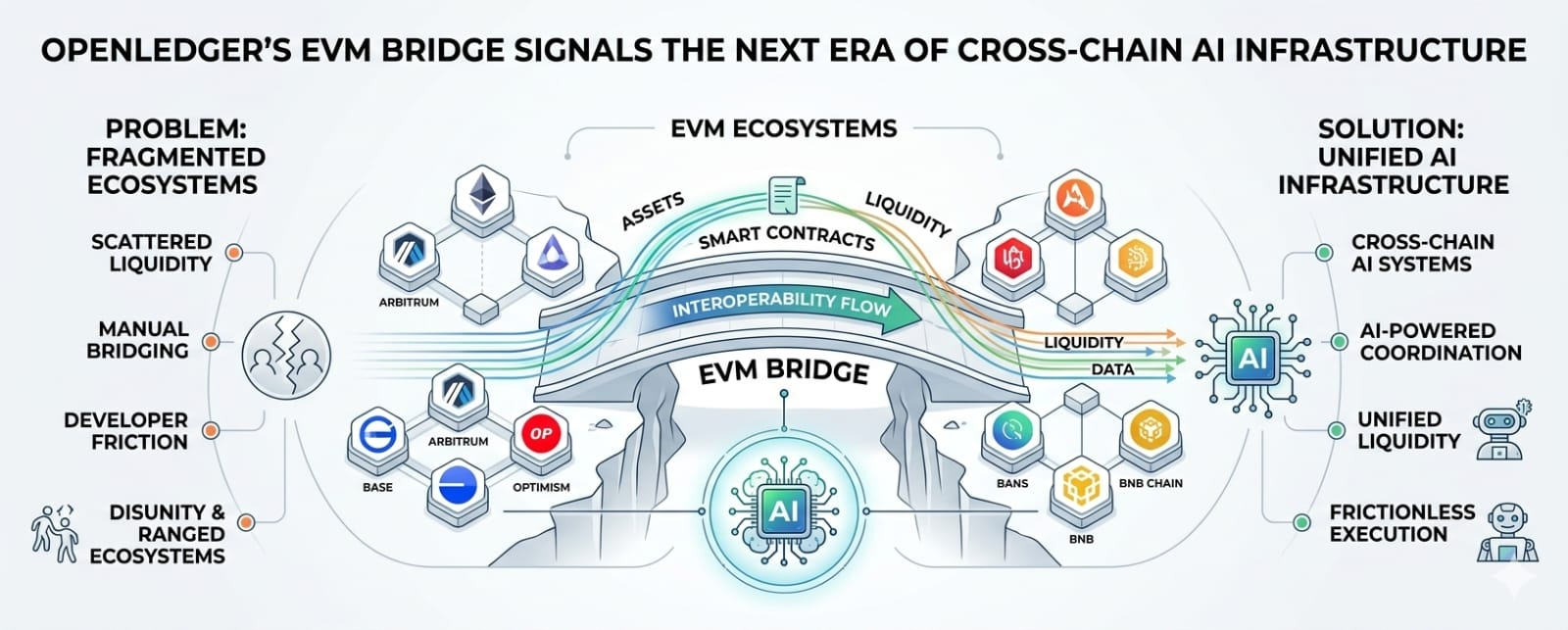
An EVM bridge, in simple terms, allows different Ethereum-compatible ecosystems to communicate with each other. Assets, smart contracts, liquidity, and data can move between networks like Ethereum, Arbitrum, Optimism, Base, BNB Chain, and other EVM environments without users feeling completely locked into one ecosystem. Technically, that sounds straightforward, but the impact is much bigger than most people think.
Over the last few years, crypto slowly became fragmented. Ethereum remained dominant, but newer chains kept growing because they solved different problems. Some offered lower fees, some offered faster execution, others focused on scaling, gaming, AI, or specialized DeFi infrastructure. On paper, that growth was healthy because competition improved the overall ecosystem. But it also created friction everywhere.
Liquidity became scattered across networks. Developers had to maintain separate integrations for different chains. Traders constantly bridged assets manually. Capital became less efficient because moving between ecosystems still felt clunky and slow. Even experienced users accepted this as normal because there wasn’t really a better alternative yet.
That’s why interoperability infrastructure matters more now than it did before.
By 2026, the industry is finally starting to understand that no single chain is going to dominate everything. The future doesn’t really look like one winner taking over the entire market anymore. It looks more like a network of connected ecosystems that each specialize in different things while remaining interoperable underneath.
And once that realization happens, bridges stop looking like optional tools. They become core infrastructure.
What makes OpenLedger interesting here is that the project isn’t approaching interoperability from a purely transactional perspective. Most bridge conversations historically focused on moving tokens from one chain to another. OpenLedger’s broader direction feels different because it’s tied closely to AI-powered blockchain infrastructure.
That changes the conversation completely.
AI systems operating on-chain need more than just access to one ecosystem. They need flexibility. They need execution environments that can operate across multiple networks at the same time. They need access to liquidity wherever it exists, not wherever the system happens to be deployed.
And unlike humans, AI systems don’t handle friction well.
A trader can tolerate switching wallets, waiting for confirmations, managing gas manually, or bridging assets across ecosystems. Autonomous systems can’t operate efficiently with that kind of fragmentation. Every additional step introduces latency, inefficiency, and potential failure points.
That’s where interoperability becomes much more than a convenience feature.
If AI is eventually going to move beyond analytics and actually participate in execution, coordination, liquidity management, or automated decision-making on-chain, then those systems need unified infrastructure underneath them. Otherwise every chain becomes its own isolated operational silo.
That’s the deeper part of OpenLedger’s direction that stands out.
The bridge itself is important, but the bigger idea is what the bridge enables. It creates the possibility for AI-native systems to operate across environments without constantly rebuilding integrations for every separate ecosystem. That may not sound dramatic today, but long-term it could matter a lot more than people expect.
There’s also a noticeable shift happening across the wider industry that makes this timing interesting. Over the past year, more projects have started prioritizing standardization instead of isolated ecosystems. You can already see it in modular infrastructure, shared rollup frameworks, interoperability protocols, standardized vault systems, and cross-chain messaging layers. The market is slowly moving away from disconnected experimentation toward integrated architecture.
That shift usually happens when an industry matures.
Early crypto was mostly about proving things could exist at all. Then came scalability. Then came DeFi expansion, NFTs, Layer 2 competition, AI integrations, and modular ecosystems. But underneath every cycle, the same issue kept resurfacing: none of these systems work efficiently if they remain isolated from each other.
Eventually infrastructure becomes more important than narratives.
That’s why developments like this matter even when they don’t generate massive excitement immediately.
From a trader’s perspective, interoperability improves capital efficiency. Every extra bridge transaction, confirmation delay, or manual transfer slows execution. In volatile markets, even small inefficiencies add up over time. Better cross-chain infrastructure means liquidity moves faster, strategies become more flexible, and opportunities can be accessed more efficiently.
From a developer’s perspective, the impact is probably even bigger. Maintaining separate integrations across fragmented ecosystems has always been expensive and inefficient. Standardized EVM compatibility already simplified a lot of development, but interoperability pushes that even further. The easier it becomes for applications to communicate across environments, the easier it becomes to scale products and onboard users.
And honestly, this is probably where crypto is heading whether people realize it yet or not.
The market is becoming too large and too interconnected for isolated ecosystems to remain practical long-term. Users expect smoother experiences now. Institutions entering the space expect infrastructure that feels reliable and efficient. AI systems certainly require it. The old “figure it out yourself” phase of crypto is slowly fading.
Of course, none of this removes the risks.
Bridges have historically been one of the weakest points in crypto security. Some of the largest exploits in the industry happened through poorly designed bridging systems. Cross-chain infrastructure is difficult because it connects multiple trust environments at once, and every additional connection creates potential vulnerabilities.
That’s why implementation matters just as much as vision.
OpenLedger using standardized OP Stack bridge architecture instead of entirely custom infrastructure is probably a smart decision from a security perspective. Standardized systems that have already been battle-tested across multiple ecosystems usually reduce unnecessary risk compared to experimental bridge models. But realistically, trust in infrastructure only comes with time, testing, and consistent reliability under real-world conditions.
And adoption won’t happen overnight either.
Even good infrastructure takes time before users fully trust it. Integrations need to expand, ecosystems need to mature, and real usage needs to prove stability. But historically, once infrastructure proves reliable, adoption accelerates much faster than people expect.
That’s why developments like this tend to matter more over the long run than short-term market reactions.
Most people focus on visible narratives because they’re easier to measure. Price moves are obvious. Hype cycles are obvious. But infrastructure quietly shapes how the entire ecosystem evolves underneath those narratives.
That’s really what OpenLedger’s EVM bridge represents.
Not just another feature release, but part of a larger transition toward a more connected crypto environment where interoperability becomes foundational instead of optional. A future where liquidity, applications, AI systems, and execution layers operate across multiple ecosystems without constant friction.
And if that future actually arrives, the projects building connective infrastructure today will probably matter a lot more than the market currently gives them credit for.
