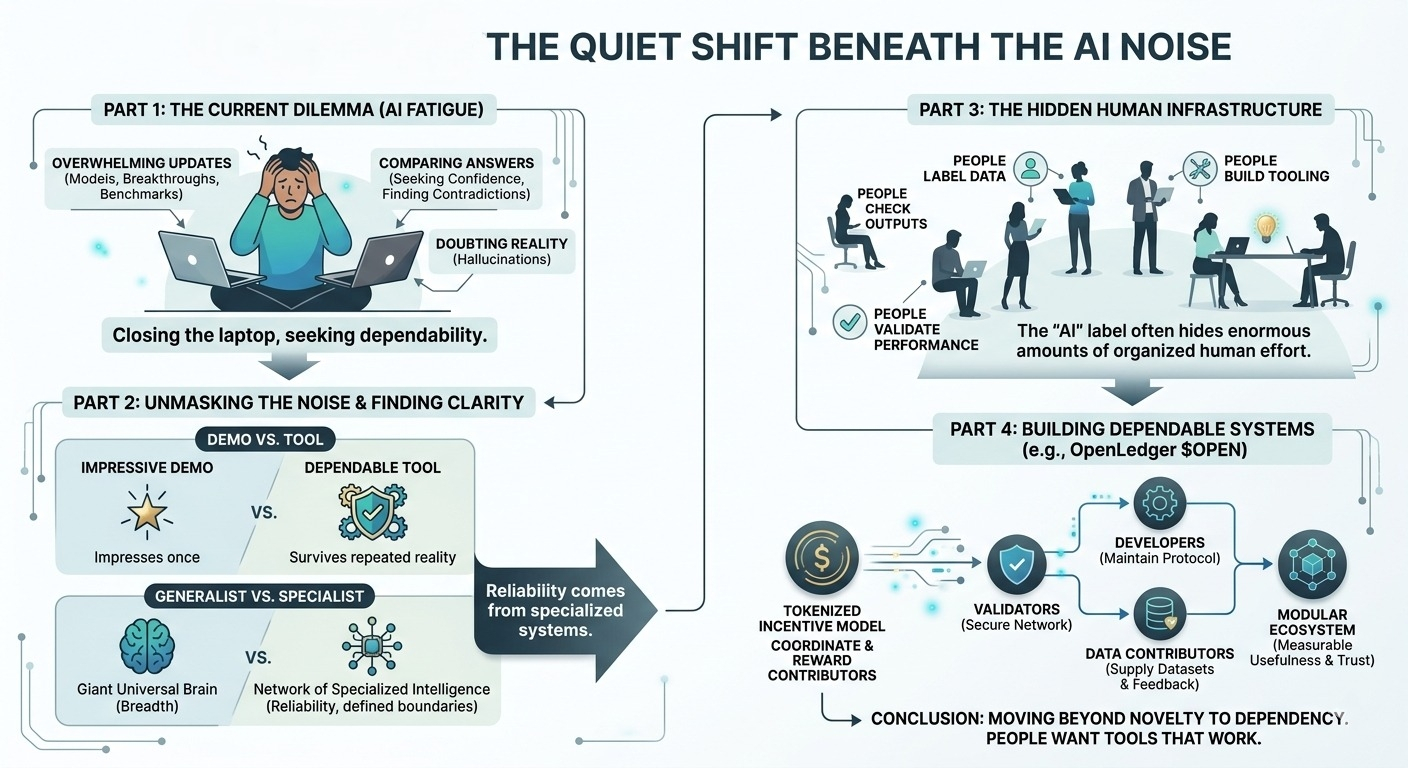
A few nights ago, I caught myself doing that thing I’ve started doing too often: opening three AI tools in separate tabs, asking roughly the same question in each, then comparing answers like I was some kind of exhausted product tester. One gave me confidence with total certainty. Another contradicted it politely. A third hallucinated something that sounded plausible enough to make me doubt my own memory.
I closed the laptop and made tea.
That kind of AI fatigue feels strangely specific to this moment. Not because the tools are bad, exactly. Some are genuinely useful. But because there’s this ambient sense that everything is updating faster than anyone can meaningfully evaluate it. New models, benchmarks, wrappers, agents, assistants, copilots. Every week, another “breakthrough.” Every week, the same vague question underneath: is any of this actually becoming dependable?
I honestly can’t tell yet.
What has started to feel clearer, though, is that the loudest part of AI may not be the most important part.
For a while, the dominant story seemed obvious: bigger models win. More parameters, more compute, broader capabilities. Build something that can do everything reasonably well, then keep scaling until “reasonably well” becomes “surprisingly good.”
And to be fair, that approach worked. At least enough to reshape expectations.
But after spending too much time around both crypto and internet products, I’ve learned that impressive demos and dependable tools are very different species.
A demo only needs to impress you once.
A tool needs to survive repeated contact with reality.
That distinction stayed in my head longer than expected.
Because when you think about actual workflows—legal review, medical assistance, financial analysis, research pipelines, industrial automation—it becomes less obvious that giant general-purpose intelligence is the final form. Breadth is impressive, but reliability tends to come from narrower systems with clearer boundaries.
A specialist often beats a generalist when the cost of being wrong matters.
That’s where some of the quieter infrastructure conversations start getting interesting.
Not the chatbot layer. Not the shiny interfaces. The machinery underneath.
OpenLedger ($OPEN) started making more sense to me in that context—not as some isolated crypto token story, but as part of a broader question: what does AI infrastructure look like if the future is less about one giant universal brain and more about networks of specialized intelligence?
Because specialized systems need specialized ingredients.
Different data. Different validation mechanisms. Different incentive structures.
And maybe different economic models too.
One thing AI discourse often smooths over is the hidden human labor underneath all this. Training data doesn’t materialize from nowhere. Evaluation doesn’t happen magically. Reliability doesn’t emerge because someone used the word “autonomous.”
People label data. People check outputs. People build tooling. People validate whether a model actually performs the task it claims to perform.
The “AI” label sometimes hides an enormous amount of organized human effort.
Crypto, for all its weirdness, has always been unusually comfortable exposing incentive systems directly.
Which is partly why projects like OpenLedger are interesting, even if I’m still not sure exactly how these models play out.
The idea—at least structurally—isn’t hard to understand: if AI increasingly depends on contributors beyond a centralized lab, how do validators, developers, and data contributors coordinate? How do they get rewarded? How do you verify useful participation without collapsing into noise?
Tokenized incentives are one possible answer.
Maybe that works. Maybe it creates different problems.
The internet usually changes once incentives appear.
That part feels predictable.
People optimize for whatever the system rewards. Sometimes that creates healthy ecosystems. Sometimes it creates spam farms wearing better branding.
Crypto history gives plenty of reasons to be skeptical here.
But incentives also matter because invisible labor tends to become fragile if nobody can sustainably support it.
Contributor-driven ecosystems are messy by nature. Yet some infrastructure systems only exist because enough participants find the economics worthwhile.
Validators securing networks. Developers maintaining protocol tooling. Contributors supplying useful datasets or model feedback.
Strip away branding, and this starts looking less like speculative internet theater and more like coordination design.
Which sounds less exciting than consumer AI demos, and probably is.
But quiet infrastructure tends to matter later.
Consumer products get attention first because they’re visible. Infrastructure gets attention after something important depends on it.
That pattern keeps repeating across technology.
I think what makes this AI transition confusing is that two narratives are happening simultaneously.
One narrative says AI gets bigger, more generalized, more human-like.
The other suggests AI becomes narrower, embedded, task-specific, almost boring in the best possible way.
I suspect the second narrative may produce more practical value, even if it attracts less spectacle.
Nobody gets especially emotional about dependable workflow infrastructure.
But dependable workflow infrastructure changes industries.
OpenLedger fits somewhere inside that possibility space for me—not as certainty, but as an indicator that some builders are thinking less about singular AI personalities and more about modular ecosystems where usefulness can actually be measured.
That feels healthier.
Or maybe just more realistic.
Still, trust remains the unresolved issue.
Not just trust in outputs, but trust in the systems creating them.
Who supplied the data?
Who validated the claims?
Who benefits if the model succeeds?
Who gets paid if it fails?
These questions matter more once AI moves from novelty into dependency.
And maybe tokenized infrastructure helps answer some of them.
Or maybe it just adds another abstraction layer for people to game.
I honestly can’t tell yet.
But I do think we may be moving away from the phase where AI wins by appearing magical.
Magic is expensive.
Magic is unreliable.
Eventually people just want tools that work.
If that future belongs less to giant omniscient models and more to specialized, incentive-aligned infrastructure networks, projects like OpenLedger might matter more than they currently appear to.
Not because they’re loud.
Because they’re trying to solve quieter problems.