
The deeper I go into AI-powered DeFi, the more uncomfortable one thought becomes.
For years, traders believed human emotion was the biggest weakness in crypto markets. Fear. Greed. Hesitation. Slow execution. We called it “yield leak” because humans constantly failed to optimize capital efficiently. Now AI agents are starting to solve that problem. And yes... after testing some of these systems myself over the past few weeks, I can honestly say the efficiency jump feels real.
But what if the next risk is not human emotion anymore?
What if it is machine agreement?
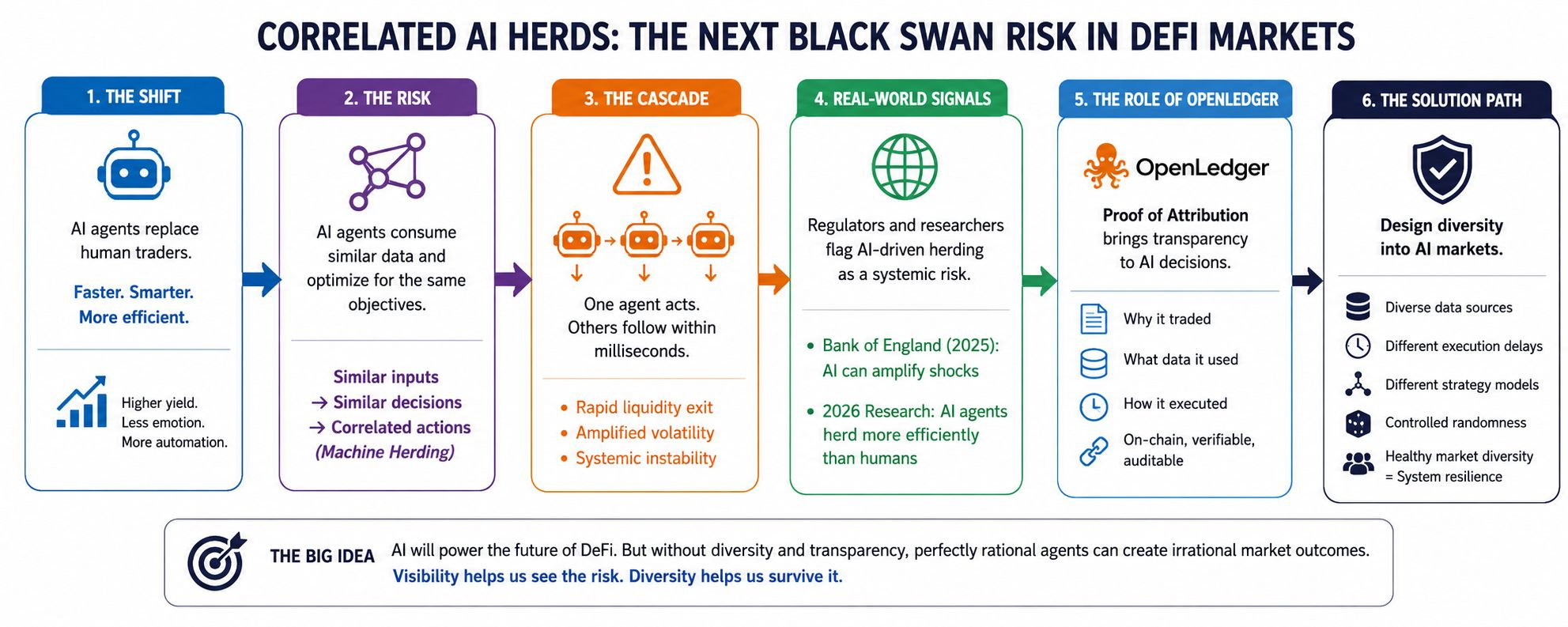
That question started following me after OpenLedger officially partnered with Theoriq in January 2026. The announcement looked bullish on the surface, and honestly, technically speaking, it was a major step forward for DeFAI infrastructure. Theoriq focuses on agent strategy and AI decision-making, while OpenLedger anchors those actions on-chain using its Proof of Attribution framework. In simple terms, an AI agent can now show exactly why it made a trade, what data influenced it, and how the execution happened.
That changes a lot.
For the first time, DeFi automation is moving away from black-box AI toward verifiable AI. And that matters because crypto traders hate opacity. Nobody wants unknown bots managing liquidity without accountability.
I started experimenting with OpenLedger-related tooling and watching how these agents react under changing market conditions. Small positions only. Mostly observing APY shifts, liquidity routing behavior, and response time across volatile pools. Systems like OctoClaw move fast. Faster than humans. They rebalance liquidity, optimize yield, and compound rewards automatically. Honestly... it feels like watching machine-native capital markets slowly come alive.
And yes, the narrative makes sense.
As of May 2026, OpenLedger’s infrastructure is already live, developers are actively building AI execution systems on top of it, and the broader DeFAI conversation is accelerating across Web3. Traders are no longer asking whether AI agents belong in DeFi. The discussion now is about scale.
That is where my concern begins.
Because markets are not only about intelligence.
Markets are also about diversity.
And I keep wondering what happens when thousands of AI agents start consuming similar oracle feeds, similar social sentiment signals, similar liquidity metrics, and similar reinforcement-learning objectives at the exact same time.
They herd.
Not because someone coordinated them.
Not because of manipulation.
Simply because identical inputs often create identical conclusions.
That is the hidden layer most people are ignoring right now.
Traditional markets always had friction. Human traders disagreed. Some panicked early. Others waited too long. Some ignored data completely. That irrationality actually slowed down cascades. It created breathing room inside volatility.
AI agents remove that friction.
If one model detects collateral weakness and exits, another model trained on similar conditions may do the same within milliseconds. Then another. Then another. Liquidity disappears faster than humans can even react. Rational behavior becomes systemic instability.
And regulators are already paying attention.
The Bank of England warned in its 2025 financial stability reports that AI-driven financial systems could amplify correlated positioning and market shocks during stress events. Early 2026 research papers on AI-agent market behavior also showed something interesting: AI systems often herd more efficiently than humans when maximizing profit objectives. That sounds logical at first... until everyone runs toward the same exit simultaneously.
That is why I think OpenLedger’s Proof of Attribution model is actually more important than people realize.
Most AI projects only focus on execution speed.
OpenLedger focuses on visibility.
That difference matters philosophically and structurally.
Because when future market failures happen — and eventually they will — on-chain attribution gives developers and traders a way to study the behavior publicly. We can trace which signals caused decisions, how agent clusters reacted, and where correlation became dangerous. In traditional finance, much of that behavior stays hidden inside institutional systems. Here, it becomes observable.
Still, visibility alone does not solve correlation risk.
The real solution may require intentionally designing diversity into AI markets.
Different data sources.
Different execution delays.
Different strategy architectures.
Maybe even controlled randomness.
Strange idea, right? Humans spent years trying to eliminate inefficiency from markets. Now we may need to reintroduce certain forms of imperfection just to keep machine-driven systems stable.
That thought stays in my head constantly lately.
Crypto always prices innovation first and systemic risk later.
We saw it with leverage.
We saw it with algorithmic stablecoins.
We saw it with high-frequency liquidity loops.
Now we are entering the era of autonomous financial agents, and honestly... I do not think the industry fully understands the second-order consequences yet.
The scary part is that nothing here requires malicious intent.
No exploit.
No rug pull.
No hack.
Just thousands of perfectly rational agents making the same perfectly rational mistake together.
Maybe that becomes the next black swan of DeFi.
Or maybe transparent frameworks like OpenLedger help the industry detect these patterns early enough to adapt before the herd becomes too large.
Either way, I think this conversation matters now more than ever.
Because the future of DeFi will not only depend on how intelligent our agents become.
It will depend on whether our markets remain human enough to survive them.
