I remember a treasury call that began sometime after 2 a.m., the kind where nobody speaks with urgency at first because everyone is still hoping the anomaly is a misunderstanding. A transaction path had triggered concern, not because funds were definitively compromised, but because nobody could reconstruct the authority chain with confidence. One signer believed their permissions had expired weeks earlier. Another assumed delegation had been scoped to a single operational window. Documentation suggested one reality; actual execution rights suggested another. The technical problem was serious. The institutional confusion was worse.
That was the moment it became difficult to keep believing the industry’s preferred story about progress.
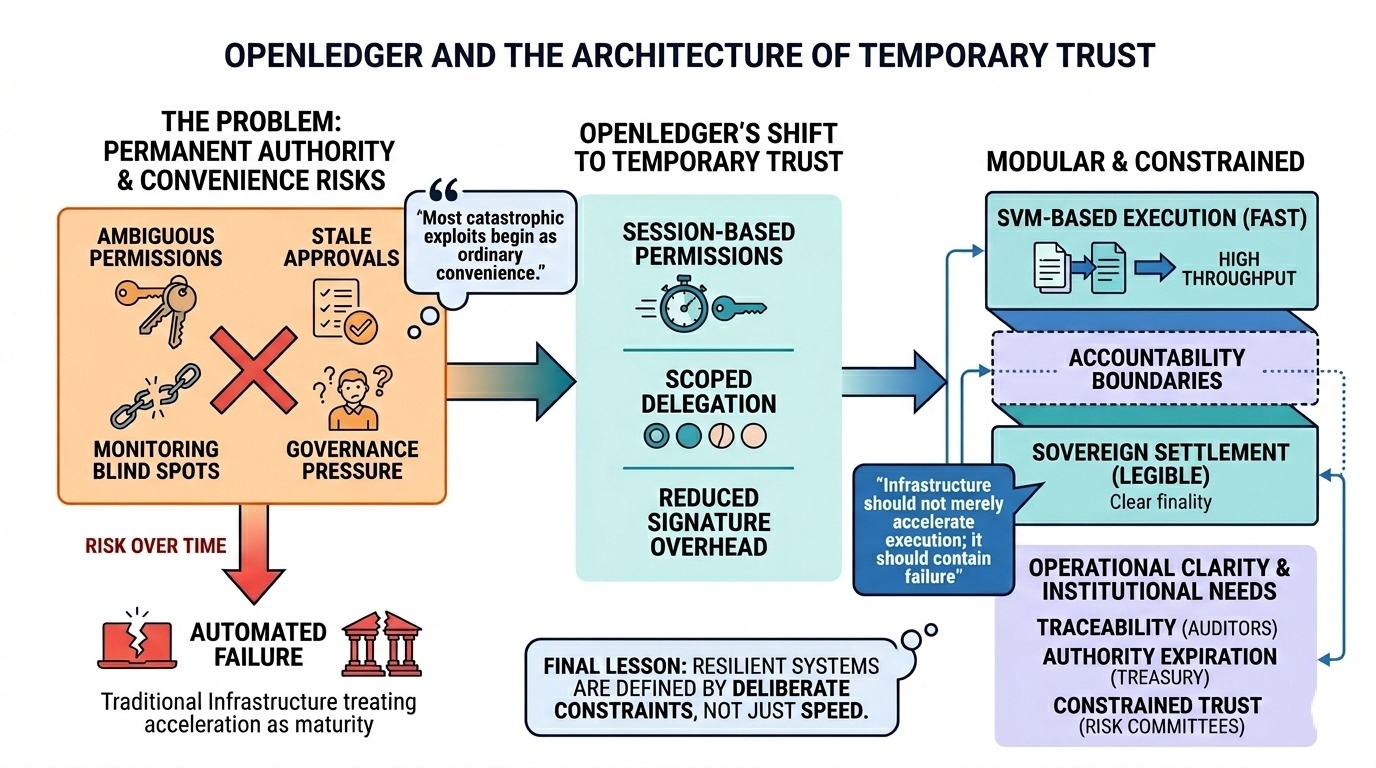
For years, blockchain infrastructure has treated acceleration as a proxy for maturity. Higher throughput, smoother UX, faster execution, cleaner settlement. Entire ecosystems became fixated on reducing friction while largely ignoring a more consequential question: who retains authority when systems become operationally complex? Crypto’s most expensive failures have rarely emerged from insufficient speed. They emerge from ambiguous permissions, monitoring blind spots, stale approvals, governance pressure, and trust assumptions that survive long after anyone actively verifies them.
“Most catastrophic exploits begin as ordinary convenience.”
That is why OpenLedger is interesting—not because it promises computational efficiency, but because of the assumptions embedded in how authority is handled.
Session-based permissions introduce a discipline infrastructure has often lacked: temporary trust. Scoped delegation matters because permanent signer authority is rarely maintained with permanent attention. Reducing signature overhead sounds efficient until one realizes execution authority may still persist indefinitely. Convenience without expiration is simply risk with delayed visibility. Infrastructure should not merely accelerate execution; it should contain failure when human assumptions inevitably drift.
“The dangerous permissions are usually the forgotten ones.”
Architecturally, OpenLedger’s SVM-based execution and high-throughput orientation are familiar enough. The more meaningful design choice is modularity. Separating execution from settlement creates psychological clarity as much as technical separation. Accountability boundaries become more legible. EVM compatibility feels less ideological than operationally pragmatic, acknowledging that institutional adoption often depends less on purity than coexistence. Yet interoperability remains dangerous. Bridge fragility does not disappear because architecture is elegant. State verification across modular environments introduces fresh complexity. Composability expands attack surfaces faster than monitoring discipline usually matures.
“A fast system that cannot refuse dangerous behavior eventually automates failure.”
Institutional operators understand this intuitively. Auditors want traceability. Treasury teams want authority expiration. Validators inherit responsibility, not merely yield. Risk committees fear ambiguity far more than milliseconds.
Infrastructure fails quietly before it fails publicly.
The deeper lesson is not about OpenLedger alone. It is about recognizing that resilient blockchain systems are not defined by how quickly they move, but by how deliberately they constrain trust before trust inevitably degrades.