
I remember the first time I tried explaining OpenLedger to a friend.
I started talking about AI infrastructure, attribution layers, decentralized data, model contributors, blockchain coordination. Halfway through, he stopped me and asked:
“So… why does any of this need blockchain?”
That question stayed with me longer than I expected.
Because the truth is, if users have to first understand the infrastructure before they can feel the value, the system already created friction.
And that is what makes $OPEN interesting to me.
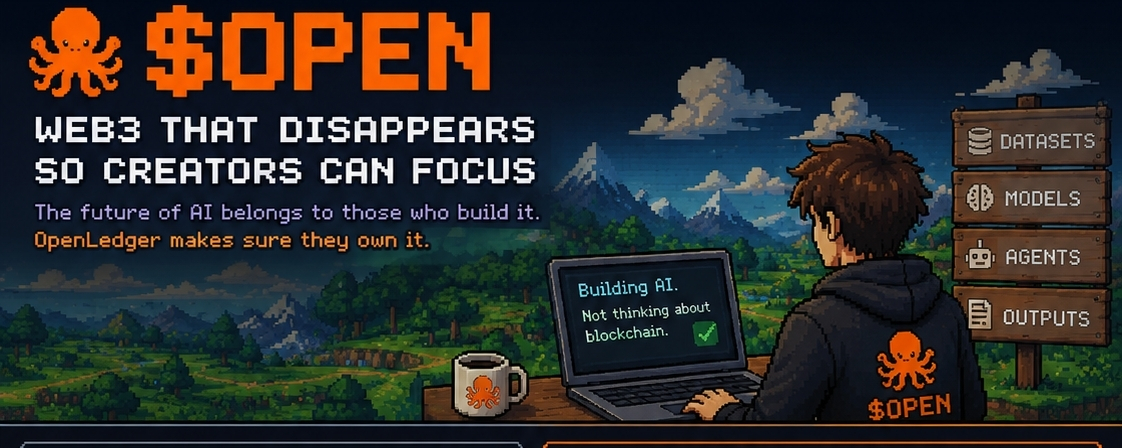
OpenLedger does not try to force people to care about blockchain mechanics. It focuses on something much simpler: making AI contribution, ownership, and coordination work in the background while users focus on building.
Most people contributing data, improving models, or creating AI outputs do not actually care about consensus mechanisms or on-chain architecture. They care about whether their work matters, whether attribution exists, and whether value flows back to them.
That is the shift I keep noticing with OpenLedger.
The blockchain is not positioned as the product itself. It becomes the invisible layer that records contribution, tracks ownership, and distributes value underneath the experience.
And honestly, that changes everything.
A lot of Web3 infrastructure still feels like it wants users to constantly acknowledge that they are “using crypto.” Wallets, signatures, approvals, gas, bridges. The infrastructure keeps appearing in front of the user.
But systems scale better when the infrastructure fades into the background.
OpenLedger feels closer to that direction.
Contributors focus on datasets, AI models, agents, and outputs. Meanwhile attribution, provenance, and rewards happen beneath the surface.
The important part is not removing blockchain.
It is removing the need for people to think about blockchain while participating.
That distinction matters more than most people realize.
Because users rarely adopt technology simply because the architecture is better. They adopt things when the experience becomes natural enough that the architecture disappears from their decisions.
And the deeper I look into AI x blockchain, the more I feel this paradox becoming true:
Web3 does not win when users constantly see it.
It wins when users no longer need to notice it at all.
$OPEN is interesting because it pushes toward that future, one where blockchain is not the experience itself, but the invisible layer quietly ensuring attribution, ownership, and value distribution behind AI. @OpenLedger #OpenLedger