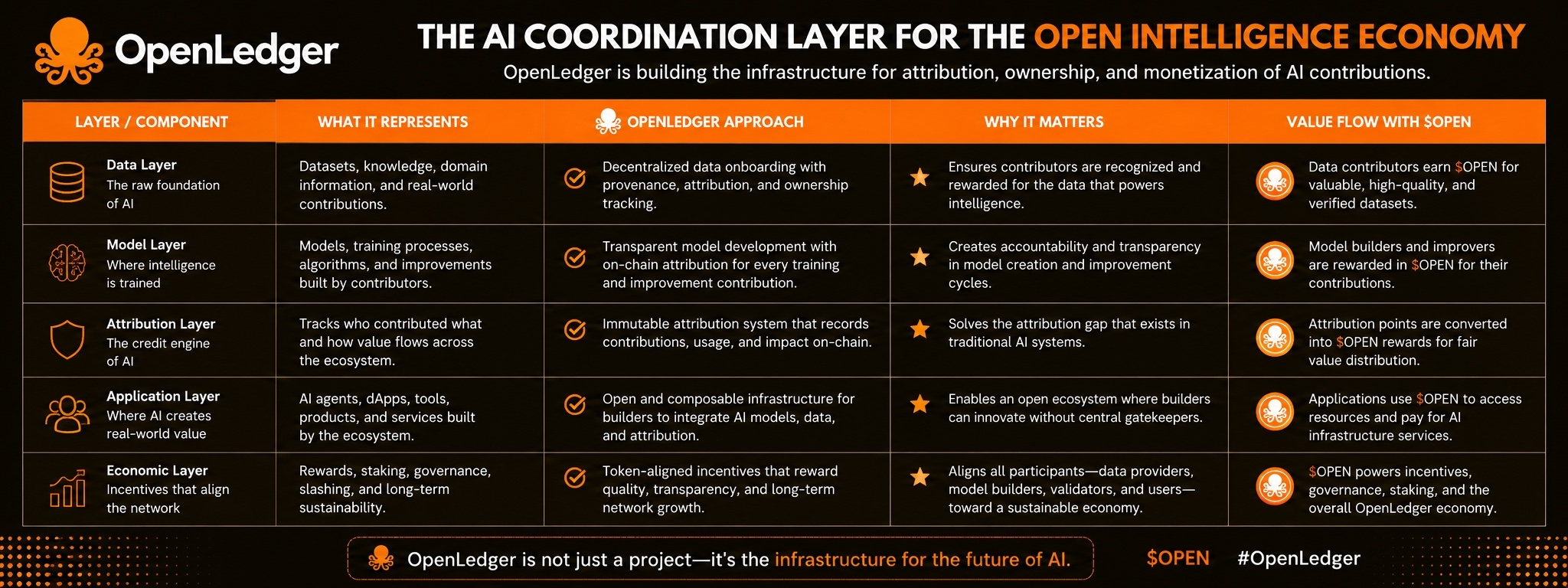
For the last year, most conversations around AI have stayed trapped at the surface level.
People focus on chatbots.
Model launches.
GPU shortages.
Valuations.
Billion-dollar funding rounds.
But the deeper structural shift is happening underneath all of that.
The real battle is slowly becoming about ownership, attribution, coordination, and economic alignment inside AI systems themselves.
And honestly, I think that’s where projects like @OpenLedger start becoming much more important than the market currently realizes.
Because once AI moves from being a novelty product into actual economic infrastructure, one uncomfortable question keeps appearing:
Who owns the intelligence layer?
Not the interface.
Not the app.
The actual underlying intelligence infrastructure.
That question sounds abstract at first, but it changes everything once you sit with it long enough.
Today, most AI systems operate like black boxes.
Data enters.
Models train.
Outputs emerge.
Revenue gets captured.
But the people contributing the value inside that loop usually disappear completely.
The dataset creators disappear.
The niche domain experts disappear.
The communities disappear.
Even the model contributors themselves often disappear behind centralized ownership structures.
And that creates a strange imbalance where the intelligence economy grows while the attribution layer stays broken.
That imbalance probably cannot scale forever.
Especially once AI becomes integrated into finance, healthcare, governance, logistics, education, autonomous systems, robotics, and digital coordination at global scale.
Because eventually markets start asking harder questions:
Who contributed the data?
Who improved the model?
Who verified the outputs?
Who owns the economic upside generated from the system?
Who gets rewarded when an AI network becomes valuable?
This is where OpenLedger’s direction starts feeling less like a niche crypto experiment and more like early infrastructure positioning.
What OpenLedger seems to understand better than many projects is that AI itself is slowly becoming a coordination economy.
Not just a compute economy.
That distinction matters a lot.
Most people still think the AI race is purely about bigger models and larger compute clusters.
But over time, coordination becomes equally important.
How do contributors organize?
How do models remain transparent?
How does attribution persist?
How do networks reward useful participation instead of extractive behavior?
How does data remain economically linked to downstream intelligence outputs?
Those are infrastructure questions.
And infrastructure narratives usually look boring before they suddenly become unavoidable.
The internet went through something similar.
In the early days, people focused on websites and apps.
Later, they realized the real power sat inside protocols, standards, routing layers, cloud infrastructure, and data coordination systems.
AI feels like it’s entering that same transition now.
The market attention is still concentrated at the application layer.
But the long-term value may accumulate deeper inside the intelligence coordination stack.
That’s partly why decentralized AI infrastructure keeps attracting serious builders despite broader market volatility.
There’s a growing realization that centralized AI eventually runs into structural trust problems.
Not immediately.
But gradually.
Especially when AI systems begin influencing economic outcomes directly.
Financial decisions.
Medical recommendations.
Autonomous agents.
Institutional workflows.
Government processes.
Digital identity systems.
At that point, transparency and attribution stop being philosophical discussions and become operational necessities.
And honestly, this is where crypto-native systems start making more sense.
Because blockchains were always fundamentally coordination systems.
People reduce crypto down to tokens and speculation, but underneath that noise, crypto solved something important:
How strangers coordinate economically without centralized trust assumptions.
That design philosophy suddenly becomes extremely relevant once AI agents, datasets, and models start interacting autonomously across open systems.
OpenLedger seems positioned directly inside that intersection.
AI coordination.
Attribution systems.
Economic ownership.
Decentralized contribution layers.
Transparent intelligence infrastructure.
The interesting thing is that OpenLedger isn’t trying to compete with OpenAI by building another chatbot interface.
That would probably be a losing battle anyway.
Instead, the project appears more focused on building rails for how AI economies themselves function underneath the surface.
And infrastructure plays often look underestimated during early cycles because users initially care more about visible products than invisible systems.
But invisible systems usually capture enormous long-term value once adoption scales.
Cloud infrastructure looked boring before AWS became massive.
APIs looked boring before entire industries depended on them.
Payment rails looked boring before fintech exploded globally.
AI coordination infrastructure may follow a similar path.
Especially as autonomous AI agents become more active economically.
That part still feels under-discussed.
Most people imagine AI as assistants answering prompts.
But eventually AI agents start interacting with markets, applications, protocols, liquidity systems, customer support layers, governance structures, and real-time execution environments.
Once that happens, attribution suddenly becomes economically critical.
If an AI agent generates value:
Who gets rewarded?
The model creator?
The dataset provider?
The validator?
The application layer?
The network itself?
Traditional AI structures don’t answer this cleanly.
Open systems potentially can.
And this is probably where tokenized incentive systems become much more powerful than people currently appreciate.
Because tokens are not just speculative assets.
At their best, they are coordination mechanisms.
They align participation.
Distribute ownership.
Incentivize contribution.
Reward network effects.
Sustain infrastructure growth.
That’s likely part of the broader thesis around $OPEN.
Not simply as another AI token competing for short-term attention, but potentially as an economic coordination layer tied directly to decentralized intelligence infrastructure.
Whether the market fully understands that yet is another question entirely.
Crypto markets often price narratives before fundamentals.
Then later fundamentals catch up.
Then eventually infrastructure becomes invisible because everyone simply uses it by default.
AI may follow the same cycle.
Right now the industry is still obsessed with spectacle.
Largest raise.
Fastest model.
Most impressive demo.
Highest valuation.
But underneath the spectacle, a quieter infrastructure race is already happening.
Data provenance.
Attribution systems.
Distributed intelligence coordination.
AI monetization frameworks.
Decentralized model contribution systems.
Economic ownership rails.
Those layers matter more than people think.
And honestly, one reason this sector feels important is because AI itself changes how value gets created online.
For years, internet platforms monetized attention.
AI potentially monetizes intelligence itself.
That changes the economics completely.
Because intelligence is generated collectively.
Models learn from contributors.
Communities.
Human feedback.
Specialized datasets.
Real-world interactions.
If the underlying economic systems fail to recognize those contributions fairly, extraction eventually dominates participation.
And extraction-heavy systems rarely remain stable forever.
OpenLedger’s broader direction appears designed around solving parts of that imbalance before it becomes a larger systemic problem.
That’s a much more interesting thesis than simply “AI + blockchain.”
A lot of projects say those words together.
Very few seem focused on the deeper coordination problem underneath them.
That’s probably why decentralized AI infrastructure feels like one of the few sectors in crypto still early enough to matter structurally.
Not every project survives.
Not every token captures value.
Not every narrative sustains itself.
But the underlying problem definitely exists.
AI needs trust layers.
Attribution layers.
Economic coordination layers.
Transparent contribution systems.
And increasingly, markets are starting to realize centralized ownership of global intelligence infrastructure may create risks of its own.
That realization alone changes the conversation.
The interesting part is that OpenLedger is entering this discussion before most mainstream capital fully arrives there.
Historically, infrastructure opportunities tend to feel obvious only in hindsight.
People rarely recognize foundational rails while they’re still being built.
The market usually notices later, once applications, users, and economic dependency start stacking on top.
That’s why watching AI infrastructure today feels somewhat similar to watching early cloud infrastructure years ago.
At first it looked technical and abstract.
Later it became impossible to ignore.
I think decentralized AI coordination systems may eventually experience the same transition.
Especially if the future internet becomes increasingly agent-driven rather than purely human-driven.
Because once machines begin coordinating with machines economically, transparent attribution and incentive alignment stop being optional.
They become foundational.
And that possibility is exactly why projects like @OpenLedger continue attracting attention inside the deeper infrastructure side of crypto.
Most markets still focus on AI outputs.
The more important opportunity may actually sit inside the systems coordinating where intelligence comes from, who contributes to it, and how value flows back through the network itself.
That shift is still early.
But it does not feel small anymore.