

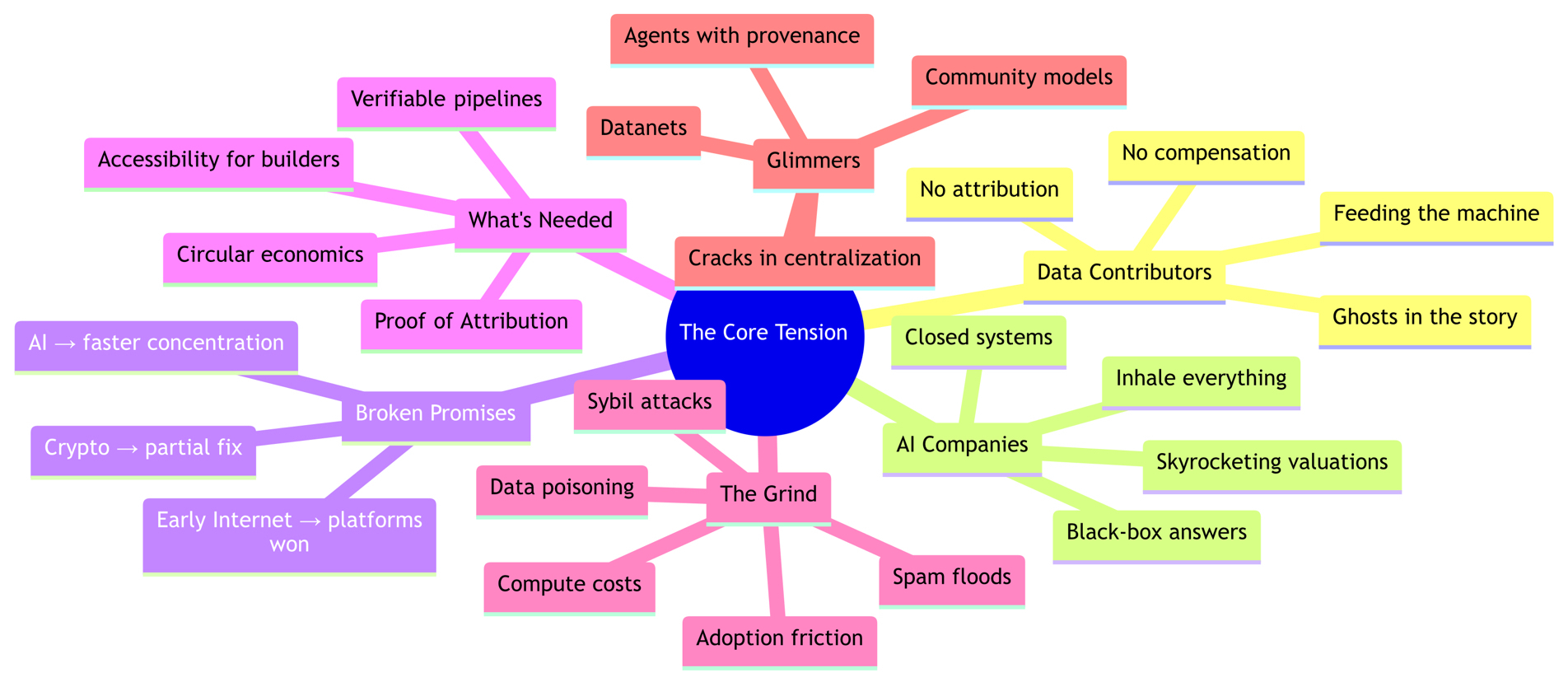
We’ve built these crazy powerful machines that just inhale everything—our random posts at 2 a.m., old photos, forum rants, careful research notes—and then they spit back answers like magic. But the people who actually put that stuff in? They disappear. Poof. No name, no thank you, no slice of anything.
That’s what’s been bugging me for weeks now. You type a question into one of these AI tools, get back something scarily good, and it just hits different when you realize most of that “intelligence” started with regular folks somewhere. Yet those folks are ghosts in the story. The models keep getting sharper by the day. The companies stack valuations that feel unreal. And the rest of us? We keep feeding it our time and data, usually for nothing, then pay up to use the polished version. It doesn’t feel evil or anything dramatic. Just… off. Like we wandered into a deal that looked fair at first but is not holding up.

I don’t know maybe I am overthinking it. But this kind of thing stays with you.
Why it feels bigger than a tech complaint
AI isn’t staying in its lane anymore. It’s sliding into finance trading signals infrastructure planning security checks even how groups make big calls. And the base layer—where the data comes from, who controls it how anyone gets rewarded—still feels mostly locked down run by a few big players and pretty one-sided.
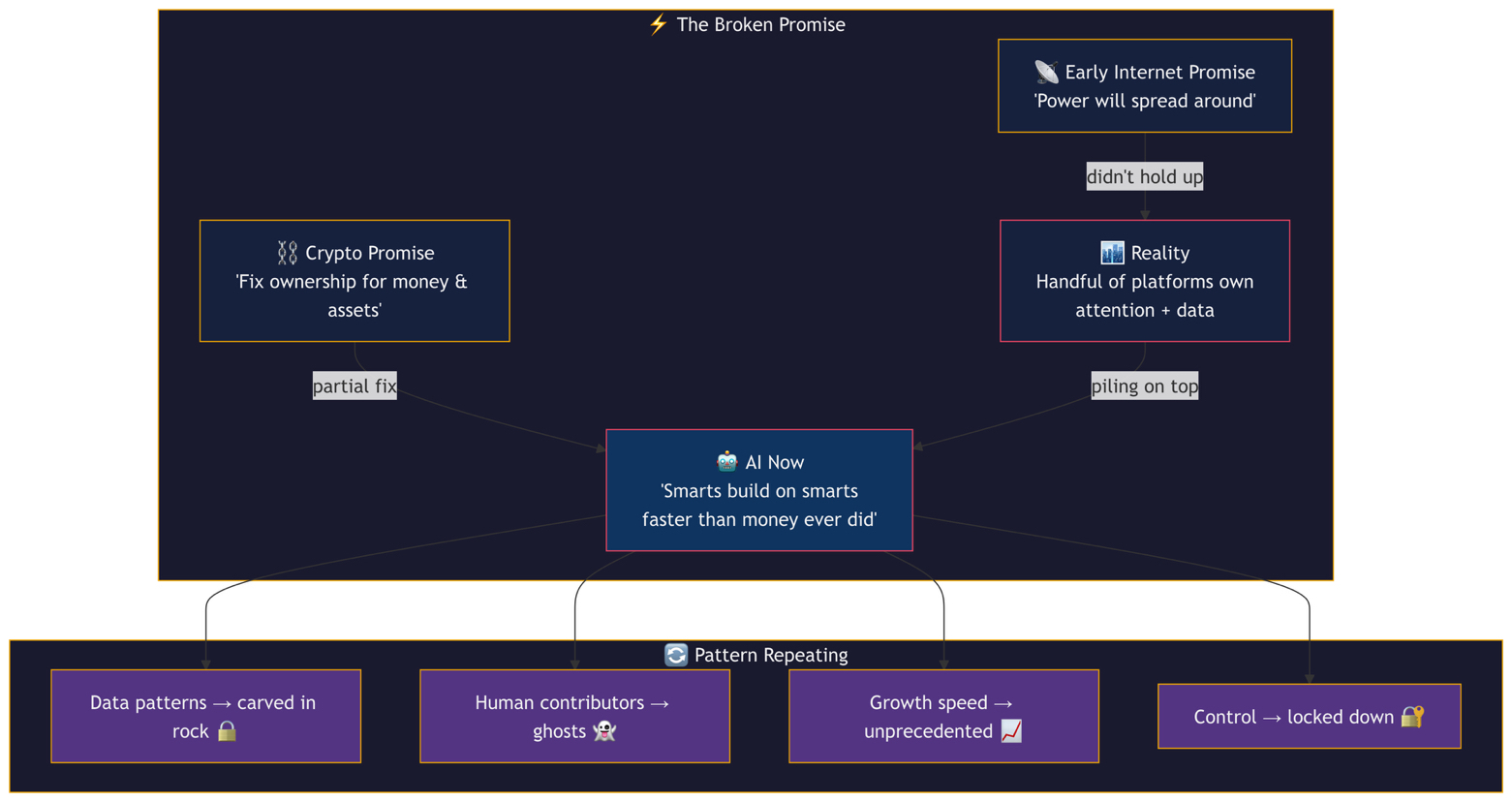
It reminds me of the early internet days. Everyone thought it would spread power around but a handful of platforms ended up owning the attention and the data. Crypto showed up later saying it would fix ownership for money and assets. Now AI is piling on top of all that, and I can’t shake the feeling we’re repeating the pattern, except this time the growth is insane because smarts build on smarts way faster than money ever did.
The system holds onto every data pattern like it’s carved in rock. But the economy? It forgets the actual humans who lived it, typed it, argued over it.
Most of what I see floating around this space is chasing the hot narrative—hype drops, token launches, quick hooks that sound useful. They’re built for speed and attention. Not a lot of teams are down in the weeds sorting the ugly plumbing: how do you actually make data feel ownable and useful without killing privacy, opening the floodgates to spam, or letting sharp operators twist the whole thing?
That contrast keeps popping up for me. Spinning up something new is easy when the story’s exciting. Making it survive real life—people being greedy, lazy, clever at breaking rules, or just bored—that’s where most stuff cracks.
Picturing what decent setup would need
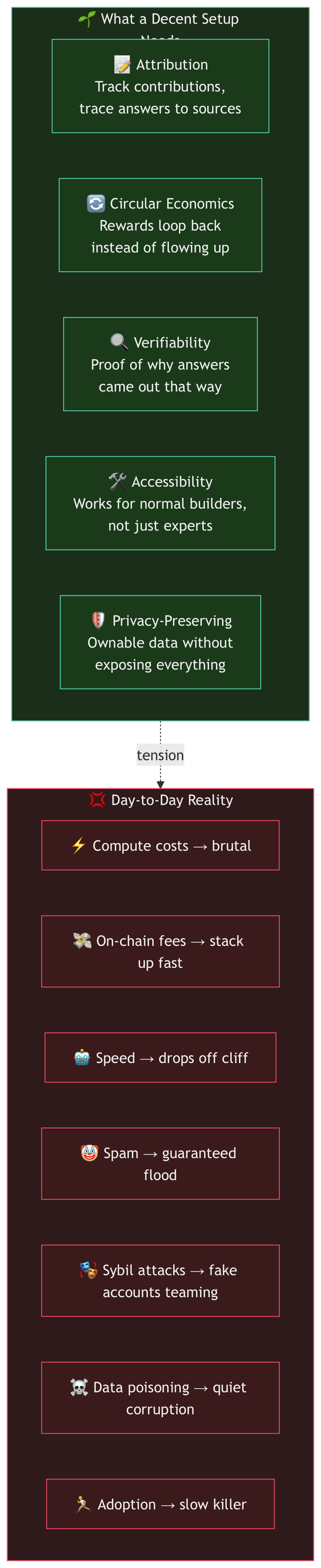
I’ve been chewing on this, trying to imagine infrastructure that doesn’t just copy the old traps. You’d want real ways to track what people add so they actually get something back when it helps a model improve. Some proof that lets you trace why an answer came out a certain way. Money and rewards that loop around instead of all flowing up. And it has to work for normal builders—not some theory that only experts can touch.
But damn, the day-to-day reality is tough. AI needs serious compute. Trying to verify stuff on-chain sounds right until fees stack up and speed drops off a cliff. Spam is basically guaranteed—if rewards are loose, folks will dump junk data just to farm. Manipulation risks feel everywhere: fake accounts teaming up, quiet poisoning of datasets, attribution getting gamed. Then there’s adoption, the slow killer. Why move your decent data onto something newer when the big centralized spots give you instant speed and scale with zero extra hassle?
I’m not convinced anyone has this fully sorted. The execution side feels heavy with risk. Good people are spread thin, liquidity doesn’t just show up, and grabbing attention in the AI-crypto corner is straight competition.
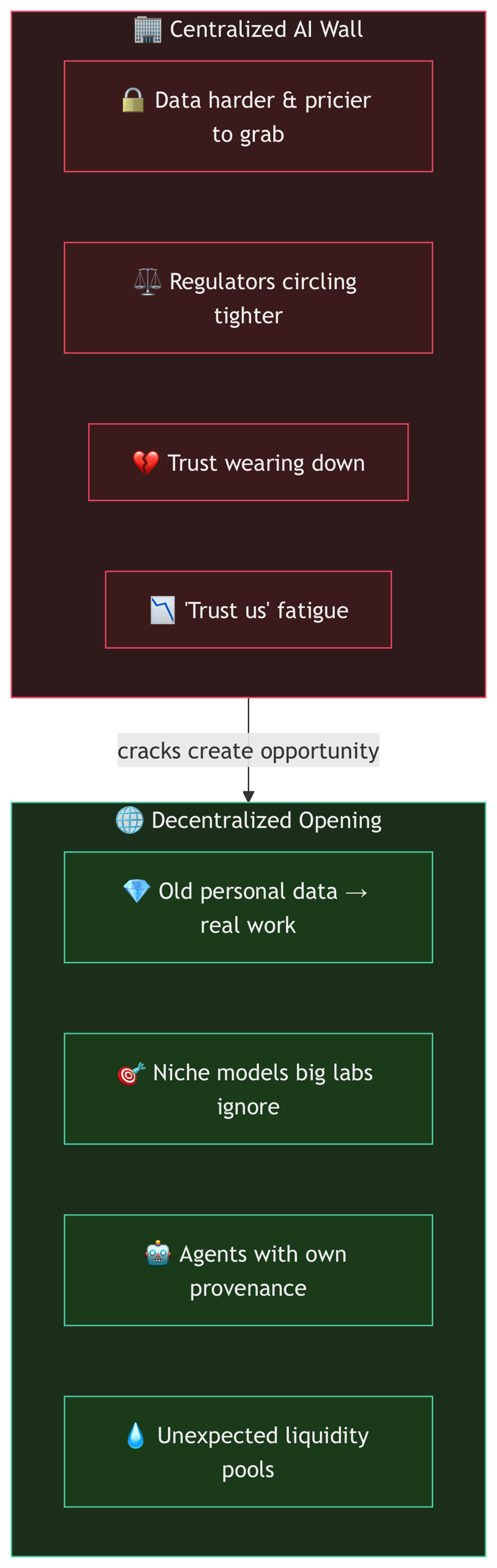
Even so, centralized AI is running into its own walls. Regulators circling tighter, data getting harder and pricier to grab, trust wearing down after too many “trust us” moments. A decentralized try, bumpy as it would be, might open up some unexpected liquidity. Old personal data suddenly doing real work. Models for specific corners that big labs ignore. Agents that carry their own record instead of feeling like rented black boxes.
Something that seems to be grinding on the real questions
There’s one project I’ve been keeping tabs on, not because they’re shouting the loudest or dropping hype every day, but because it looks like they’re actually wrestling with some of these messy pieces instead of skipping past them.
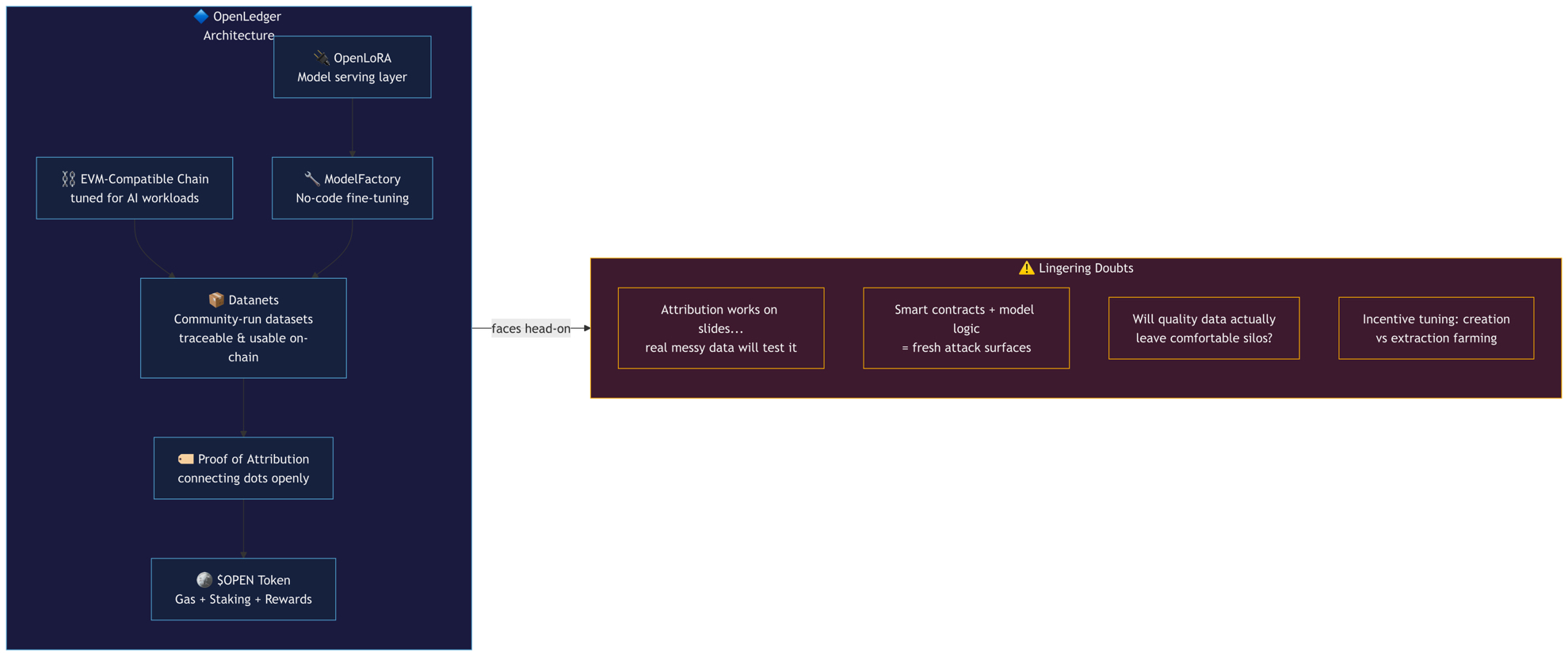
OpenLedger. From poking around, they’re building out an EVM-compatible chain tuned for AI stuff. Main focus is community-run datasets they call Datanets—trying to make data, models, and agents traceable and usable on-chain. They put weight on attribution so contributors don’t just vanish. The token $OPEN covers gas fees, staking for decisions, and spreading rewards when contributions actually matter.
They’ve got practical bits like a no-code ModelFactory so regular people can fine-tune easier, and OpenLoRA for serving models without as much hassle. Proof of Attribution is their way of connecting dots more openly. It’s not claiming it’ll beat the big frontier labs tomorrow; it’s narrower, centered on specialized stuff and community angles. That feels more grounded than the usual “we do it all” pitch.
I’m still sitting with doubts. Attribution works nice in slides, but messy real data and people trying to break it will show the truth. Security keeps me cautious too—smart contracts meeting model logic creates fresh weak spots fast. Will enough solid data actually move over, or does most of it stay comfortable in the old silos? Those aren’t throwaway questions.
What stands out though is a certain care in how they’re going about it. Using Ethereum standards for smoother connecting instead of reinventing the wheel just to look different. Incentives pointed at real input, not just showing up. In a crowd full of buzz, this one feels like it’s facing the compromises head on.
The parts that make me pause
No point pretending it’s smooth sailing. Even decent bones can fail hard in practice. Compute and storage for AI is brutal—lag alone might drive users away quick. If incentives aren’t tuned right, it turns into another short-term farm fest where extraction beats everything. I’ve watched that story too often: clean ideas on paper, then actual humans show up and stretch the seams.
Launching infrastructure that looks sharp is one thing. Keeping it safe, balanced, and kicking when real value and data start flowing is another. Governance drama, sneaky attacks, the usual slow start on getting people to join—they’re all sitting there. Most projects chase fast narrative. Fewer build for the long slow grind that decides if it lasts.
Leaving the door open
I don’t claim to know if OpenLedger nails this or if any single effort does. The AI-crypto mix is still fresh, full of tests that could bloom or just fade quiet. There’ll be changes in direction, some disappointments, probably crashes that leave everyone jaded for a bit.
But that first itch I mentioned hasn’t left. We’re giving over more of our thinking, our market edges, our shared directions to systems we don’t really check or hold. Just accepting tighter concentration feels shaky. Playing with other paths, even rough ones built on clearer incentives and openness, feels like worthwhile unease.
Perhaps it’s not about one winner taking it. It’s slower—the slow shift toward systems that recall intelligence grows from people, their odd habits, their data, their stubborn tinkering. Systems that feed the circle back instead of burning through it.
I’m watching this closely. Putting thoughts down like this helps clear my head. No idea exactly how it plays out. But I stay curious, the real kind, about the ones sticking with the tough, less flashy work over chasing shine.
We’ll see where it heads.
