
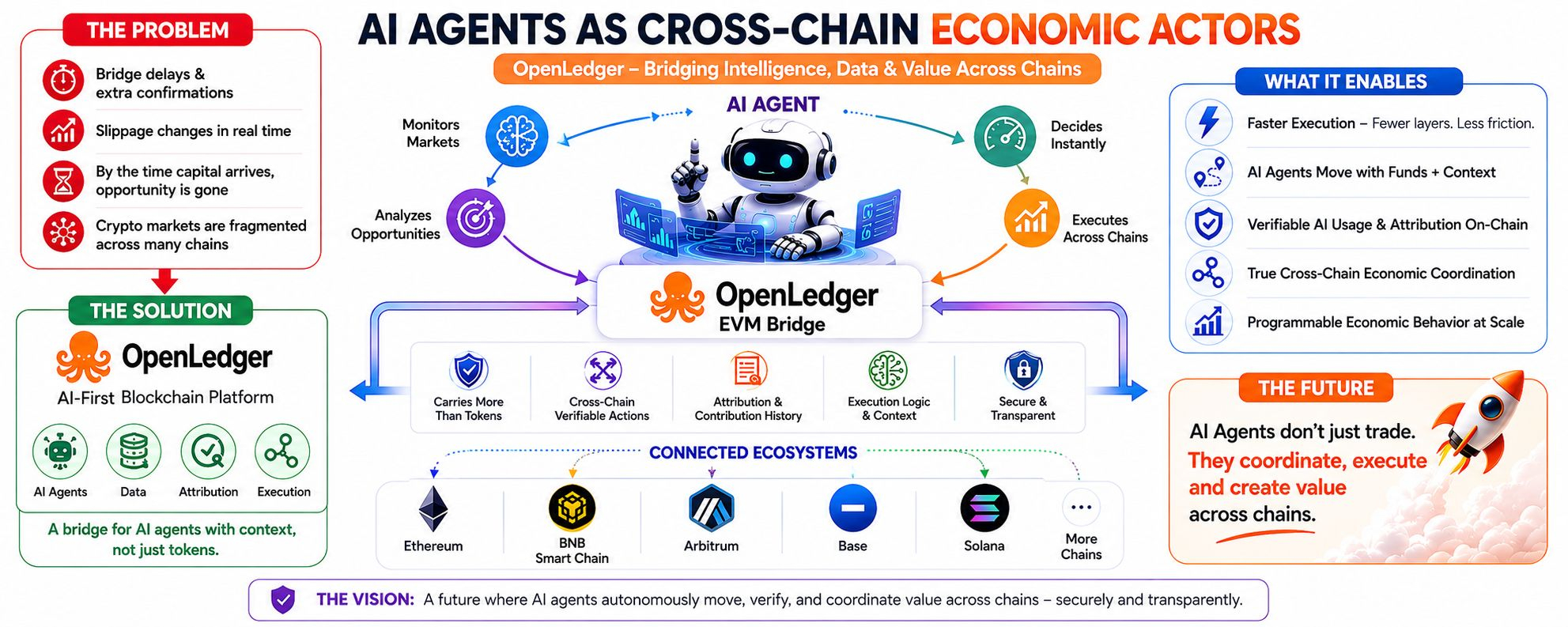
A few nights ago, I had one of my small AI Trading agents chasing rotation between chains during the volatile market move, and I got the hmmmm factor. It was a good sign. It was just right. However, the typical issue came back: Bridge delay. Extra confirmations. Slippage changing in real time. When finally the capital did come, the opportunity had passed.
Truthfully… it was stuck in my brain longer than I'd like to admit.
Not due to a lack of success. Trading without trades is a common occurrence for traders. However, it made me think of something more profound. AI agents are getting more and more intelligent very rapidly, and the infrastructure that supports them is still operating in the name of a slowner internet age. These systems can process markets in a second, respond quicker than humans, and optimise capital automatically, but as soon as they start to cross ecosystems, friction emerges everywhere.
That’s when I began to focus more on OpenLedger.
Opengledger has just launched its EVM Bridge on BNB Smart Chain in February 2026 and by the end of March, the ecosystem was extended to Ethereum connectivity. The bridge was interesting but the interesting part wasn't the bridge. There already are hundreds of crypto bridges. It was the architecture that was really different.
OpenLedger's vision is to become an AI-first blockchain platform. It's marketing, isn't it?...Yes, I thought so as well. After a deeper dive into their whitepaper, and a few experiments with some of the ecosystem tooling, the direction became clear. The network is working to create a space for the collaboration of AI agents, datasets, attribution systems, and execution layers.
Most bridges nowadays work just with tokens. OpenLedger appears to be seeking to do more. It desires AI systems to relocate along with their contextual environment. In simple words, an agent doesn’t just carry funds. It provides cross-chain verifiable actions, contribution history, attribution data, and execution logic.
That changes the ball game.
The crypto market is highly fragmented at the moment. Ethereum remains the leader in liquidity, though. BNB Chain is moving at the lightning speed. The DeFi community loves Arbitrum. Base continues growing. Solana continues to draw retail interest. Each ecosystem has unique opportunities, fees and user behavior. It is possible to adapt manually by human traders. Without some form of cross-chain functionality, AI agents will not be very efficient.
This is where OpenLedger's bridge story comes into play.
I just recently tested a small autonomous workflow with OpenLedger related tooling in combination with cross-chain monitoring strategies. It wasn't some overnight get rich scheme that is impossible to achieve. However, there was a difference in the way things were done. The agent could react quicker to the problem and not having to do too much work. Fewer layers. Less friction. Cleaner execution flow.
People don't think about that as much as they should.
The next wave of crypto is likely to be more than just tokens. It could be a model of economic coordination that is done independently. AI agents are managing liquidity.AI agents are doing liquidity routing. Managing treasuries. Executing hedges. Monitoring volatility. Dynamic exposure adjustment across ecosystems. We're getting closer and closer to what's known as programmable economic behaviour, but it is a gradual shift.
But, I think most people still don't appreciate that change...
This overall trend is also reflected in the direction of OpenLedger's collaboration with AI-driven ecosystems, such as Theoriq, in the first half of 2026. The concept of verifiable use of AI is becoming more and more relevant. Traditional AI systems tend to make decisions within a black box. You don't see the steps to the solution, only the solution. That's where blockchain makes a difference. Execution history becomes audible in a flash. Attribution becomes visible. Economic actions are traceable.
This opens up interesting options for developers. It contributes to traders having to build new layers of infrastructure to watch. It also poses a much larger philosophical question for investors.
So what happens if AI agents cease to function as tools and begin acting more like economic agents?
No, I don't mean a kind of general intelligence that will replace people tomorrow. That's a tall order. Economically autonomous systems are already beginning to emerge in small forms, however. Treasury agents. Yield optimizers. Cross-chain execution bots. Data valuation systems. They already steer liquidity behavior all but indirectly.
There are, however, serious dangers as well.
Infrastructure has been one of the weakest security points in the crypto world ever since inception. Over the years we have witnessed billions of dollars get lost out of the bridge. Ronin. Wormhole. Harmony. The past is very sad. While OpenLedger's protocol-layer design can address some of the security fundamental questions, security guarantees should always be subject to extended time testing over time under liquidity pressure. Infrastructure is always stable before scale.
Hence my cautious approach to watching rather than emotional.
But there's something significant about that evolution. Perhaps because it affects the way we perceive value movement. Interoperability has been “tokens talking to tokens” for years. Intelligence now is beginning to be interoperable as well.
And that's the greater narrative here.
Another meme coin cycle or another ‘temporary hype narrative' is unlikely to be the catalyst for the quiet revolution of the year 2026. It could be infrastructure that makes it possible for autonomous systems to move, make decisions, verify and coordinate economically on chains without constant human approval.
The bridge is not the show-stopper.
The actual headline begins to cross underneath it.
