

OpenLedger is the kind of project I would normally scroll past without giving it too much emotional energy.
I want to know where the system gets tested. I want to know whether the idea survives outside a thread, outside a launch post, outside the first wave of people farming attention around AI. Because crypto is very good at recycling old narratives in new clothes. AI is the latest outfit. The noise is heavy.
But here’s the thing.
OpenLedger is at least pointing at a real problem.
AI has a dirty little issue that people do not like talking about clearly. It runs on data, models, training, prompts, agents, user behavior, and all kinds of invisible contribution. Then the final output appears, and suddenly everyone acts like value came from nowhere.
That is not how value works.
Someone created the data. Someone trained the model. Someone built the tools. Someone supplied the inputs. Someone shaped the result. But in most AI systems, all of that gets flattened into one clean output. No trail. No proper ownership. No clear reward path.
OpenLedger is trying to work on that layer.
Not the shiny part.
The accounting part.
The receipt part.
The part where you ask: who actually added value here, and can the system prove it?
That is why I am still watching it. Carefully. Not emotionally.
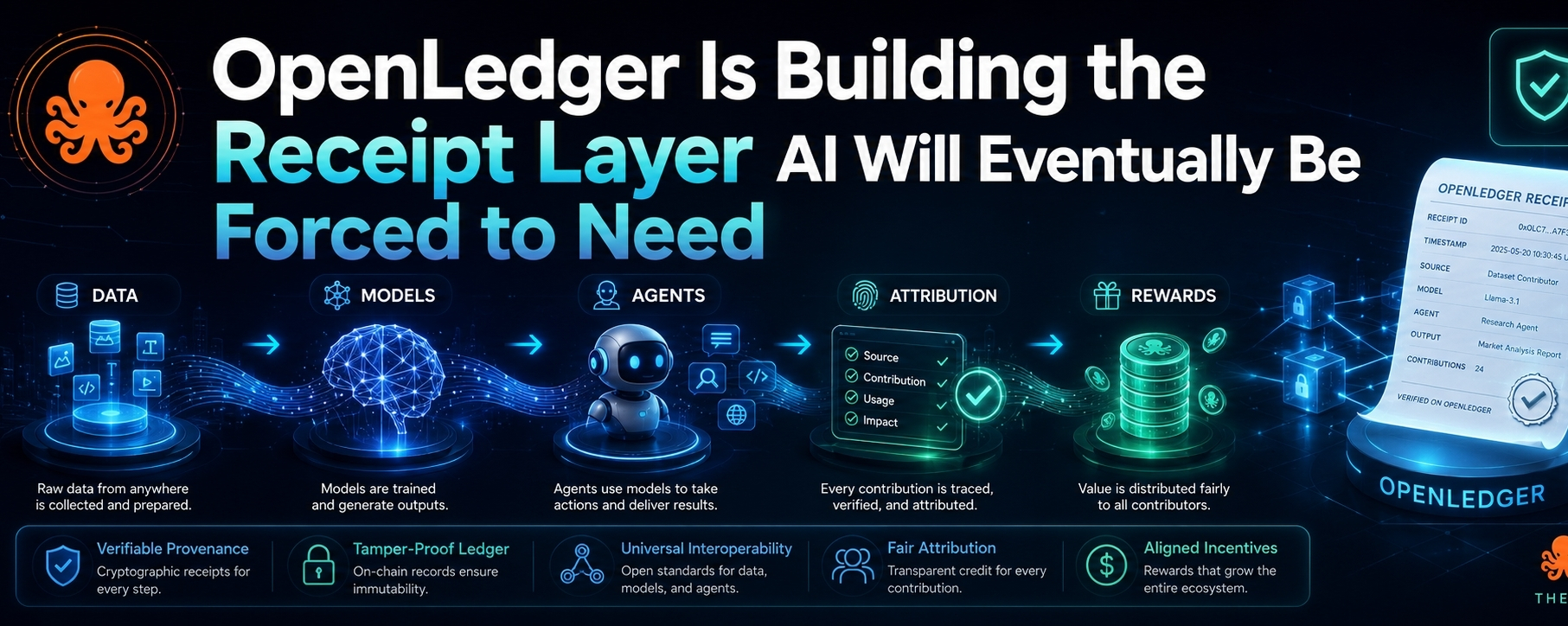
The project is built around data, models, agents, attribution, and rewards. On paper, that sounds almost too neat. Too neat usually makes me suspicious. Crypto projects love neat diagrams because the real world is messy and diagrams are cheap.
Still, the direction makes sense.
AI is not going to stay as a simple chat window forever. It is moving toward agents that can research, execute, automate, and interact with digital systems. Once agents start doing actual work, the question changes. It is no longer just can this agent answer me? It becomes what did it use, where did the data come from, who owns the model behind it, and what happens when that activity creates value?
That is not a small question.
That is the grind OpenLedger is stepping into.
And honestly, it is a hard grind. Maybe too hard. Data attribution is messy. Model ownership is messy. Agent execution is messy. Token incentives make everything even messier. You can build a clean system in theory, but the moment real users, traders, builders, bots, and incentives enter the room, things start bending.
I’m looking for the moment this actually breaks.
That sounds negative, but it is not. That is how I judge infrastructure now. Not by how good it sounds when everything is calm. By where it cracks when usage arrives.
OpenLedger wants to create a structure where data can carry value, models can be monetized, AI agents can do useful work, and contributors are not completely forgotten once the machine starts producing outputs. That is a strong idea. I just do not think strong ideas are enough anymore.
The market is full of strong ideas buried under dead charts.
What makes OpenLedger slightly more interesting is that it is not only talking about AI in a vague way. It is trying to build around the actual economic layer behind AI activity. If an agent uses a model, that should be traceable. If data helps create output, that should not vanish. If someone contributes something useful, there should be a way for value to move back.
Simple to say.
Painful to build.
And that pain is where the real story is.
A lot of AI crypto projects are still selling the dream that intelligence itself is the product. I do not fully buy that anymore. Intelligence gets copied. Interfaces get copied. Hype gets copied fastest of all. The harder part is building systems where usage, ownership, and payment do not collapse into a fog.
OpenLedger seems to understand that.
Its focus on agents is also important, but I would not over-romanticize it. Agents are becoming another noisy word in crypto. Everyone has agents now. Half of them feel like dressed-up bots with nicer branding. The real test is whether these agents can do work that people come back for when there is no campaign, no reward farming, no loud market mood carrying the attention.
That is what I want to see.
Repeat usage.
Builder activity.
Real workflows.
Less theater.
OpenLedger’s agent direction could matter because agents need a base layer. They need access to data, tools, execution, permissions, and records. If they are going to operate in crypto environments, they also need accountability. Nobody serious wants autonomous systems moving through financial rails with zero visibility into how decisions are made.
That is where OpenLedger has a reasonable angle.
Not perfect.
Reasonable.
The data side may be even more important. AI eats data constantly, but most data providers are treated like raw material. Used once, absorbed forever, forgotten quickly. OpenLedger is trying to make data feel more like an asset inside the AI economy. If that works, it could give builders, creators, communities, and researchers a better reason to participate.
But again, I am not handing out trust early.
Crypto has taught me not to.
I want to see whether people use OpenLedger when they are not being pushed to use it. I want to see whether builders actually build on it because it solves a problem, not because it gives them a temporary distribution boost. I want to see whether model activity, agent activity, and data monetization connect into one living system instead of sitting as separate features on a website.
That connection is everything.
Without it, OpenLedger is just another AI infrastructure project with clean positioning.
With it, the project becomes more serious.
The uncomfortable part is that OpenLedger is trying to solve something the market may not fully care about yet. Traders care about price. Communities care about momentum. Builders care about tools. Companies care about reliability. Contributors care about rewards. Getting all of these groups to care about attribution and trackable AI value at the same time is not easy.
It may take longer than people want.
And crypto people do not love waiting.
That is the tension here. OpenLedger is building for a world where AI activity needs records, payments, ownership logic, and accountability. I think that world is coming. I just do not know how fast it becomes valuable on-chain, or how much patience the market gives the project before demanding proof.
The idea is not weak.
The execution window is unforgiving.
If OpenLedger can turn its pieces into a working loop, then it becomes much more interesting. Data enters the system. Models use it. Agents act on it. Usage gets tracked. Rewards move back to contributors. Builders get something useful. Users get automation that does not feel like smoke and mirrors.
That loop would matter.
Until then, I am watching the boring signals. Usage. Retention. Builder behavior. Real agent workflows. Whether contributors actually earn. Whether the ecosystem feels alive after the first wave of attention fades.
Because that is where most projects disappear.
OpenLedger has picked a serious problem. That alone does not make it safe. It just makes it worth keeping on the screen a little longer.