
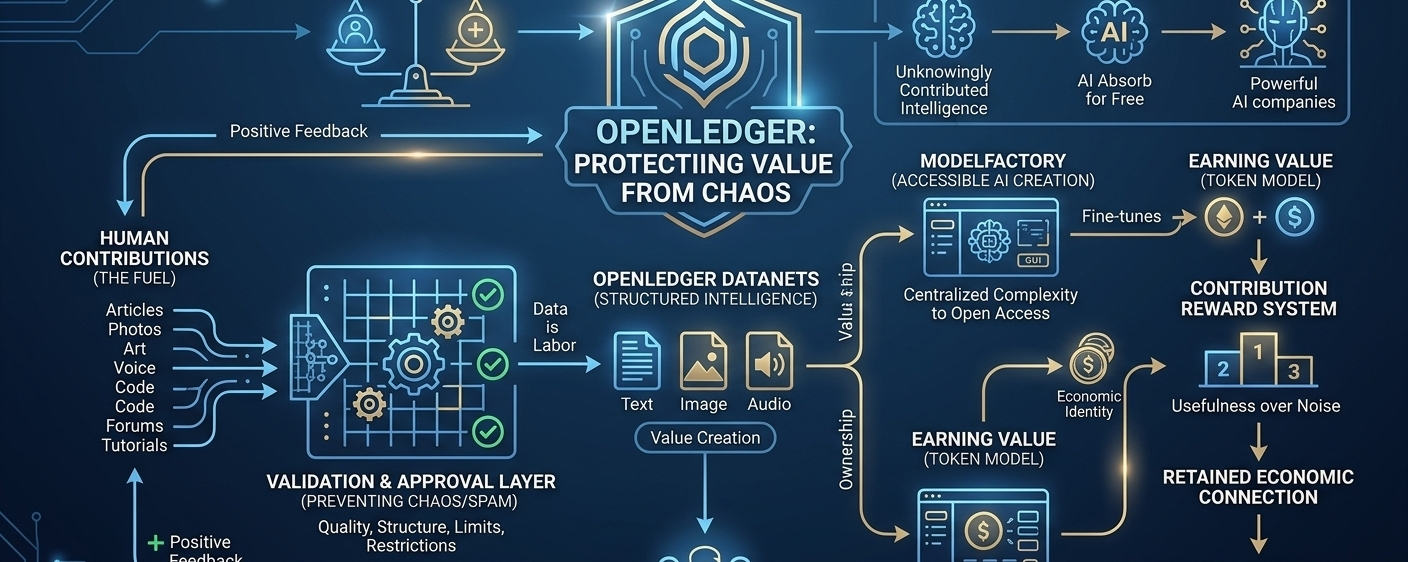

There is something strangely emotional about projects like OpenLedger once you really sit with them long enough.
At first glance it feels cold.
Rules everywhere.
Validation systems.
Limits.
Restrictions.
Upload caps.
Approval layers.
Nothing feels wild or free.
And honestly if you come from the usual Web3 world where everything is open permissionless and chaotic you almost feel uncomfortable looking at it.
You expect freedom.
Instead you see structure.
But the deeper you go the more you realize something important.
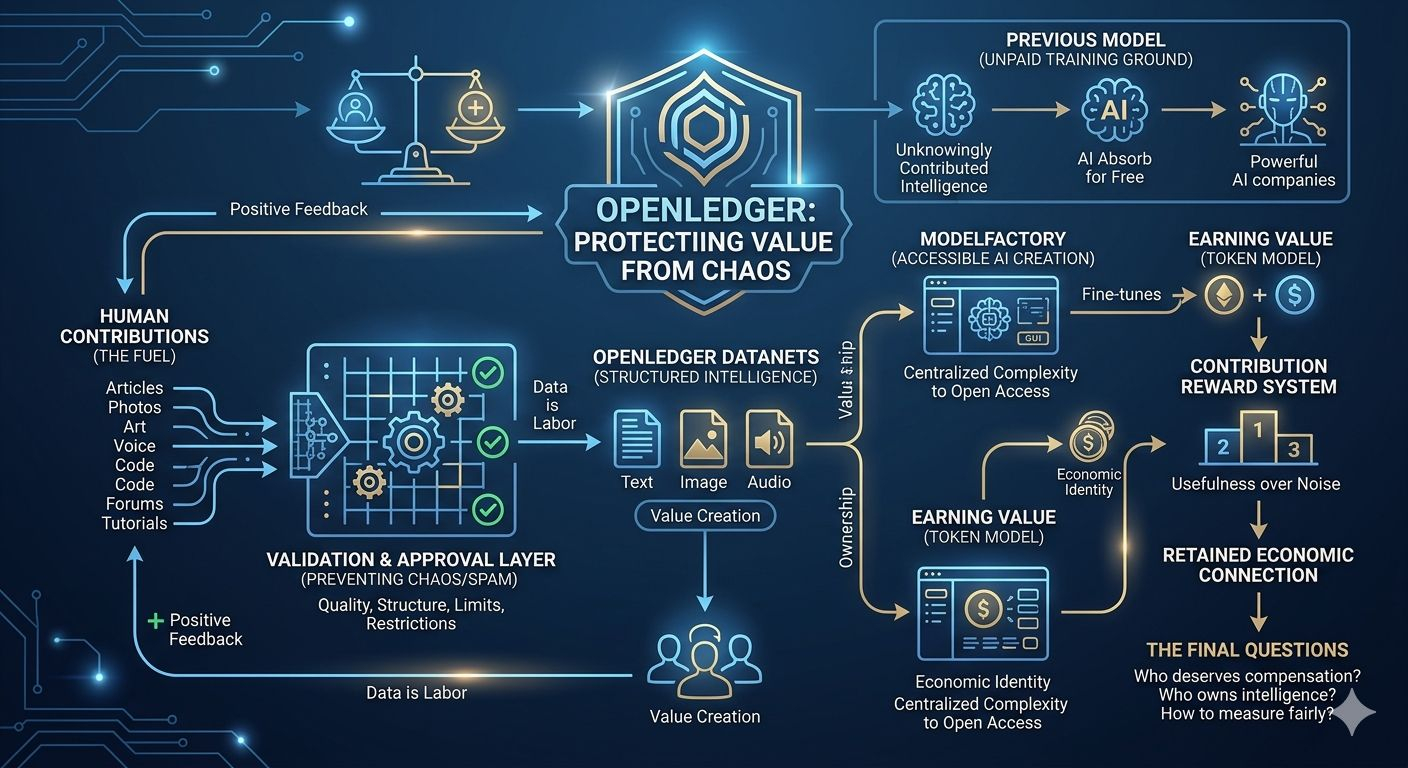
OpenLedger is not trying to kill chaos.
It is trying to protect value from chaos.
And somehow that changes the entire feeling of the project.
Because beneath all the AI language blockchain systems and token mechanics there is actually a very human question hiding underneath everything.
Who deserves value in the age of AI
That is the real story here.
Not hype.
Not farming.
Not trends.
But value.
Because for years the internet has been feeding artificial intelligence for free.
People wrote articles.
Uploaded photos.
Shared ideas.
Answered questions.
Posted tutorials.
Created art.
Recorded voices.
Spent years building knowledge online.
And slowly AI systems absorbed all of it.
Quietly.
Silently.
Without most people even realizing what was happening.
Human knowledge became fuel.
And the people creating that fuel usually received nothing back.
That is the uncomfortable truth sitting underneath the entire AI industry right now.
And honestly OpenLedger feels like one of the first projects seriously trying to confront that reality.
Not emotionally.
Not politically.
But structurally.
Almost like it is asking
What if data should belong to the people who create it
What if contribution should actually mean ownership
What if intelligence itself becomes an economy
And suddenly OpenLedger stops looking like another AI crypto project.
It starts feeling like an experiment about the future itself.
THE INTERNET CREATED AI
BUT NEVER GOT PAID FOR IT
This is probably the hardest part to ignore once you think about it deeply.
Every AI system today exists because humans spent decades filling the internet with knowledge.
Everything became training material.
Books.
Forums.
Images.
Blogs.
Code.
Videos.
Conversations.
Opinions.
Corrections.
Memories.
Experiences.
The internet became one giant unpaid training ground for machine intelligence.
And the strange part is most people still do not fully realize it.
AI companies became powerful because millions of ordinary people unknowingly contributed intelligence every single day.
That imbalance is exactly where OpenLedger enters the conversation.
Because the project is built around one radical idea.
Data should not only be consumed.
It should be earned from.
And honestly that idea feels small at first until you realize how massive the consequences could become if the world starts moving in that direction.
OPENLEDGER FEELS DIFFERENT FOR ONE REASON
Most AI projects today focus on outputs.
Faster models.
Bigger models.
Smarter models.
Better conversations.
More automation.
OpenLedger focuses on something earlier in the chain.
Contribution.
And that changes everything.
The ecosystem is designed around the belief that intelligence has origins.
That AI knowledge comes from somewhere.
And if it comes from somewhere maybe the people contributing that value should not disappear from the equation entirely.
This is where their whole concept of Datanets starts becoming interesting.
DATANETS ARE NOT JUST DATA STORAGE
When people first hear the word Datanets they usually think it is just another fancy name for datasets.
But honestly it feels deeper than that.
Datanets are OpenLedger’s attempt to organize human contribution before it disappears into AI systems forever.
Text stays structured.
Images stay categorized.
Audio stays separated.
Validation matters.
Quality matters.
Acceptance matters.
And yes there are restrictions.
A lot of them.
At first it almost feels annoying.
Why limit uploads
Why validate contribution
Why create barriers
But then you realize something uncomfortable.
Without structure every reward system eventually turns into noise.
That happens everywhere online.
The moment incentives appear people stop optimizing for value and start optimizing for rewards.
Spam grows.
Garbage spreads.
Quantity replaces quality.
Signal disappears.
And slowly trust dies.
OpenLedger seems deeply aware of this danger.
That is why the ecosystem feels disciplined.
Not because it hates openness.
But because it understands that unlimited openness without filtering usually destroys itself over time.
THE LEADERBOARD SYSTEM SAYS SOMETHING IMPORTANT ABOUT HUMAN NATURE
This part honestly feels smarter the longer you think about it.
Most internet systems reward activity.
Post more.
Upload more.
Engage more.
Generate more attention.
But OpenLedger quietly changes the psychology behind contribution.
Acceptance rate matters more than raw volume.
That changes behavior immediately.
You cannot simply flood the system hoping to climb higher.
The ecosystem cares whether your contribution actually helps.
And honestly there is something emotionally refreshing about that.
Because for once the system is trying to reward usefulness instead of noise.
That feels rare online now.
Especially in an era where algorithms constantly reward outrage speed and attention over depth or meaning.
THE MOST HUMAN PART OF THE SYSTEM
One tiny detail says a lot about the philosophy behind OpenLedger.
Rejected contributions do not automatically destroy your reputation.
That sounds small.
But psychologically it matters.
Because fear destroys experimentation.
If every mistake punished contributors harshly people would stop trying new things.
OpenLedger seems to understand that progress requires room for failure.
That is a surprisingly human design choice.
The system filters quality without turning experimentation into fear.
And honestly many ecosystems never figure out how to balance those two things.
MODELFACTORY IS WHERE THE PROJECT STOPS FEELING SMALL
This is the point where OpenLedger suddenly feels far more ambitious than people first assume.
Because now the conversation is no longer only about data.
Now it becomes about who gets to build AI itself.
And right now the truth is simple.
Most people still cannot.
AI development feels intimidating.
Terminals.
Code.
GPU setups.
Configuration files.
Frameworks.
Dependencies.
Errors.
Most people see that world and instantly feel locked out.
OpenLedger is trying to soften that barrier.
Not by removing complexity entirely.
But by making interaction more human.
Visual workflows.
Adjustable training systems.
GUI based fine tuning.
Interactive refinement.
The deeper idea here is not convenience.
It is access.
Because the future of AI changes dramatically depending on whether intelligence creation stays centralized or becomes more open.
And OpenLedger clearly wants more people inside the room.
THERE IS SOMETHING QUIETLY POWERFUL ABOUT THE TOKEN MODEL
Most crypto tokens feel disconnected from reality.
Speculation first.
Purpose second.
But OpenLedger is trying to connect value directly to contribution and usage.
And honestly this is where the emotional layer becomes impossible to ignore.
Imagine contributing meaningful knowledge to an AI system and actually retaining economic connection to the intelligence created from it.
That changes the relationship between humans and technology completely.
Suddenly data is not disposable anymore.
It becomes labor.
It becomes ownership.
It becomes economic identity.
And maybe that sounds dramatic now.
But the deeper AI integrates into society the more these questions will matter.
Who owns intelligence
Who deserves compensation
Who receives value
Who gets erased
OpenLedger is trying to answer those questions before the rest of the world fully catches up to them.
THE BIGGEST TENSION INSIDE OPENLEDGER
This is probably the most fascinating part of the entire project.
OpenLedger stands directly between two opposite worlds.
Freedom and control.
Openness and structure.
Chaos and order.
Too much openness creates spam.
Too much control kills participation.
Too much freedom destroys trust.
Too much filtering destroys creativity.
Most systems eventually collapse to one side.
OpenLedger is trying to hold both together at the same time.
And honestly that balancing act may decide whether the project succeeds or fails long term.
Because maintaining healthy structure without becoming overly restrictive is one of the hardest problems in digital ecosystems.
THE HARDEST QUESTION OF ALL
There is one question sitting quietly underneath the entire OpenLedger experiment.
Can human contribution inside AI ever truly be measured fairly
That problem is incredibly difficult.
AI systems do not learn in clean straight lines.
Knowledge blends together.
Patterns overlap.
Influence becomes abstract.
So proving attribution inside intelligence systems may become one of the hardest technical and philosophical problems of this generation.
But OpenLedger is still trying.
And honestly there is something admirable about attempting difficult problems instead of chasing easier hype.
WHY THIS PROJECT FEELS IMPORTANT
Not because it guarantees success.
Not because it has all the answers.
And not because every part of the model is already proven.
It feels important because it is asking questions most of the AI industry still avoids.
Questions about ownership.
Questions about fairness.
Questions about contribution.
Questions about invisible labor.
Questions about whether human knowledge should continue flowing into machines without recognition forever.
And maybe that is why OpenLedger feels different emotionally.
Because underneath all the systems and mechanics it is ultimately about people.
People whose knowledge built the internet.
People whose contributions shaped AI.
People who were never part of the value equation.
Until now maybe.
FINAL THOUGHTS
OpenLedger is not loud.
It is not trying to dominate headlines every day.
It almost feels strangely quiet compared to most crypto AI projects.
But sometimes the quiet projects are the ones asking the deepest questions.
And the deepest question here is simple.
If AI becomes one of the most valuable industries in human history then what happens to the humans whose knowledge created it
Maybe OpenLedger succeeds.
Maybe it struggles.
Maybe the entire model evolves into something completely different years from now.
But one thing already feels undeniable.
The future AI economy will eventually collide with questions about ownership attribution transparency and human value.
And OpenLedger is already standing in the middle of that collision trying to build structure before the chaos fully arrives.
