
The more time I spend exploring AI infrastructure projects, the more I notice how many of them focus only on hype instead of usability. Almost every platform claims to be building the future of decentralized AI, but very few actually explain how developers, creators, or businesses are supposed to use these systems in practical ways. That’s one reason why OpenLedger has genuinely caught my attention lately.
What makes OpenLedger interesting to me is that it doesn’t feel like a project trying to force AI into a complicated ecosystem just for the sake of sounding advanced. Instead, the entire approach seems focused on making AI deployment, customization, and scalability easier for real users. The ecosystem feels designed around utility rather than marketing language.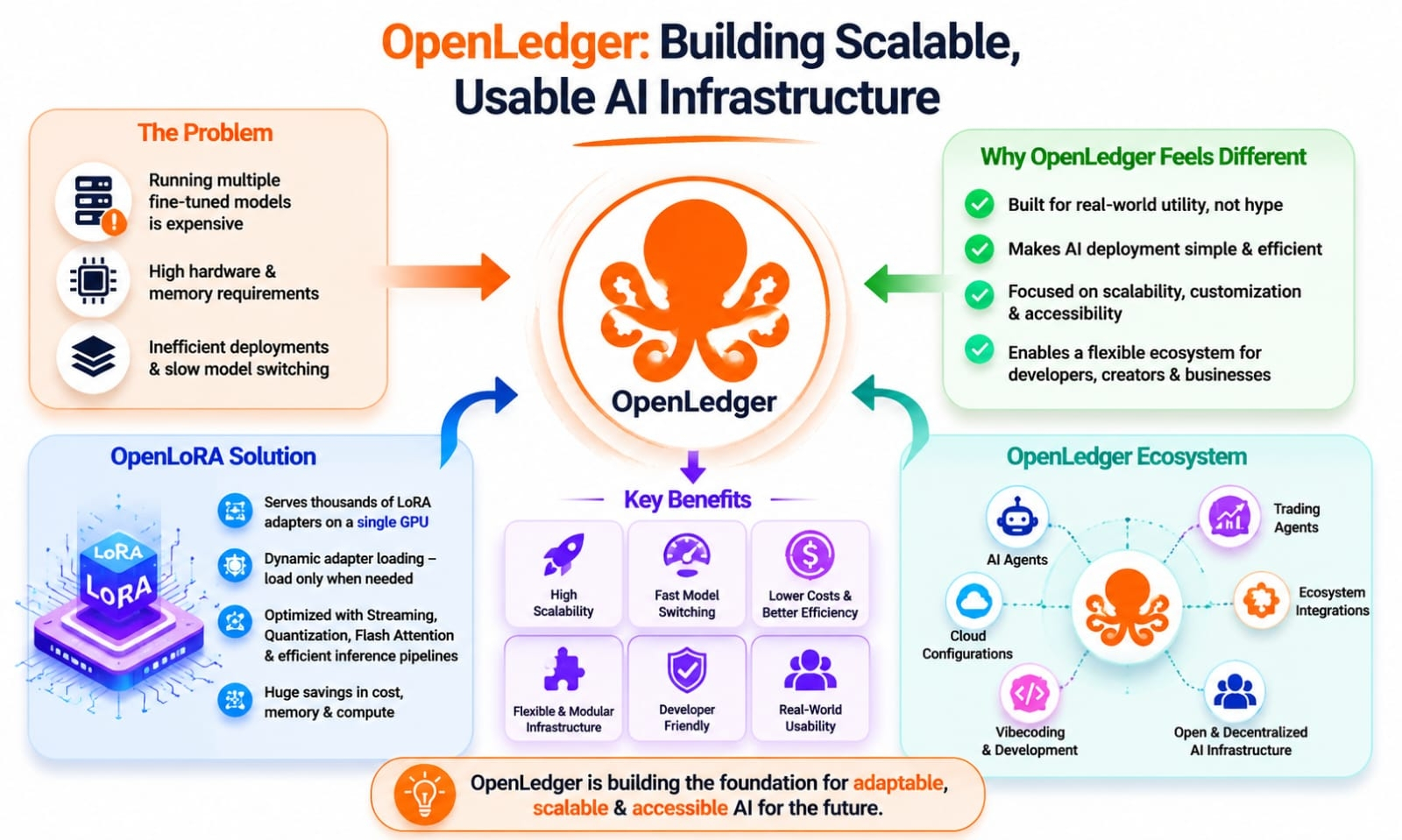
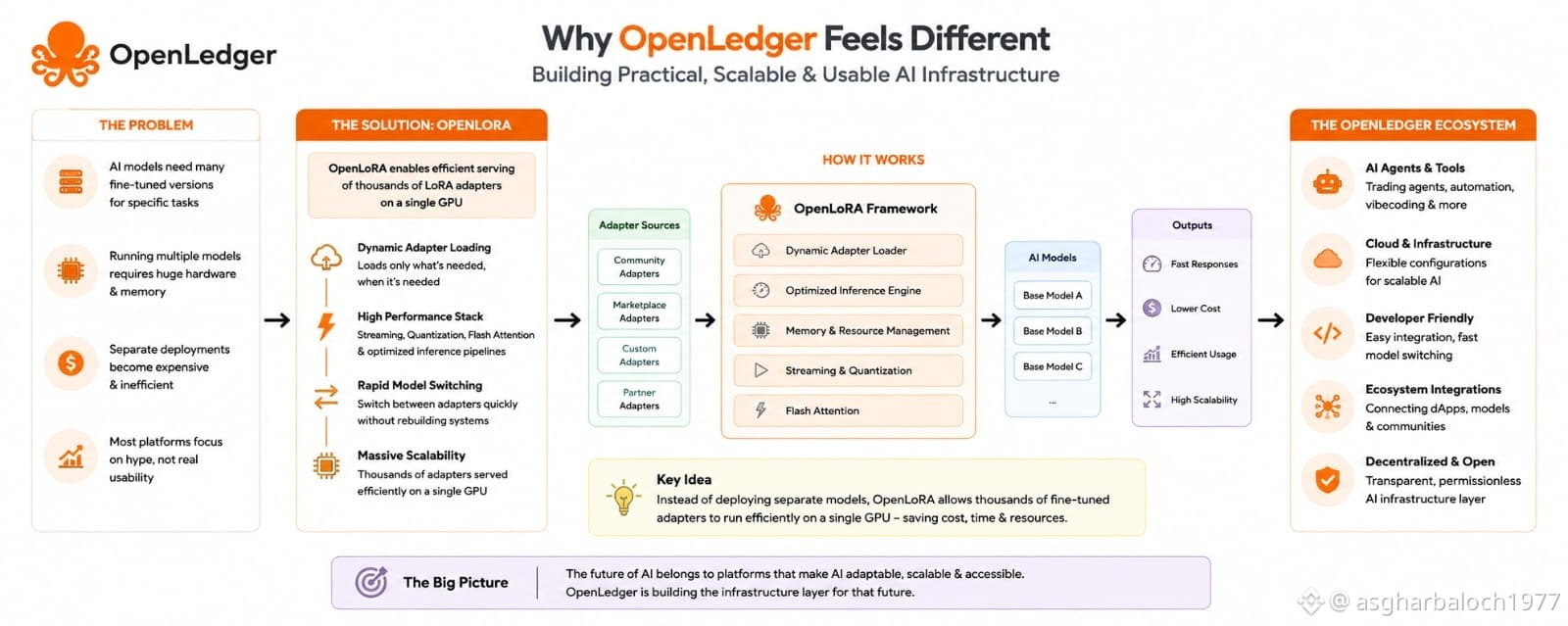
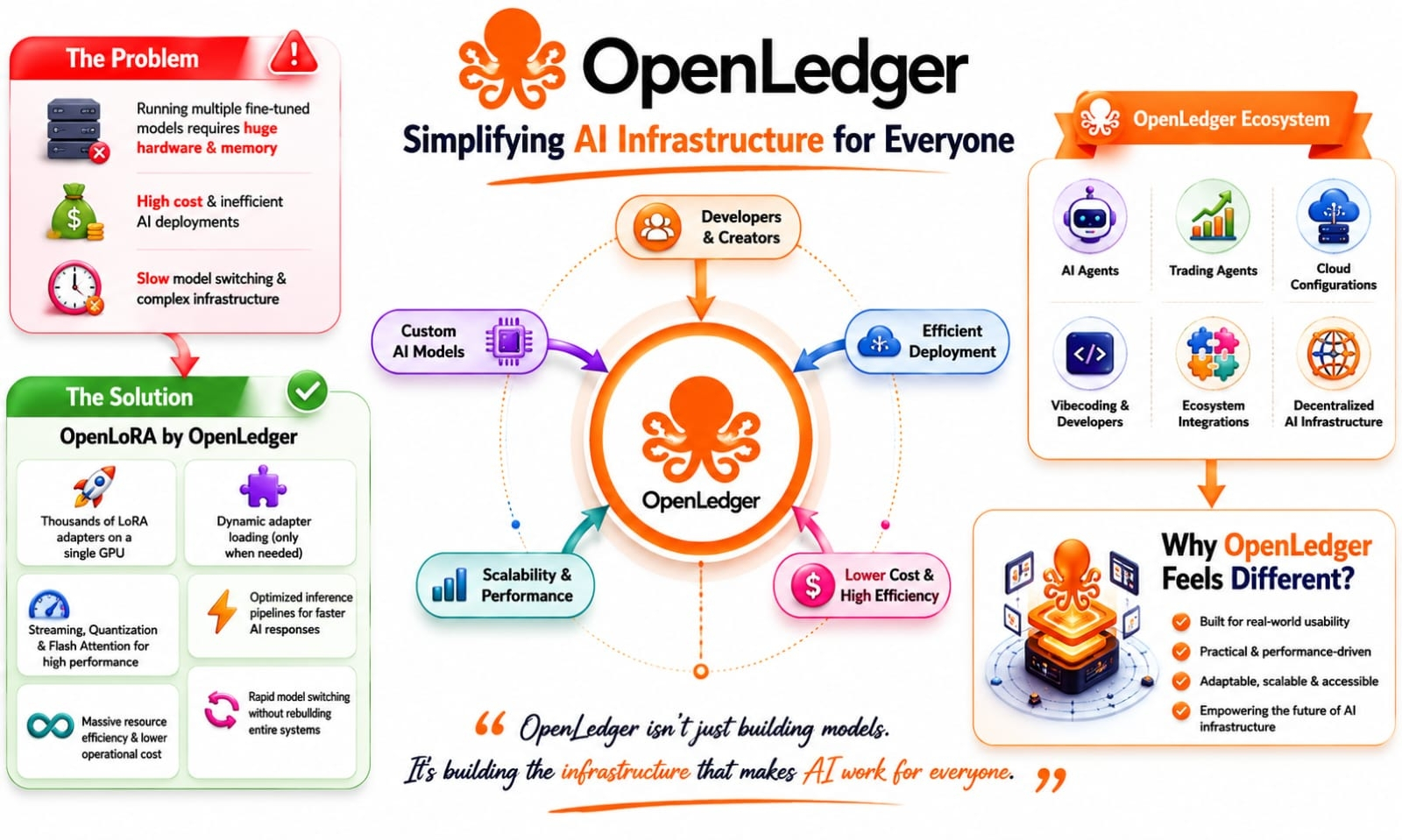
One part of the project that stood out to me was OpenLoRA. I think this is one of the most practical ideas within the OpenLedger ecosystem because it addresses a real problem in modern AI infrastructure. As AI models continue evolving, developers constantly need different fine-tuned versions for specific tasks. The issue is that running multiple customized models usually requires large amounts of hardware and memory, which becomes expensive and inefficient very quickly.
OpenLoRA approaches this challenge in a much smarter way.
Instead of forcing separate deployments for every fine tuned model, the framework allows thousands of LoRA adapters to be served efficiently on a single GPU. That alone changes how scalable AI systems can become. The dynamic adapter loading system is especially impressive because it enables models to load only when needed rather than keeping everything active in memory all the time. From a technical perspective, that creates major improvements in resource efficiency and operational cost.
What I personally appreciate is that the design feels practical instead of theoretical. OpenLoRA isn’t just another AI concept paper. The framework is built around real-world performance optimization. Features like streaming, quantization, flash attention, and optimized inference pipelines all contribute to making AI responses faster and more efficient without creating unnecessary infrastructure overhead.
Another thing I find important is the flexibility of the ecosystem. Developers can pull adapters from different sources and switch between models rapidly without rebuilding entire systems. That may sound like a small feature at first, but in real AI workflows, fast model switching can save huge amounts of time and computational expense.
Beyond OpenLoRA itself, OpenLedger also appears to be building a broader environment where AI agents and tools can interact more naturally. Whether it’s trading agents, cloud configurations, vibecoding experiments, or ecosystem integrations, the overall direction feels focused on creating a usable AI infrastructure layer rather than a closed platform.
I think that matters a lot right now because the AI space is becoming crowded with isolated systems. Many projects are building powerful models, but fewer are building ecosystems that make those models easy to deploy, scale, and customize. OpenLedger seems to understand that infrastructure usability could become just as important as model performance in the long run.
The biggest reason I keep paying attention to OpenLedger is because the project feels aligned with where AI is actually heading. The future probably won’t belong only to the companies with the largest models. It will belong to the platforms that make AI adaptable, scalable, and accessible across different workflows and industries.
From my perspective, OpenLedger is positioning itself in that direction very early. And if the ecosystem continues developing at this pace, I think OpenLoRA could become one of the more important infrastructure components for scalable AI deployment in the decentralized ecosystem.