
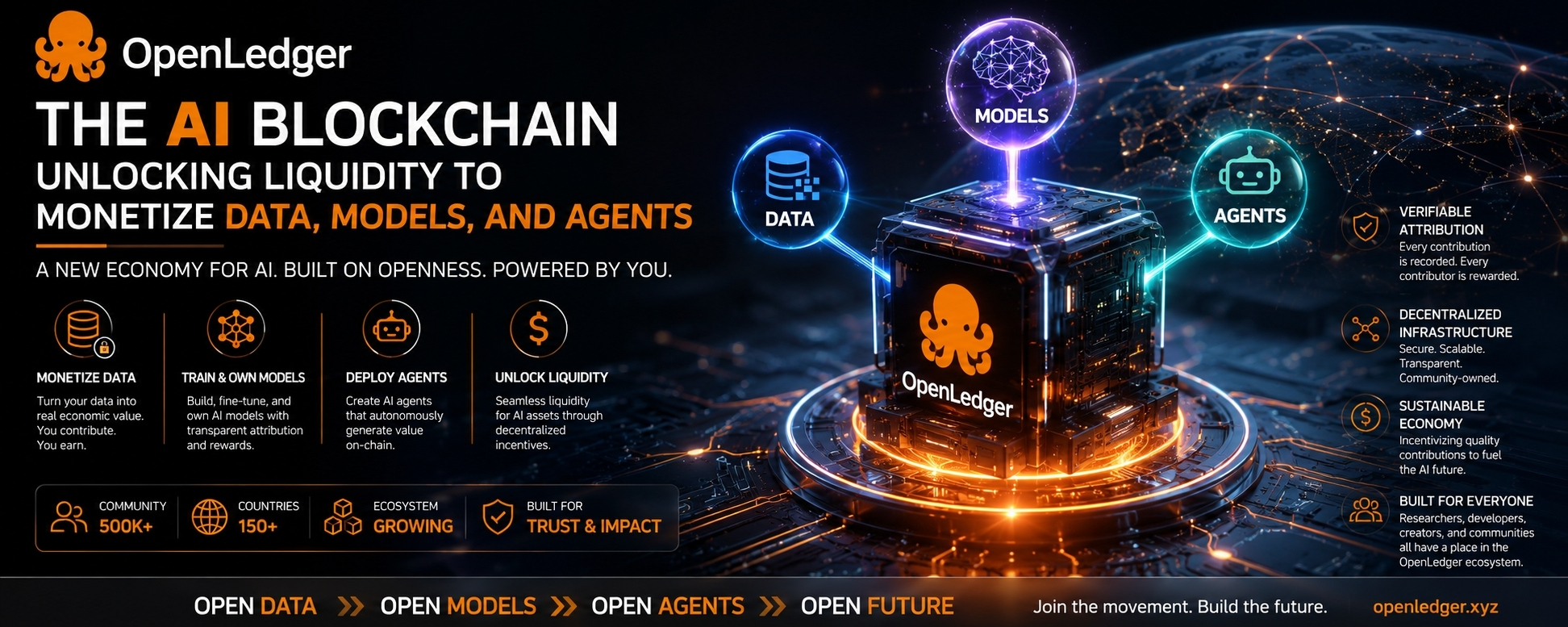
OpenLedger feels like one of those ideas that makes more sense the longer you sit with it.
At first glance, it sounds technical — an AI blockchain, a place to monetize data, models, and agents, a system for unlocking liquidity. But underneath that language is a much more human question: who actually gets credit when intelligence is built from the work of many people?
That is the part OpenLedger seems to care about. Not just making AI bigger, but making it traceable. Not just faster, but more accountable. In a world where models often feel like they appear out of nowhere, OpenLedger is trying to put the story back into the system. It wants AI to remember where it learned from, who helped shape it, and how value should flow back to the people and communities that made it possible.
That idea hits a nerve because the AI boom has been full of invisible labor. Datasets are cleaned, refined, labeled, filtered, improved, and then absorbed into systems that rarely say thank you. A model may look like a single polished product, but in reality it is usually the result of hundreds of small contributions stitched together over time. OpenLedger is trying to make that hidden layer visible. It is saying that data should not just be fuel burned behind the scenes. It should have a trail. A history. A place to live in the economy.
That is why the project stands out. It is not treating AI like magic. It is treating AI like infrastructure. The kind of infrastructure that needs records, rules, ownership, and receipts.
There is something almost poetic about that. Modern AI has been built on scale — more data, more compute, more parameters, more speed. The industry got very good at teaching machines to predict and generate. What it never fully solved was ownership of the value underneath all that intelligence. OpenLedger steps into that gap and asks a simple but important question: if data and models are creating real economic value, why should the trail disappear the moment the output is produced?
That question opens the door to a bigger social shift. Right now, a lot of AI value gets concentrated at the top, inside a few platforms and companies. The people who clean the data, build the niche datasets, contribute domain knowledge, and improve the model’s usefulness often remain unseen. OpenLedger imagines a different setup, one where those contributions can be recognized instead of erased. In that world, people are not just inputs. They are participants.
That is a strong idea, and it has real appeal. But it is also where the hard part begins.
Because once you try to reward contribution, everything gets complicated. Who counts as a contributor? How do you measure influence? What happens when data is duplicated, reused, synthetic, private, or controversial? How do you stop the system from rewarding the loudest participants instead of the most useful ones? And how do you keep attribution from becoming another layer of bureaucracy? These are not small questions. They are the kind that decide whether an idea becomes durable or collapses under its own weight.
Still, the need for something like OpenLedger is easy to understand. AI is moving into a phase where trust matters just as much as performance. People want to know where outputs came from. Businesses want to know whether they can audit the systems they rely on. Builders want infrastructure that does not trap all value in one closed ecosystem. Users want transparency without having to become experts in machine learning just to figure out whether a model is trustworthy.
That is where OpenLedger’s vision starts to feel relevant. It is trying to give AI something it has always lacked: memory about its own origins. Not just a result, but a record. Not just intelligence, but accountability.
And that may be the real shift here. For a long time, the dream in tech was to make systems smarter. But intelligence alone is not enough anymore. A system can be impressive and still be opaque. It can be useful and still be unfair. It can be powerful and still leave everyone guessing. OpenLedger seems to be betting that the next phase of AI will not be won by the most fluent model, but by the most traceable one.
That is a meaningful bet, because the future of AI will not be decided only by who can train the biggest model. It will also be decided by who can build the clearest record of how that model came to be, who it relied on, and who benefits when it works.
That is what gives OpenLedger its edge as an idea. It is not just selling innovation. It is trying to restore a sense of responsibility to a field that often moves too fast to notice what it leaves behind.
And maybe that is why it sticks. Because beneath all the blockchain language and AI ambition, it is really asking something very old and very human: if many hands helped make this, should not many hands share in the value?
