
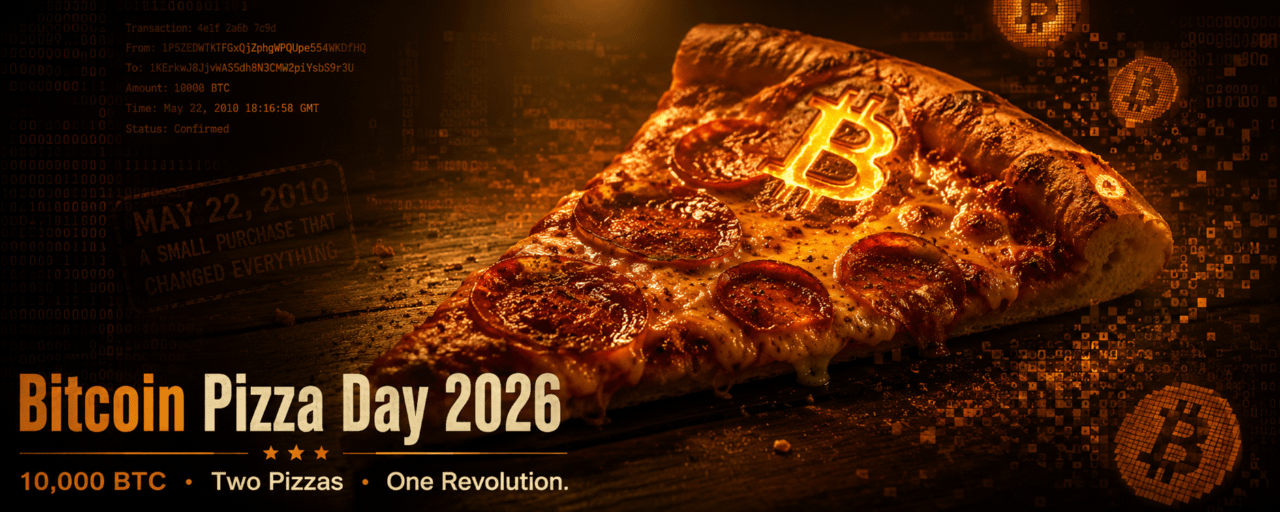

Bitcoin Pizza Day 2026: The $800 Million Pizza That Changed Everything
Every May 22, the crypto world pauses to celebrate what might be the most expensive meal in human history. But Bitcoin Pizza Day is far more than a meme about bad financial decisions — it's the origin story of an entirely new financial system.
The Night It All Started
Picture this: May 18, 2010. A Florida-based programmer named Laszlo Hanyecz opens the Bitcointalk forum and posts a simple offer.
"I'll pay 10,000 bitcoins for a couple of pizzas... like maybe 2 large ones so I have some left over for the next day."
Four days later, a 19-year-old student named Jeremy Sturdivant — going by the username "jercos" — accepted the deal. He ordered two Papa John's pizzas, had them delivered to Hanyecz's home in Jacksonville, Florida, and received 10,000 BTC in return.
The total bill in fiat? About $41.
At today's Bitcoin price hovering near $77,000, those same 10,000 BTC are worth approximately $772 million — making it the most expensive food purchase in modern financial history.
But here's the thing: Laszlo Hanyecz has never once said he regrets it.
Why This Transaction Actually Mattered
The knee-jerk reaction is to laugh at the math. And yes, the numbers are staggering — $772 million for two pizzas is the kind of figure that makes even seasoned investors do a double-take. Every May 22, this exact stack of 10,000 BTC gets repriced at the day's spot price, giving the crypto world its cleanest annual benchmark.
But obsessing over the "what if he'd held" narrative misses the entire point.
In May 2010, Bitcoin had no established market price. There were no exchanges, no payment processors, no institutional rails, no liquidity of any kind. Bitcoin was a white paper turned into software, running on personal computers, used by a small community of cryptography enthusiasts who largely traded it for free or in tiny amounts among themselves.
What Hanyecz did was prove that Bitcoin could function as money.
He wasn't naive. As one of the most technically sophisticated early Bitcoin developers, Hanyecz understood the fixed supply schedule, the halving mechanism, and the deflationary trajectory built into Bitcoin's code. He had personally mined a significant fraction of all coins in circulation at the time. He knew exactly what he was trading. He did it anyway — because he understood that an asset nobody will spend has no value at all.
By exchanging Bitcoin for a physical commodity through a voluntary transaction, Hanyecz performed what economists call a "price discovery event." He created a subjective value bridge. He proved Bitcoin could fulfill the fundamental economic requirement of a medium of exchange — and without that proof of utility, the subsequent "store of value" narrative that underpins Bitcoin's entire multi-trillion dollar market cap might never have taken root.
As Hanyecz himself later reflected: the trade made Bitcoin feel tangible.
The Man on the Other Side of the Trade
Everyone remembers Laszlo. Far fewer remember Jeremy Sturdivant — the 19-year-old who received 10,000 BTC for ordering pizzas.
In a 2026 reflection shared by Bitcoin Magazine, Sturdivant admitted: "I had no idea how huge it would become."
He reportedly spent most of the BTC relatively quickly, which means he too "missed" the full appreciation. But that's somewhat beside the point. Sturdivant's willingness to take Bitcoin as payment — to trust it enough to do business with it — was the other half of the equation. Every transaction requires two parties. Both Hanyecz and Sturdivant made Bitcoin Pizza Day possible.
Hanyecz Did It Again — Eight Years Later
Here's a detail that most Pizza Day retrospectives skip over, but it perfectly illustrates Bitcoin's technical evolution.
On February 25, 2018, nearly eight years to the week after the original order, Laszlo Hanyecz became one of the first documented people to buy pizza using the Lightning Network. Same restaurant (Papa John's). Same use case. But this time, he paid the equivalent of 0.00649 BTC — and the transaction settled in under one second.
From a four-day forum negotiation and a $41 payment to a sub-second Layer 2 settlement: the same person, the same pizza, the same fundamental idea — separated by an entire generation of engineering work.
That through-line tells you everything about what Bitcoin Pizza Day actually commemorates.
From $41 Pizzas to a $3 Trillion Industry
The crypto landscape of 2010 barely resembles today's ecosystem. Here's how far payments have come in sixteen years:
Then (2010):
No exchanges, no market price
Transactions required finding a willing counterparty on a forum
No wallets, no merchant infrastructure, no regulatory framework
Now (2026):
The Lightning Network now facilitates over 52% of Bitcoin's payment volume, with typical payment channels supporting up to 5 BTC — enough for luxury purchases, travel bookings, and enterprise software
39% of U.S. merchants now accept cryptocurrency, with crypto payment adoption growing 82% from 2024 to 2026
Binance Pay supports 500+ digital assets with zero-fee instant settlements and processes hundreds of millions in transactions globally
Crypto debit cards — powered by Visa and Mastercard rails — let users spend digital assets at over 4 million point-of-sale terminals across the United States
Coinbase integrated Lightning Network payments enabling near-instantaneous microtransactions with fees below 0.1%
Major brands including Chipotle, Burger King, Subway, Gucci, and Balenciaga now accept crypto in some capacity
Stablecoin-backed payment cards are emerging as one of the fastest-growing trends in consumer fintech
The Lightning Network alone now processes over $1 billion in monthly volume. USDT and USDC account for approximately 34% of all crypto-denominated cross-border transactions.
The Legacy Nobody Expected
Bitcoin Pizza Day works as a cultural moment because it combines everything people love about the crypto story: a quirky origin, mind-bending numbers, a protagonist who doesn't regret his "mistake," and a clear before-and-after that anyone can understand.
But its deeper significance is about what had to be proven first.
Before Bitcoin could become a store of value, it had to prove it could be exchanged. Before it could underpin a $3 trillion industry, someone had to be willing to use it to buy lunch. Before Lightning Network could settle a transaction in a second, someone had to spend four days arranging a pizza delivery on an internet forum.
Laszlo Hanyecz didn't lose $772 million on two pizzas. He spent $41 worth of Bitcoin to prove that Bitcoin was worth something — and in doing so, he planted the seed for everything that followed.
So this May 22, go ahead and order a pizza. Pay with crypto if you can. And raise a slice to the programmer in Florida who, sixteen years ago, made digital money feel real.