
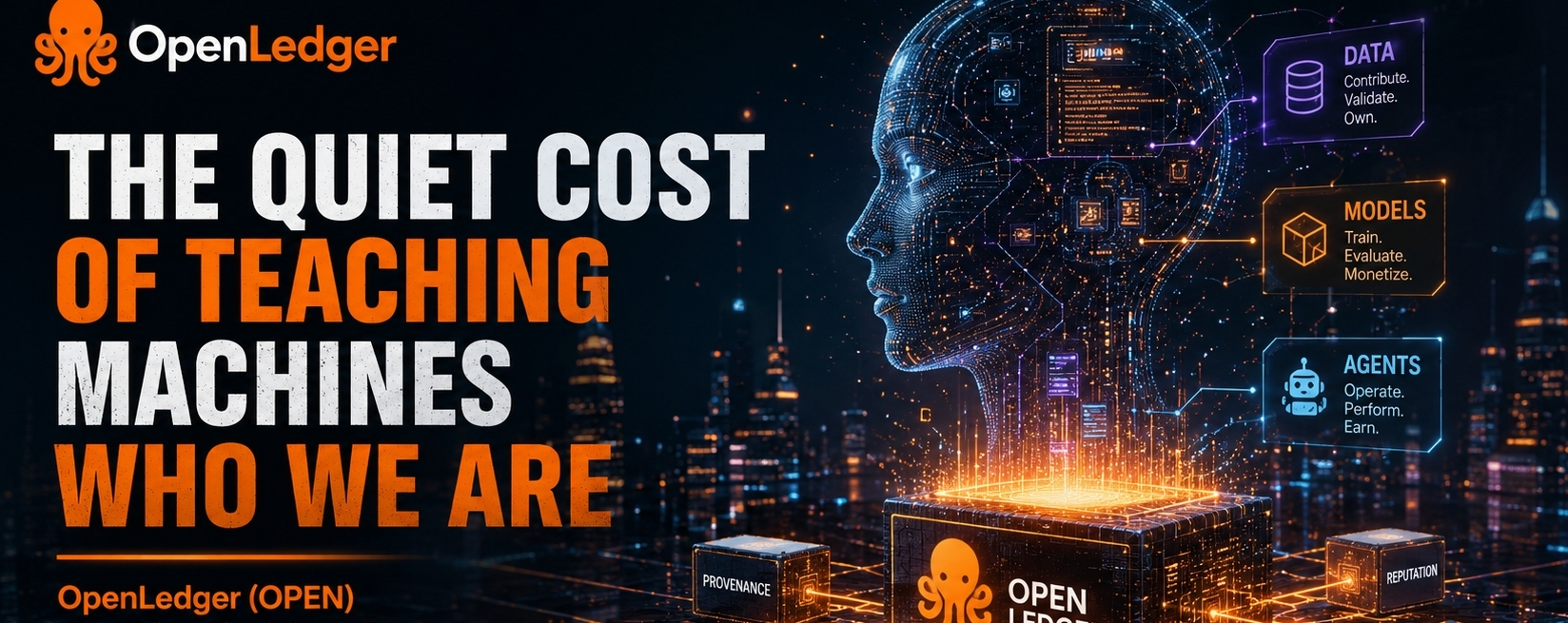
Something clicked for me when I stopped reading the social threads and looked at where value actually accumulates inside AI systems because almost every discussion around AI monetization feels upside down. People obsess over model performance while ignoring the supply chain feeding those models every second. Data. Human behavior. Feedback loops. Edge corrections. That invisible layer is where the extraction happens. OpenLedger keeps pulling me back because it frames this differently through an AI blockchain built around monetizing data models and agents instead of treating contributors as disposable inputs.
The phrase unlocking liquidity sounds harmless until you unpack it. Liquidity for what exactly. Data is not a static asset. Models are not fixed products. Agents are not passive software objects. They evolve through interaction. OpenLedger is effectively pointing at the production layer itself and asking whether the people creating signal should remain permanently disconnected from the economic output. Different question. Bigger consequences.
Most AI systems operate with delayed invisibility. Users contribute information through prompts conversations corrections preferences and behavioral traces. Models absorb it. Platforms scale it. Revenue compounds elsewhere. The contributors disappear from the economic picture. OpenLedger introduces a structure where data models and agents become monetizable units inside a blockchain environment which means attribution starts behaving less like accounting and more like ownership infrastructure.
That creates tension. Real tension.
Because monetization sounds attractive until operational responsibility appears. Someone has to validate quality. Someone carries risk around low signal inputs. Someone absorbs the cost of useless data inflation. Markets reward quantity first. Intelligence needs quality first. Those incentives collide hard.
This is where I think the hidden friction lives.
If liquidity enters the data layer too early participants may optimize for output volume rather than model utility. We already saw versions of this in social platforms. Engagement farming everywhere. Metric inflation. Behavioral distortion. The same thing can happen inside AI ecosystems if attribution lacks quality weighting mechanisms. Data contributors chase rewards. Models absorb noise. Agents degrade slowly. Nobody notices until performance slips months later.
Long timeline issue.
Bigger than people think.
OpenLedger is interesting because monetizing data models and agents is not merely creating assets. It is restructuring participant psychology. Contributors stop behaving like free labor. Model builders stop treating input streams as infinite commodities. Agent creators suddenly have economic identity attached to performance persistence.
That changes behavior.
An agent with monetizable output is no longer software alone. It becomes a maintained economic actor. Maintenance matters. Memory matters. Reputation matters. Data provenance matters even more.
I keep coming back to this because AI has a memory problem disguised as a scaling problem. Systems remember information but forget origin. They preserve output while erasing contribution. The industry normalized this because extraction scales faster than attribution. OpenLedger feels like an argument against that assumption.
Not a technical argument.
An economic one.
If data models and agents become liquid assets then attribution stops being optional metadata and starts becoming settlement infrastructure. That shift is huge because the protocol layer begins deciding who gets remembered economically.
Most people will read AI blockchain and think faster transactions or token narratives. I think the deeper issue sits elsewhere. Who carries the invisible labor cost of intelligence growth. Who receives downstream ownership. Who gets erased.
Because once autonomous agents multiply and synthetic systems generate more of the internet the scarcity may not be compute anymore.
It may be verified contribution.
And the protocols that solve attribution before everyone else might end up owning the memory layer of AI itself.
