Every startup suddenly claims it’s building the future. Every tech company is racing to launch AI products. Investors are throwing money into anything connected to artificial intelligence. But behind all the hype, there’s one uncomfortable reality most people ignore:
AI runs on data.
Not magic. Not marketing. Data.
And the people creating that data? Most of them never get rewarded.
That’s exactly why OpenLedger is starting to stand out in the AI and crypto space.
This isn’t just another “AI + blockchain” project trying to ride a trend. OpenLedger is attempting to build something much bigger — an entire infrastructure where data, models, and AI agents can actually become monetizable assets.
That changes the conversation completely.
Because today’s AI economy is deeply unbalanced. Huge companies collect information from communities, websites, researchers, users, and public datasets, then train powerful models worth billions of dollars. Meanwhile, the contributors behind that intelligence usually remain invisible.
OpenLedger wants to flip that model.
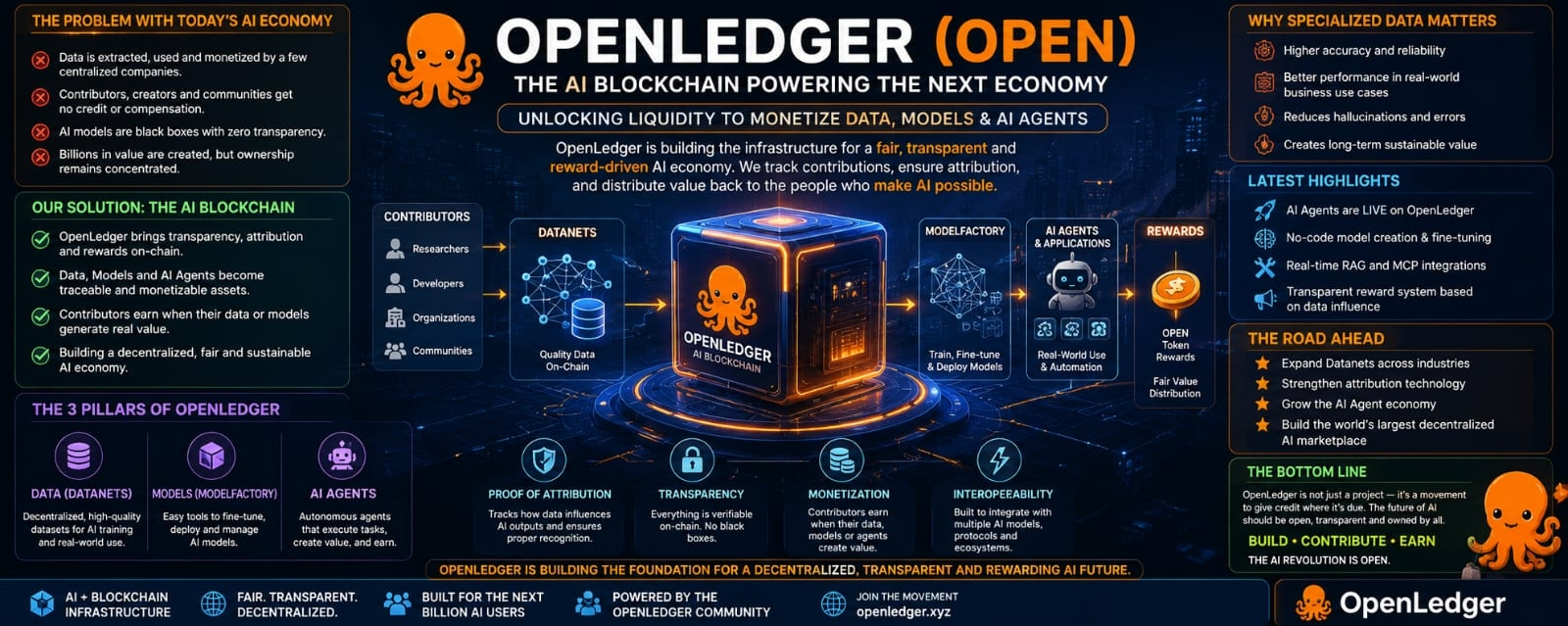
The project is building what it calls an AI Blockchain — a system designed to track contributions, reward useful data, and create transparency around how AI systems generate value. In simple terms, if your data helps improve an AI model, OpenLedger wants the network to recognize it and potentially reward you for it.
That sounds simple on paper.
In reality? It’s one of the hardest problems in AI right now.
And honestly, that’s why people are paying attention.
Most AI projects focus on the front-end experience. Better chatbots. Better image generation. Faster responses. OpenLedger is focused on the layer underneath everything — the economic engine powering AI itself.
That’s a much smarter angle long term.
The backbone of the ecosystem is something called “Datanets.” Think of them as decentralized datasets specifically built for AI training and deployment. But OpenLedger isn’t chasing random internet data. The project is heavily focused on specialized, high-quality information.
Medical research. Financial analysis. Legal documents. Technical knowledge. Industry-specific expertise.
That matters because the future of AI probably won’t belong to generic models alone. Businesses need precision. They need trustworthy outputs. A finance company doesn’t want an AI model hallucinating numbers. A healthcare system cannot afford incorrect medical responses.
And that’s where OpenLedger becomes interesting.
The project is betting that specialized data will become one of the most valuable assets in the AI economy.
Honestly, that prediction makes sense.
We’re already seeing companies move away from “one model does everything” thinking. Smaller, more focused AI systems trained on better datasets are becoming increasingly valuable. OpenLedger is positioning itself directly in the middle of that shift.
But the real power move is something called “Proof of Attribution.”
This is the part that separates OpenLedger from most AI projects flooding the market right now.
The protocol is designed to track how datasets influence AI-generated outputs. Basically, OpenLedger wants to know which data actually helped create value inside a model. If your dataset contributed meaningfully to an AI response or workflow, the network attempts to identify that contribution.
That’s a massive idea.
Because for the first time, AI contributors may finally have a transparent way to receive recognition and economic participation instead of being buried underneath giant centralized systems.
Of course, this is where things get messy too.
AI attribution is incredibly difficult at scale. Large language models contain billions of interconnected parameters. Once training happens, tracing outputs back to specific datasets becomes technically brutal. Researchers across the industry are still struggling with this challenge.
OpenLedger is basically walking straight into one of the hardest infrastructure problems in artificial intelligence.
That takes confidence.
Or madness.
Maybe both.
Still, the timing feels right.
The AI industry is entering a phase where transparency matters more than ever. Governments are paying attention. Regulators are starting to ask questions. Businesses want explainability. Users want accountability. The black-box era of AI is beginning to face pressure from every direction.
OpenLedger is building for that future.
And the project isn’t stopping at datasets and models. It’s also moving aggressively into AI agents — autonomous systems capable of executing tasks, automating workflows, and operating in real time.
That market alone could become enormous.
AI agents are quickly turning into the next major battleground in tech. Every serious AI company is exploring them. But autonomous systems need trustworthy infrastructure behind them. They need reliable data. Transparent logic. Economic coordination.
That’s exactly the environment OpenLedger wants to create.
The platform’s ModelFactory system also deserves attention. Instead of forcing developers into overly technical workflows, OpenLedger is trying to simplify model fine-tuning and deployment through more accessible tools.
That sounds like a small detail.
It isn’t.
Developer friction kills projects faster than bad ideas. If builders struggle to use your infrastructure, adoption collapses. OpenLedger seems aware that usability matters just as much as raw technical power.
Now, let’s be realistic.
This project still faces serious challenges.
Scaling attribution systems won’t be easy. Governance can become chaotic. Low-quality datasets could create spam problems. Regulatory pressure around AI data ownership is growing globally. And like every crypto project, OpenLedger also has to survive market volatility and ecosystem competition.
The tech world is brutal.
Good ideas fail constantly.
But what makes OpenLedger different is that it’s tackling a real structural problem instead of chasing temporary hype. The project is asking a question the AI industry can’t avoid forever:
Who should benefit when AI creates value?
Right now, the answer is mostly giant corporations.
OpenLedger is betting the next phase of AI looks more decentralized, more transparent, and more community-driven.
And honestly?
That’s probably where the industry is heading anyway.
Because eventually, people are going to demand more than just smarter AI. They’re going to demand accountability, ownership, attribution, and fair economic participation too.
That’s the bigger story here.
OpenLedger isn’t simply trying to build another AI platform.