
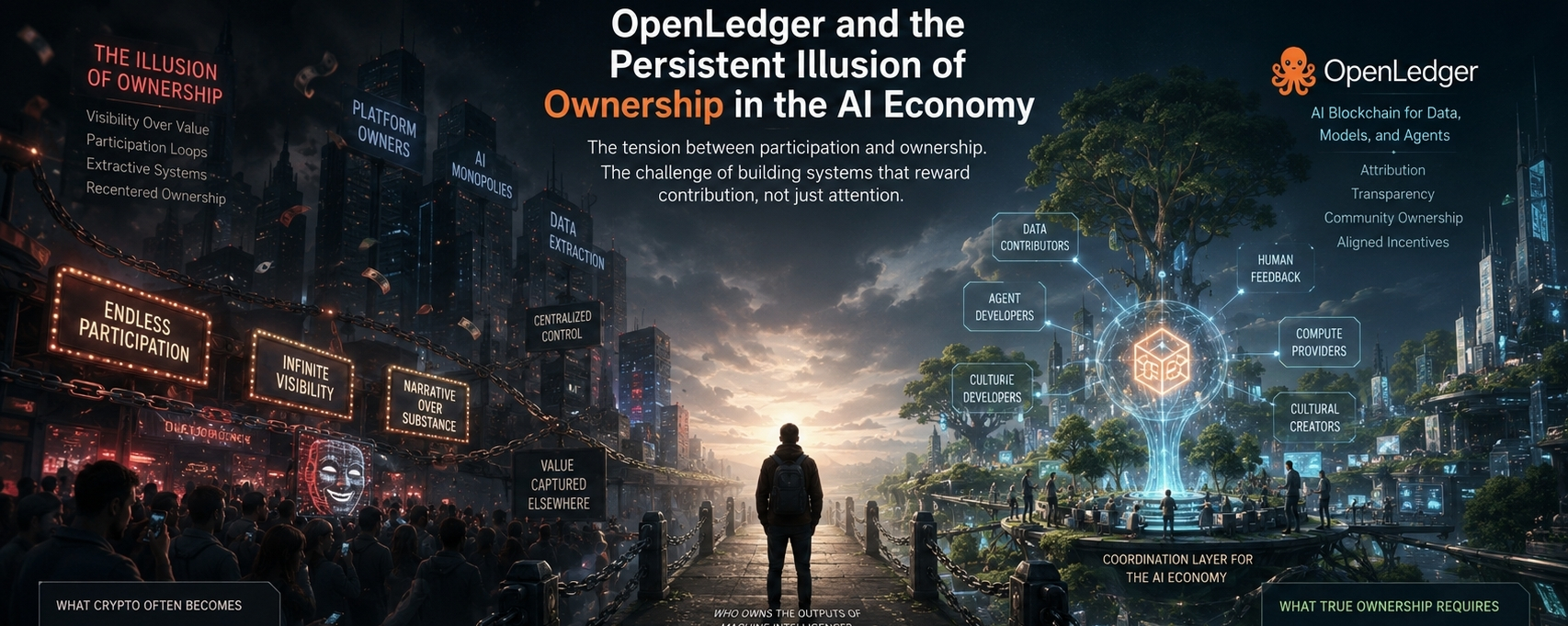

For a long time, I have watched crypto drift between two identities that never fully reconcile with each other. One identity presents itself as infrastructure: serious, foundational, almost political in its language about ownership, coordination, and freedom. The other behaves more like theater. Endless participation loops. Infinite visibility. Constant movement that often disguises the absence of durable value underneath it.
I think that tension has defined most of the industry for years.
Every cycle arrives with a new vocabulary that promises to solve the failures of the previous one. First it was payments. Then smart contracts. Then DeFi, NFTs, DAOs, modular systems, rollups, AI integrations, autonomous agents. The language evolves faster than the underlying incentives. And eventually I find myself asking the same question again: who is actually creating value here, and who is simply generating the appearance of value for someone else higher in the stack?
That question matters more to me now than it did years ago because I have seen this before. I have seen systems built around participation rather than usefulness. I have seen ecosystems reward visibility over contribution. I have seen entire narratives constructed around decentralization while ownership quietly reconcentrated itself in familiar places. The interfaces changed. The slogans changed. The underlying gravity often did not.
That is partly why OpenLedger caught my attention.
Not because I fully trust it. I do not.
What interests me is the specific direction of the problem it seems to be pointing toward. The project describes itself as an AI blockchain designed to unlock liquidity around data, models, and agents. On the surface, that language sounds dangerously close to the kind of polished abstraction crypto has become extremely good at producing — sophisticated enough to sound important, vague enough to absorb projection from whoever is listening.
And yet I keep coming back to the underlying tension beneath the marketing language, because the tension itself feels real.
AI systems are becoming increasingly dependent on invisible labor. Data labeling. Human correction. Fine-tuning. Behavioral reinforcement. Distributed computational contribution. Cultural production itself. The modern AI economy often speaks as though intelligence emerges autonomously from infrastructure, but from my view, much of it still rests on layers of attribution that remain unresolved. Someone contributes value. Someone else captures most of it. The system grows larger while the relationship between participation and ownership becomes harder to see.
Crypto, at least in theory, has always claimed it could address coordination and attribution problems like these. Most attempts have failed, or partially succeeded before collapsing into speculation. But the underlying question never disappeared.
Who owns the outputs of machine intelligence?
Who should benefit from the inputs?
And how do you prevent the entire system from becoming another extraction layer disguised as openness?
The more I sit with projects like OpenLedger, the more I think the real issue is not technological capability. It is incentive design under conditions of narrative excess. Crypto is extraordinarily effective at financializing concepts before those concepts achieve social or economic stability. Sometimes it feels as though the market treats unresolved philosophical problems as investable assets.
That dynamic creates distortion very quickly.
A system designed to reward contributors can slowly become a system optimized for insiders. A network built around open participation can become dependent on mercenary activity. Metrics begin replacing meaning. Activity begins replacing usefulness. Eventually the ecosystem starts measuring itself through its own reflections.
I have seen this before.
That does not mean every attempt is meaningless. But it does mean I have become deeply cautious whenever a project begins speaking in universal terms about ownership, intelligence, or decentralization. The more ambitious the narrative becomes, the more attention I pay to the quieter details underneath it: who controls the coordination layer, how rewards are distributed, whether contributors retain leverage, whether participation has long-term dignity or merely temporary compensation.
These questions matter more than branding.
Especially now.
AI is entering a phase where attribution itself may become economically unstable. Models are trained on oceans of collective human production, yet the individuals contributing to those oceans often disappear entirely from the value chain. The internet increasingly resembles a system where human expression is absorbed, transformed into probabilistic infrastructure, and then resold back to society through centralized platforms.
That is not simply a technical issue. It is a cultural one.
And this is where OpenLedger becomes interesting to me in a more philosophical sense, even if I remain uncertain about the outcome. I respect the attempt more than I trust the outcome. There is a difference.
Because I think many people inside crypto still underestimate how difficult coordination actually is once real economic incentives appear. Everyone claims to support openness until scarcity enters the system. Everyone supports decentralization until governance becomes inconvenient. Everyone talks about community until ownership percentages start moving.
The contradiction repeats constantly.
What makes AI-related crypto narratives especially fragile is that they operate at the intersection of two industries already saturated with abstraction. AI often obscures labor behind automation mythology. Crypto often obscures concentration behind decentralization mythology. When combined together, the result can either produce genuinely new coordination structures or simply create more sophisticated illusions.
From my view, the outcome is still unresolved.
I do not think the future will belong purely to centralized AI monopolies. But I also do not automatically believe that tokenized infrastructure solves the deeper problems of attribution, trust, or fairness. Sometimes blockchains distribute ownership. Sometimes they merely distribute speculation around ownership.
There is an important difference there too.
What I find myself paying attention to now is durability. Not excitement. Not narrative velocity. Durability.
Can systems like this survive once attention weakens?
Can they sustain participation without relying entirely on financial incentives?
Can contributors meaningfully benefit beyond early-cycle speculation?
Can usefulness exist independently from the token itself?
Those questions are harder to answer than most whitepapers admit.
And maybe that uncertainty is the most honest place to stand right now.
Because the truth is, I do not fully trust grand technological narratives anymore, even when they contain pieces of reality inside them. I have watched too many cycles confuse symbolic progress with structural progress. Too many ecosystems celebrated for movement alone. Too many projects rewarded for storytelling before proving long-term relevance.
Still, I pay attention when a project appears to be circling around a legitimate unresolved problem rather than manufacturing an artificial one.
OpenLedger may or may not become meaningful infrastructure. I genuinely do not know. But I think the broader issue it touches — the relationship between AI systems, human contribution, ownership, and economic visibility — is real enough that it cannot simply be dismissed as another passing narrative.
The challenge is that crypto has trained many of us to distrust even legitimate questions once they become attached to investable language.
And perhaps that is the strange condition the industry now exists in: real problems buried beneath layers of speculation, sincere ideas mixed with opportunism, systems attempting to coordinate human value while simultaneously incentivizing distortion around that value.
The more years I spend watching these cycles repeat themselves, the less interested I become in certainty.
What interests me now is whether any of these systems can remain intellectually honest once capital arrives at scale.
Very few ever do.