
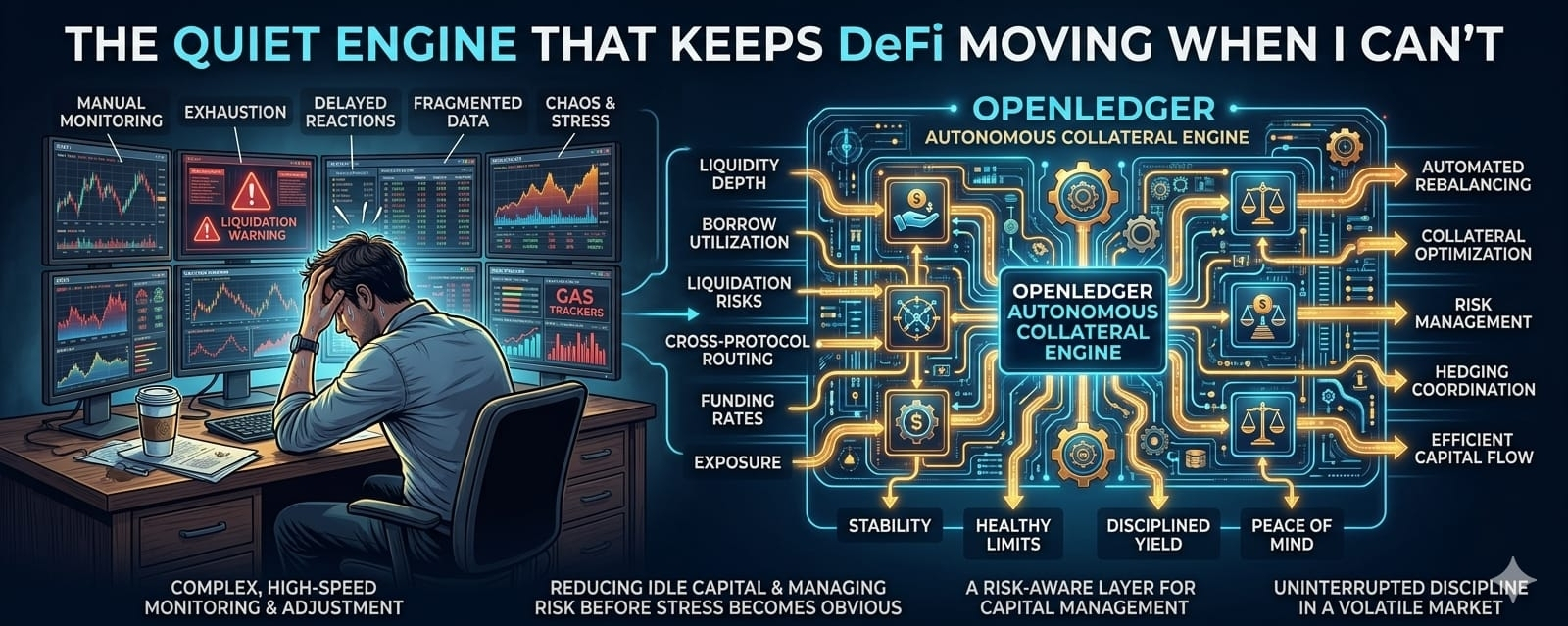
I was sitting in front of my screen with a half-finished coffee beside me, watching different DeFi dashboards refresh over and over, when I realized how impossible it is to truly keep up with everything happening at once. DeFi never moves in one clean direction. Every protocol has its own behavior, every pool reacts differently, and every collateral position carries a different kind of pressure. Borrow utilization can rise quietly, funding rates can shift without much warning, liquidity can move from one place to another, and a position that looked safe a few hours ago can suddenly feel much more exposed. At first, I used to think managing DeFi was mostly about finding better yield, but the longer I spent inside this space, the more I understood that the real challenge is not chasing numbers. The real challenge is staying aware before those numbers turn against you.
That is where OpenLedger’s Autonomous Collateral Engine starts to feel important. It does not depend on whether I am watching the screen, whether I am tired, or whether I miss a small change in the market. It keeps observing the system continuously. It monitors exposure, borrowing utilization, liquidation thresholds, funding rates, liquidity depth, and yield differences across different environments. Instead of waiting for a human to notice something and react late, it can adjust capital, move assets, rebalance collateral, and manage exposure while the market is still shifting. There is a strange comfort in that because I know the system is handling details that would be exhausting to track manually. At the same time, there is also a little discomfort because I can feel myself giving up some control to an engine that does not hesitate, does not overthink, and does not need emotional reassurance before making a decision.
I still remember a time when I tried to rebalance a lending position myself. I thought I had everything under control because I had checked the pools, compared the utilization levels, and reviewed the risk on my collateral. But markets rarely stay still just because you feel prepared. Some of my capital ended up sitting almost idle, while other positions moved closer to liquidation than I was comfortable with. Nothing completely collapsed, but the pressure was enough to make me realize how fragile manual management can be. You can understand the risks in theory and still miss the timing in practice. The Autonomous Collateral Engine changes that experience because it does not wait for stress to become obvious. It reads the data, calculates risk dynamically, and acts when the conditions require it. That kind of precision feels cold, almost robotic, but in a space as fast and fragmented as DeFi, that coldness can be exactly what makes it useful.
The execution side is what makes it even more interesting. It is not only watching numbers from a distance. It is built to respond across different protocols, routes, and collateral environments. Cross-protocol routing, exposure adjustments, collateral reallocation, and hedging coordination all become part of the same flow. If liquidity starts thinning in one place, if a chain slows down, if a pool becomes less efficient, or if risk begins to build around a position, the system can shift direction instead of sitting still. From the outside, it feels like watching a quiet traffic controller manage assets across invisible roads. I may only see the dashboards, the ratios, and the results, but underneath that surface, capital is being redirected, risk is being softened, and positions are being kept within healthier limits.
What this really changed for me is the way I look at yield. In DeFi, it is easy to get distracted by the highest APY because big numbers always look attractive. But high yield without control is not strength. It can become a trap if the liquidity is weak, the collateral is badly positioned, or the liquidation risk is being ignored. OpenLedger’s Autonomous Collateral Engine seems to approach yield from a more mature angle. It is not only asking where the return is highest. It is also asking whether the capital is being used efficiently, whether the risk is acceptable, whether the liquidity is deep enough, and whether the position can survive pressure. That makes the system feel less like a yield-chasing tool and more like a risk-aware layer for managing capital in a market that constantly changes its mood.
Still, I do not see automation as something that removes the need for human judgment completely. DeFi is full of unusual moments, edge cases, sudden shocks, and market behavior that no model can predict perfectly every single time. There will always be situations where context matters, where intuition matters, and where a human needs to step in and question what is happening. That is why I do not think the right mindset is blind trust. The better approach is measured trust. Let the engine handle the repetitive, high-speed monitoring and adjustment, but keep your own awareness alive. I want the system to manage what I cannot realistically manage every minute, but I still want to understand the direction it is taking and the risks it is protecting against.
After watching it work, I started to appreciate the discipline it brings to capital movement. Nothing feels random. Idle capital is reduced where possible, liquidation thresholds are respected, exposure is kept from becoming too aggressive, and yield differences are considered without blindly chasing every tempting opportunity. It does not try to make DeFi look simple, and it does not pretend risk disappears just because automation is involved. Instead, it creates a quieter kind of control, the kind that works in the background and only becomes obvious when it prevents something worse from happening. In a market full of loud promises, that kind of quiet consistency feels more valuable than it first appears.
I cannot say I fully trust any automated system without question, and maybe that is a healthy thing. DeFi still requires caution, patience, and the willingness to stay alert. But I also know that I cannot personally monitor every protocol, every liquidity pool, every collateral ratio, and every funding movement all day. The space is too fragmented, too fast, and too demanding for one person to manage perfectly by hand. So I watch, I learn, and I let OpenLedger’s Autonomous Collateral Engine handle the parts that are too constant and complex for me to carry alone. It makes me feel a little less powerful in one sense, but also much less overwhelmed. And in DeFi, where one missed signal can become an expensive lesson, having a quiet engine working in the background feels less like giving up control and more like finally admitting that control needs help.
