
i’ve spent enough nights watching incident dashboards at 2 a.m. to know that most failures do not begin with slow blocks. They begin with permissions nobody reviewed, wallets approving too much, and one exhausted operator clicking “confirm” because the queue refuses to stop growing. Risk committees never panic over raw TPS. They panic over key exposure, unclear delegation paths, and systems that cannot say no when they should.
That is why i keep looking at OpenLedger less like a marketing narrative and more like infrastructure that expects human error to exist. There is a difference. Most chains still behave as if users are disciplined machines who will carefully inspect every signature request forever. They won’t. Eventually fatigue wins. It always does.
The obsession with throughput has created a strange culture around blockchain design. Every week another dashboard appears showing impossible transaction numbers, microscopic latency, theoretical capacity under laboratory conditions. None of it answers the question compliance teams actually care about: what happens when credentials leak at 1:47 a.m. and nobody notices for nine minutes?
Because nine minutes is enough.
A compromised wallet does not care how fast the chain settles. A malicious approval does not become safer because blocks finalize in milliseconds. The industry keeps framing slowness as existential risk while treating permission sprawl as an acceptable side effect of usability. That inversion is going to age badly.
What interests me about OpenLedger is not the performance headline. The SVM-based architecture matters, yes. Parallel execution matters. High-performance systems matter. But speed without boundaries is just a more efficient way to distribute damage. The interesting part is the guardrails.
OpenLedger Sessions feels less like a convenience feature and more like an admission that permanent authority is incompatible with real-world operational security. Enforced, time-bound, scope-bound delegation changes the conversation from trust me to trust this exact permission for this exact duration. That distinction sounds subtle until you have lived through an approval exploit review with legal, security, treasury, and governance teams all sitting in the same call trying to determine who technically authorized catastrophe.
“Scoped delegation + fewer signatures is the next wave of on-chain UX.”
Not because signatures are annoying. Because constant signing trains users into blind consent. Repetition destroys caution. Every mature security model eventually realizes the same thing: humans are the unstable variable, so systems must reduce unnecessary decision fatigue instead of amplifying it.
The architecture itself reflects that philosophy. Modular execution above a conservative settlement layer feels like an acknowledgment that not every component deserves equal trust. Execution can move quickly. Specialized environments can optimize aggressively. But settlement remains restrained, slower in temperament than the layers built above it. There is maturity in that separation. A system designed entirely around acceleration eventually forgets how to contain failure.
And containment is everything.
People mention EVM compatibility as if it is some grand ideological alignment. i don’t see it that way. Compatibility mostly reduces tooling friction. It lowers migration pain for developers and operational teams already buried under existing infrastructure requirements. That matters, but it is not the foundation of trust. Familiar tooling does not prevent exploit cascades. It only makes adoption less painful.
The harder conversations live elsewhere. Bridges, for example. Every cross-chain discussion eventually reaches the same uncomfortable silence where everyone understands the dependency graph is larger than advertised. The interface may look seamless, but trust assumptions multiply underneath it. Audits help. Monitoring helps. Insurance funds help until they don’t.
“Trust doesn’t degrade politely—it snaps.”
i have watched systems appear stable right up until the exact second they weren’t. There is rarely a graceful decline. Usually there is just a timestamp, a drain event, and a postmortem explaining how assumptions compounded faster than visibility. The market likes to describe these incidents as black swans because admitting predictability would require redesigning incentives.
That is why i think the native token matters less as a speculative instrument and more as security fuel. Staking is not passive yield in systems like this. Or at least it shouldn’t be treated that way. Staking is responsibility. It is participation in the enforcement layer that decides whether the system resists pressure or folds under it.
Most infrastructure debates still revolve around how quickly a chain can say “yes.” More throughput. More approvals. More composability. More execution.
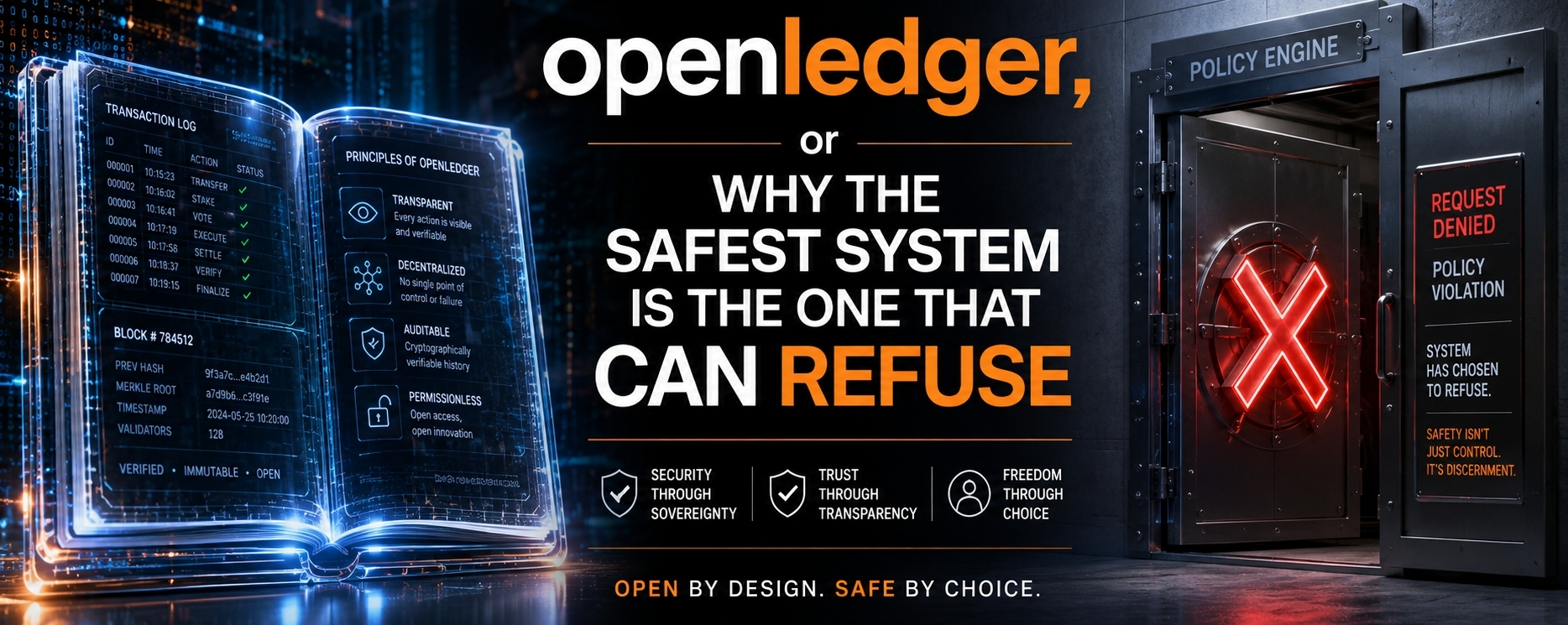
But mature systems are defined by their ability to refuse.
Refuse malformed intent. Refuse overreaching permissions. Refuse authority without scope. Refuse actions outside defined boundaries. Refuse panic-driven escalation during operational stress.
A fast ledger that cannot say “no” is not advanced infrastructure. It is an accelerant.
And eventually every incident report reaches the same conclusion written in slightly different language: the failure was technically possible long before it became visible.
i think OpenLedger understands that better than most. Not because it is fast, but because it seems designed around the uncomfortable reality that humans make predictable mistakes, keys leak, permissions drift, and operational discipline decays under pressure.
The future probably belongs to systems that assume this from the start.
Not chains that move fastest.
Chains that fail slowest.
