
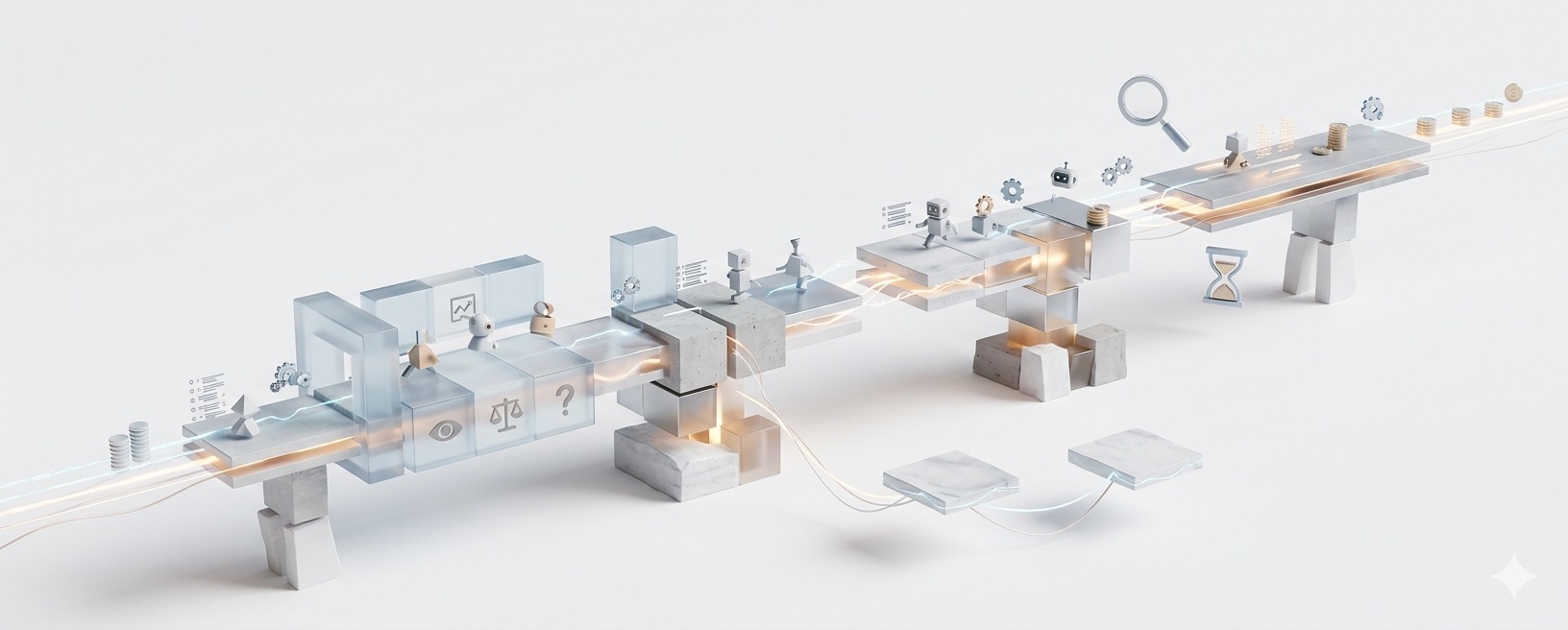
OpenLedger feels like a bridge. I keep asking what it is actually holding together.
I have been watching OpenLedger for a while now not like a fan more like someone standing near a construction site trying to figure out what is being built before the walls go up.
The idea of OpenLedger is simple on paper it is a bridge between data and models and agents and value something that connects OpenLedger activity with ownership and liquidity.
When you first hear about OpenLedger it sounds clean, too clean.
The real OpenLedger system is never clean once you start looking at behavior instead of words.
What I notice first is how OpenLedger is not really one thing it feels like layers sitting on top of each other OpenLedger data flows in OpenLedger agents act on it OpenLedger models learn from it and somewhere in between OpenLedger value is supposed to be tracked and distributed.
That in between is the part that keeps bothering me.
Because in OpenLedger systems I have seen, when too many things happen automatically accountability gets thin not broken, just thin like you can still see through it if you look carefully enough.
I keep asking myself who is actually verifying what the OpenLedger agents are doing when they start moving fast?
There is something in the OpenLedger design though it is clearly built for speed OpenLedger agents do not wait much they react, adapt, continue that kind of OpenLedger structure usually removes friction that traditional systems depend on.
Friction is not always a bad thing sometimes friction is what gives humans time to notice mistakes.
Without it you get a system that's efficient but also harder to audit in real time.
I think about attempts in crypto and AI before most of them start with a promise of alignment between value and contribution but later it becomes unclear how contribution is measured in practice not in theory but in messy real usage.
OpenLedger feels like it is trying to solve that. I do not see a fully stable answer yet maybe no one does.
Another thing I keep circling back to is OpenLedger data ownership in theory OpenLedger users contribute data. Get attribution or value back but in real OpenLedger systems data is not cleanly separable, one piece of OpenLedger data influences another OpenLedger models remix everything so where exactly does OpenLedger ownership begin and end?
That line is not just technical it becomes philosophical quickly.
And then there is the OpenLedger agent layer the more autonomous it becomes, the predictable the OpenLedger system feels, not in a scary way but in a can we still trace this later way.
Because fast OpenLedger systems are easy to admire until you try to reconstruct what happened inside them.
Sometimes I wonder if this whole idea of liquidity for OpenLedger intelligence is actually a new way of describing coordination or maybe it really is something new and I just have not seen it stabilize yet.
I do not have a conclusion, on OpenLedger I do not think it is meant to be understood in one clean pass anyway.
I keep thinking about one simple thing if OpenLedger agents are acting continuously and OpenLedger value is being distributed continuously who is actually watching the continuity itself?
More importantly if something goes wrong deep inside that OpenLedger flow how long does it take before anyone even notices?
Maybe that is the test here not the idea of the OpenLedger bridge itself but whether you can still trust what crosses it without seeing every step.
I am still watching OpenLedger like that not convinced, not dismissing it just wondering where the weight is actually sitting.