
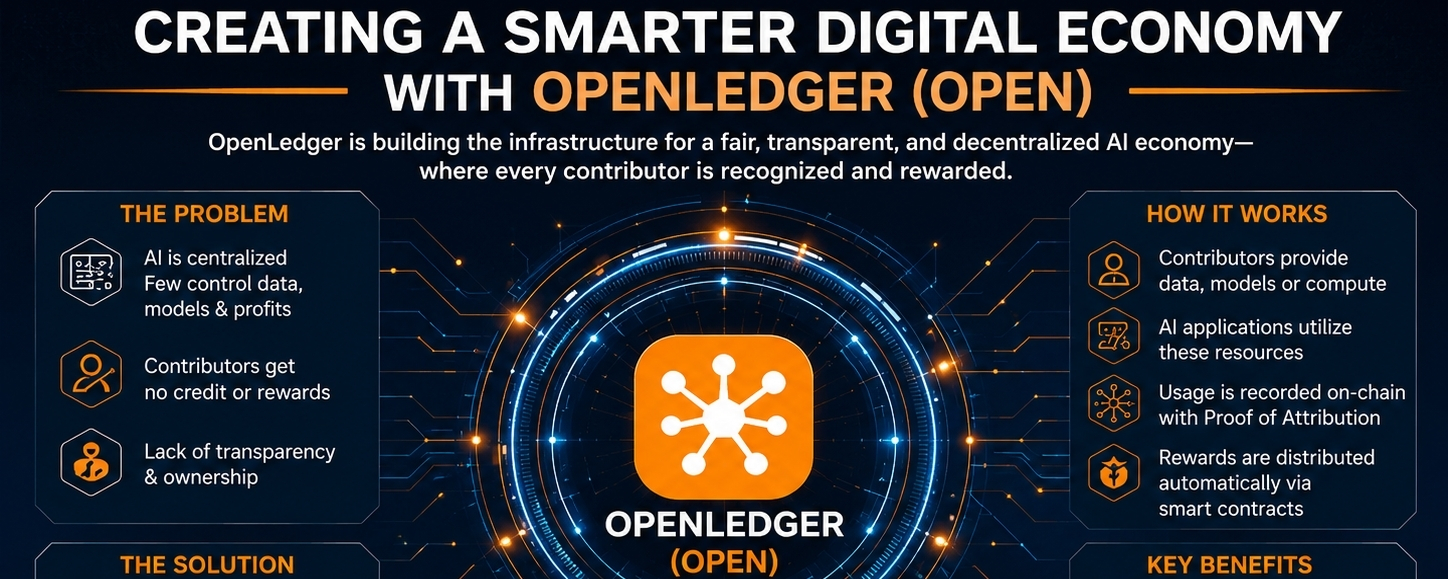
The digital economy is changing faster than ever, and I believe we are entering a period where artificial intelligence and blockchain technology will no longer operate separately. Instead, they are starting to merge into one connected ecosystem. In this transformation, OpenLedger (OPEN) has emerged as one of the most interesting projects because it is trying to solve a problem that many people in the AI industry still ignore: who actually owns the value created by AI?
Right now, most AI systems are controlled by large centralized companies. They collect data, train models, and generate profits, while the people who contribute information, datasets, or computing power rarely receive proper recognition or rewards. I think this imbalance is becoming one of the biggest issues in the AI economy. OpenLedger is trying to change that by creating a decentralized framework where contributors can finally be compensated fairly for the role they play in building AI systems.
What makes OpenLedger different is that it is not only focused on cryptocurrency trading or blockchain hype. Its main vision is much broader. It wants to create what the project describes as a “Payable AI” economy — a system where data providers, developers, and contributors automatically earn rewards whenever their work is used inside AI models or applications. In my opinion, this idea could become extremely valuable in the coming years because AI is expanding into almost every industry, from healthcare and finance to education, entertainment, and digital marketing.
One thing I appreciate about OpenLedger is that it recognizes how important attribution has become in the AI world. Today, AI systems are trained on enormous amounts of information collected from the internet, businesses, and individuals. However, very few systems track where the data came from or whether the original creators deserve compensation. OpenLedger introduces a blockchain-based mechanism known as “Proof of Attribution,” which records contributions transparently and allows contributors to benefit economically from the AI outputs their data helps generate.
I think this approach addresses one of the most important debates surrounding modern AI. Many creators, writers, artists, researchers, and developers are concerned that AI companies are using their work without permission or payment. OpenLedger is trying to create a system where ownership and contribution are no longer invisible. Instead of concentrating profits within a few corporations, it aims to distribute value across the network.
From my observation, this is where OpenLedger starts to stand out from many other AI-related crypto projects. A lot of blockchain projects simply add “AI” to their branding because it is trending. OpenLedger, however, appears to be building actual infrastructure designed specifically for decentralized artificial intelligence.
The way the platform works is relatively easy to understand. Users can contribute datasets, computing resources, AI models, or development tools to the network. Whenever these resources are used by applications or AI systems, smart contracts automatically calculate and distribute rewards. In simple words, the ecosystem creates a transparent economy where people are paid according to their contribution.
I think this model has strong long-term potential because future AI systems will require massive amounts of specialized data and computing power. If contributors are rewarded fairly, more people will be willing to participate, which could help decentralized AI ecosystems grow faster.
Another thing I find impressive is the speed at which OpenLedger has expanded its ecosystem. The project has already processed millions of transactions and attracted a large number of participants during its testing phases. In blockchain development, community activity matters a lot because it shows whether people are actually interested in using the network rather than simply trading the token.
The launch of the OPEN Mainnet was another important milestone. In my opinion, moving from a test environment to a live blockchain network demonstrates that the project is serious about long-term development. Many crypto projects remain stuck in the “coming soon” phase for years, but OpenLedger has continued to push forward with infrastructure deployment and ecosystem building.
I also think the project’s funding and partnerships add credibility to its future plans. OpenLedger has secured support from major investment firms connected to the blockchain industry, and it has introduced ecosystem funding initiatives designed to support developers building decentralized AI applications. This is important because technology projects need strong financial backing if they want to survive in highly competitive markets.
One partnership that particularly caught my attention was OpenLedger’s collaboration with Story Protocol. I believe this partnership reflects where the future of AI regulation is heading. Governments and regulatory authorities are becoming increasingly concerned about intellectual property rights, AI-generated content, and licensing issues. By working on transparent AI licensing systems, OpenLedger is positioning itself ahead of many competitors.
From my perspective, the biggest strength of OpenLedger is that it aligns with the future direction of the internet. The digital economy is moving toward decentralization, ownership transparency, and creator empowerment. People no longer want platforms where corporations control all the value while users receive little in return. OpenLedger’s ecosystem tries to create a more balanced structure where contributors remain part of the economic cycle.
At the same time, I think it is important to remain realistic. Like every emerging blockchain project, OpenLedger also faces significant challenges. The AI and crypto sectors are both extremely competitive, and market conditions can change quickly. There are many companies and blockchain protocols attempting to combine AI with decentralized technologies, which means OpenLedger must continue innovating if it wants to maintain momentum.
Token volatility is another challenge. The OPEN token experienced strong market appreciation after major exchange listings, attracting investor attention and trading activity. However, crypto markets are naturally volatile, and prices can fluctuate heavily within short periods. I believe long-term success will depend less on temporary price movements and more on whether the ecosystem can achieve real adoption.
Still, I think OpenLedger’s overall direction is promising because it focuses on utility rather than pure speculation. The project is attempting to build infrastructure that could become increasingly relevant as AI adoption accelerates globally.
Looking ahead, I can see several future benefits if OpenLedger continues growing successfully.
First, it could become a foundational platform for decentralized AI development. As businesses and developers search for transparent and compliant AI solutions, systems that offer attribution and fair compensation may become highly attractive.
Second, OpenLedger could create new economic opportunities for independent developers, data providers, and creators. Instead of relying entirely on centralized corporations, individuals may finally have a direct way to monetize their contributions to AI systems.
Third, I think the project could play an important role in future AI regulation. Governments are likely to demand more transparency regarding how AI models are trained and where their data originates. OpenLedger’s attribution system directly supports this requirement.
Another possible benefit is enterprise adoption. Large companies may eventually require blockchain-based verification systems to ensure legal compliance and ethical AI practices. If that happens, OpenLedger’s infrastructure could become valuable far beyond the crypto market itself.
I also believe that the rise of AI agents, decentralized applications, and autonomous systems could increase demand for platforms like OpenLedger. Future digital economies may rely heavily on automated systems interacting with each other, exchanging services, and processing payments in real time. OpenLedger’s model fits naturally into that future.
In my opinion, one of the most important aspects of OpenLedger is its attempt to humanize the AI economy. Today, many people feel disconnected from how AI companies operate. Their data is used, their content is consumed, and their contributions often go unnoticed. OpenLedger is trying to create a framework where contributors are visible, rewarded, and economically included.
That idea alone gives the project meaningful relevance in today’s technology landscape.
Overall, I see OpenLedger as more than just another cryptocurrency project. I see it as an experiment in building a fairer digital economy where AI development becomes more transparent, decentralized, and community driven. The road ahead will not be easy, and success is never guaranteed in emerging technologies. However, I think OpenLedger has positioned itself in one of the most important intersections of the future: artificial intelligence, blockchain, and digital ownership.
If the project continues expanding its ecosystem, strengthening partnerships, and delivering practical utility, it could become one of the more influential platforms shaping the next generation of decentralized AI infrastructure.