


The first time I seriously tried exploring AI tools, I expected something simple. The narrative online made it sound effortless connect a wallet, click a few buttons, and suddenly you’re part of the “AI future.”
That illusion didn’t last long.
Within minutes, I ran into the real barrier: complexity. One platform required coding knowledge. Another assumed I understood deployment pipelines. Then came discussions about APIs, GPU compute, model hosting, and fine-tuning. It quickly became clear that AI, despite all the hype, is still largely inaccessible to the average user.
That experience changed how I started looking at AI infrastructure and it’s exactly why @OpenLedger caught my attention.
Instead of focusing purely on narratives, it’s building something far less visible but arguably more important: the underlying systems that make AI usable, scalable, and economically fair.
At the core of this is a simple realization AI today is powerful, but it’s also opaque. Most models operate like black boxes. You see outputs, but you rarely understand the chain of contributions behind them.
$OPEN approaches this differently.
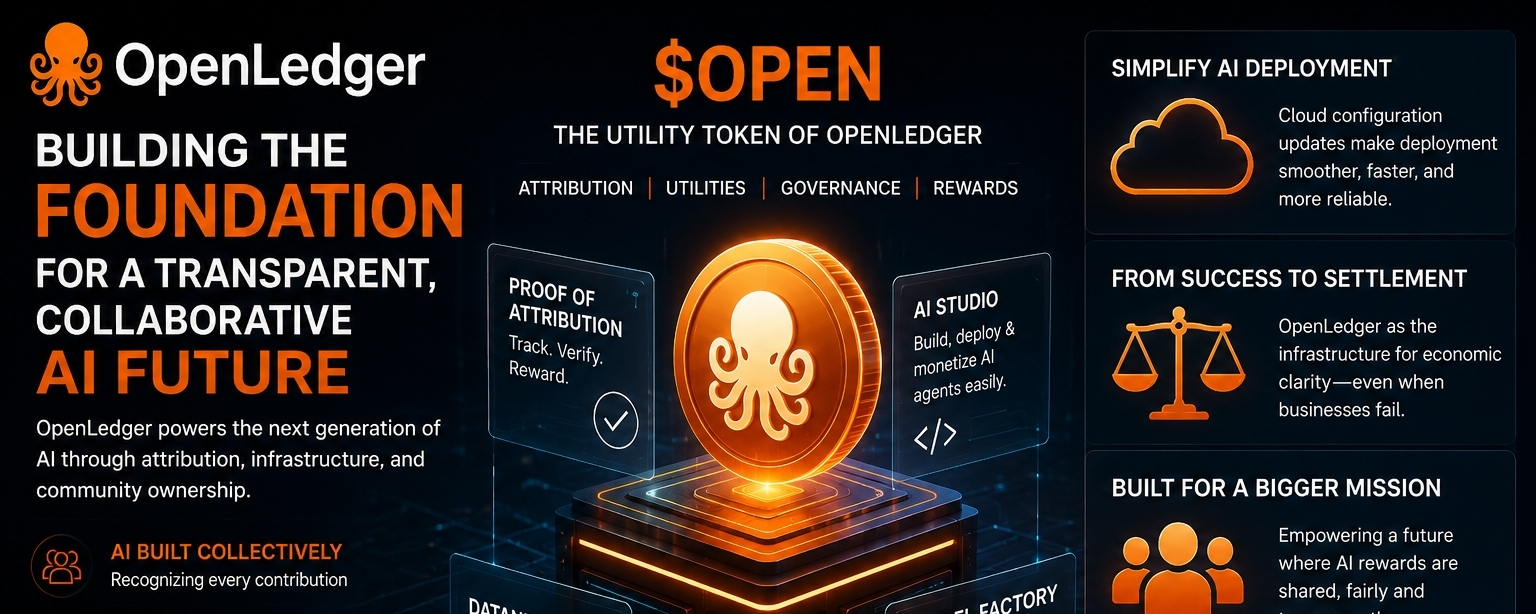
Through its Model Factory and OpenLoRA systems, it provides a structured environment where developers can train, fine-tune, and deploy models more efficiently. But what stood out to me wasn’t just the tooling it was the idea of on-chain verification for model components.
That introduces something AI has been missing: transparency that actually persists.
And then there’s Proof of Attribution (PoA), which, in my opinion, is where things become truly interesting.
Right now, AI is built on collective human input datasets, conversations, annotations, and creative work contributed at massive scale. Yet once a model becomes valuable, that contribution effectively disappears into the background.
PoA challenges that model.
Instead of losing attribution entirely, contributions can be tracked, measured, and potentially rewarded through $OPEN . It’s not just about fairness it’s about making the invisible layers of AI economically visible.
The more I thought about it, the more it felt like a missing piece.
Because if AI is trained collectively, shouldn’t the value it generates also be distributed more collectively?
This idea extends further with OpenLedger’s Datanets. While most attention in AI is focused on models, data remains the true foundation. Datanets introduces a way for communities to collaboratively build, refine, and structure datasets into something usable for large language models.
That shifts data from being a passive resource into an active economic layer.
Then there’s AI Studio, which might end up being the most impactful part for adoption. It lowers the barrier for building and deploying AI agents, making it possible for more people to participate without needing deep technical expertise from day one.
That matters more than people think.
Mass adoption rarely comes from advanced capabilities it comes from reducing friction.
And that brings me to something often overlooked: deployment.
In theory, building AI models has become easier. In practice, deploying them remains painful. Configuration issues, scaling challenges, unstable environments these are the everyday realities developers deal with.
OpenLedger’s recent cloud configuration updates seem aimed at addressing exactly that.
At first glance, these updates don’t look exciting. They’re not headline-grabbing. But infrastructure improvements rarely are. What they do is quietly remove friction standardizing environments, improving reliability, and making systems easier to manage.
And historically, the projects that reduce friction tend to become foundational.
If deployment becomes smoother within the @OpenLedger ecosystem, it creates a ripple effect: more developers can build, more applications can go live, and more real activity can happen on-chain.
That’s how ecosystems grow not through hype, but through usability.
But the more I explored this, the more my perspective shifted in an unexpected direction.
Initially, I saw attribution as a mechanism for success rewarding contributors when AI systems generate value.
Now, I’m starting to think that might not be the most important use case.
What happens when things fail?
Because they will.
Startups shut down. Products lose traction. Revenue disappears. Legal disputes emerge. And in those moments, clarity becomes more valuable than optimism.
AI systems today are built on complex dependency chains datasets, models, APIs, external tools. When everything works, that complexity is hidden. When things break, it becomes a problem.
This is where attribution infrastructure becomes something else entirely.
Not just a reward system but a record of responsibility.
OpenLedger doesn’t solve legal disputes, and it doesn’t magically enforce outcomes. But what it does offer is something more fundamental: a persistent, machine readable history of contributions.
That changes how disagreements are handled.
Instead of relying on memory, documentation, or fragmented records, there’s a verifiable trail. And while that doesn’t eliminate conflict, it makes it more structured.
In a way, this starts to resemble financial infrastructure.
Traditional systems have settlement layers, audit trails, and bankruptcy processes not because everything goes well, but because failure needs to be manageable.
AI doesn’t really have that yet.
And maybe that’s the bigger opportunity.
If $OPEN evolves beyond simple utility into something that influences access, trust, or economic coordination then it starts to play a role in how value and responsibility are negotiated within AI ecosystems.
That’s a much heavier function than most people are currently pricing in.
Of course, there are challenges.
Attribution is inherently complex. Not every contribution is equally valuable. Tracking influence at scale raises questions about relevance, thresholds, and governance. And on-chain visibility doesn’t automatically translate to real-world enforcement.
But even with those limitations, the direction feels meaningful.
Because mature systems aren’t defined by how they perform during growth they’re defined by how they handle stress.
Right now, most AI narratives are focused on acceleration: better models, faster inference, bigger markets.
Very few are focused on what happens when those systems are tested.
That’s where infrastructure matters most.
And that’s why OpenLedger doesn’t feel like just another “AI + crypto” experiment to me anymore.
It feels like an attempt to build the underlying rails for an AI economy—one where contributions are visible, deployment is manageable, and even failure has structure.
It’s not the loudest story in the market.
But it might end up being one of the more important ones.

#OpenLedger #TrumpSaysIranDealLargelyNegotiated #BitcoinBreaksBelow75KAsWarshTakesFedHelm