
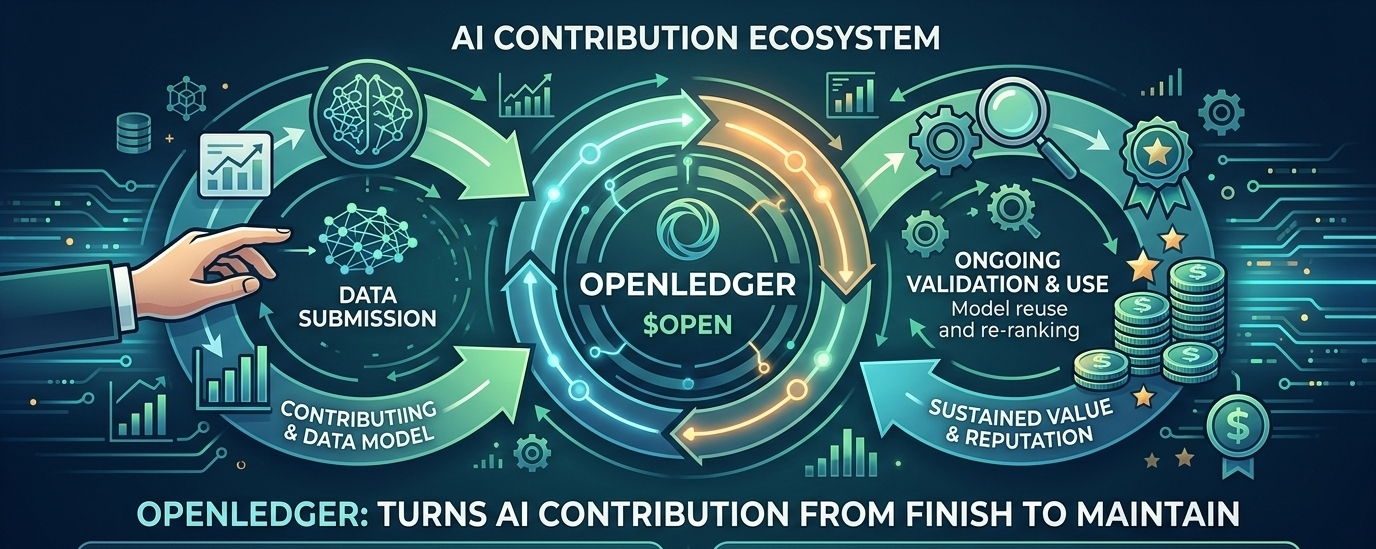
When I read OpenLedger (OPEN) describing itself as an AI blockchain where data, models, and agents can all be monetized, one detail kept bothering me. It doesn’t treat contribution like a one-time act. It treats it like something that stays inside the system.
My thesis is simple: OpenLedger may slowly turn AI contribution into a reputation maintenance loop, where value is not just earned once but continuously re-validated by the system.
That shift changes how the whole structure feels.
OpenLedger connects three core surfaces — data, models, and agents — into a single environment where all of them can carry value. On paper, this looks like a liquidity system for AI assets. But once value is tied to ongoing usage and evaluation, contribution stops being something you “finish.” It becomes something that remains exposed to the system.
And that exposure matters more than it first looks.
Because in a setup like this, contribution doesn’t just enter and disappear into history. It stays available for repeated interpretation. The system can keep referencing, re-ranking, or re-evaluating it based on how it is used across different contexts.
So value is not fully locked at the moment of creation.
It stays partially open.
That is where the first pressure appears. Not in earning value, but in how long that value stays aligned with the system’s current view of usefulness.
The second layer comes from how different types of contributions behave inside the same structure. Data submissions are usually static after upload. But models and agents are active — they can be reused, tested, and measured again under different conditions.
This creates a mismatch. Not all contributions age the same way inside the system.
So instead of a simple reward loop, you get something closer to a continuous validation loop, where certain contributions remain under ongoing attention while others fade more slowly.
And once that happens, behavior starts adjusting quietly.
Builders don’t only think about creating something valuable once. They start thinking about whether that value will still hold when the system looks at it again later.
That is a different mindset entirely.
Because now the goal is not just “build something useful.” It becomes “build something that keeps staying recognized as useful.”
And that difference is where OpenLedger’s structure becomes interesting.
It doesn’t just reward contribution. It keeps contribution inside a cycle where its meaning can be revisited.
One line that captures this shift is simple:
“Value is no longer a moment — it becomes something the system keeps checking.”
If that is how the system behaves at scale, then the real pressure is not entry into OpenLedger. It is persistence inside its ongoing evaluation layer.
And that creates a subtle consequence.
Systems like this don’t only decide what gets rewarded. They also influence what kind of contribution can survive repeated interpretation without losing relevance.
So the constraint is no longer just producing value once.
It is whether that value can stay valid when the system keeps looking at it again and again.
OpenLedger, in that sense, is less about a single monetization event and more about how long contribution can remain inside a state of recognition.
And in that kind of structure, the hardest part is not creating value.
It is staying worth recognizing.
