
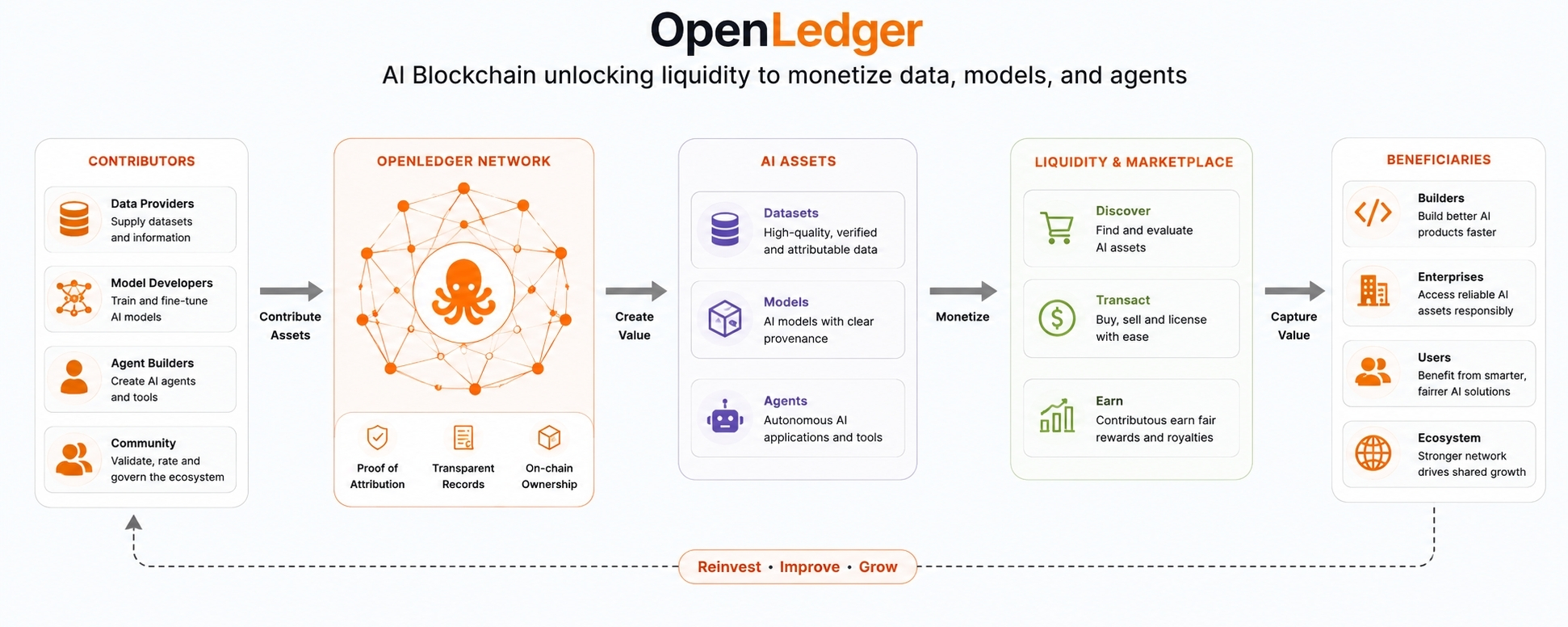

OpenLedger is one of the few AI-related crypto projects that made me spend more time thinking about the problem than the token. That doesn't happen often. Most projects in this category immediately pull attention toward infrastructure, performance metrics, partnerships, or some version of the claim that AI needs blockchain. OpenLedger feels slightly different because its starting point isn't really technology. It's value.
The project is built around a simple observation that becomes surprisingly uncomfortable once you think about it. AI systems generate enormous value, but the people contributing to that value are often invisible. Data creators, domain experts, communities, researchers, and even users collectively help shape intelligence, yet the economic rewards usually concentrate elsewhere. OpenLedger seems to be asking whether that imbalance is sustainable as AI becomes a larger part of the economy.
What caught my attention is that this isn't a hypothetical issue. AI companies are already competing for better data. The conversation around model quality is gradually shifting away from who has the biggest dataset and toward who has access to the most useful one. Specialized information, expert knowledge, and high-quality contributions are becoming more important. In that environment, the ability to identify, track, and reward contributors starts looking less like an idealistic goal and more like a practical challenge.
That is where OpenLedger enters the picture.
The project's vision revolves around creating an ecosystem where data, models, and AI agents are not just resources that get consumed but assets that can be attributed, monetized, and rewarded. The idea sounds straightforward on the surface, but I think it touches something much deeper. Most AI platforms today operate like black boxes. Contributions go in, intelligence comes out, and very few people understand how value moves between those two points. OpenLedger is attempting to make those relationships visible.
Whether people actually want that visibility is something I'm still uncertain about.
Crypto has a habit of assuming that transparency automatically creates better systems. Sometimes it does. Sometimes users simply choose convenience. The AI industry has grown incredibly fast without solving attribution in any meaningful way. Companies have largely optimized for performance and speed. OpenLedger is effectively arguing that ownership and contribution deserve a larger role in the equation.
I can see why that argument resonates.
If AI increasingly depends on unique knowledge and specialized data, contributors will eventually want more than recognition. They will want participation in the value being created. OpenLedger's framework appears designed around that possibility. Instead of treating contributors as passive inputs, it treats them as participants in an economic network.
The challenge, of course, is that incentives are rarely as clean as they appear in whitepapers.
A network can reward contributions, but rewarding contributions and rewarding useful contributions are not the same thing. The distinction matters. If participants discover that quantity is rewarded more effectively than quality, behavior adjusts accordingly. That isn't a crypto problem. It's a human problem. People naturally optimize for whatever system is placed in front of them.
This is one of the areas I find most important when thinking about OpenLedger's future.
The project doesn't just need contributors. It needs contributors who create resources that builders genuinely want. It doesn't just need activity. It needs activity that improves the usefulness of the network. The difference between those two outcomes could determine whether OpenLedger becomes meaningful infrastructure or simply another ecosystem filled with incentives chasing incentives.
What gives me some confidence is that the project appears focused on the economic side of AI rather than trying to compete directly with every other AI infrastructure narrative. There are countless projects talking about decentralized compute. Others focus on autonomous agents. Some are building marketplaces. OpenLedger's attention seems centered on creating a framework where intelligence-related assets can be tracked and rewarded in a more transparent way.
That focus feels important because the project is ultimately trying to solve a coordination problem.
Technology alone doesn't create valuable networks. People do. Builders, contributors, and users all need reasons to participate. OpenLedger succeeds only if those groups find enough value in the system to remain engaged without constant external incentives. That's a difficult balancing act because each group wants something different.
Builders want reliable resources and low friction.
Contributors want fair compensation.
Users want outcomes, not infrastructure.
The project has to satisfy all three.
That is why adoption feels far more important than any technical milestone. A system for monetizing data and intelligence only becomes valuable when real participants decide it improves their experience. If developers continue finding better resources elsewhere, the network struggles. If contributors don't believe rewards justify participation, growth slows. If users don't see better applications emerging from the ecosystem, the entire value proposition weakens.
These are not unique challenges, but they feel particularly relevant here because OpenLedger is building around behavior rather than pure technology.
I also think timing plays an interesting role. A few years ago, the conversation around AI ownership would have felt niche. Today it feels increasingly relevant. As AI becomes more integrated into businesses, research, education, and creative work, questions around contribution and value distribution are becoming harder to ignore. OpenLedger is positioning itself around that shift.
The risk is that the market may not care as much as the project expects.
Efficiency often wins. Centralized systems are frequently faster. Large platforms already possess massive advantages in distribution and resources. OpenLedger is not just competing against other crypto projects. It is competing against established habits and existing AI ecosystems that many people already use comfortably.
That makes execution incredibly important.
The project's vision is easy to appreciate. The harder part is transforming that vision into something participants actively choose. Networks don't become valuable because their ideas are compelling. They become valuable because enough people decide the alternative is worse.
After spending time looking at OpenLedger, I don't come away thinking about hype, narratives, or market cycles. I find myself thinking about whether the future of AI eventually demands better economic relationships between creators and consumers of intelligence. That feels like the core bet behind the project.
If that future arrives, OpenLedger could find itself operating in a category that becomes increasingly important. If it doesn't, the project may struggle to convince participants that attribution and ownership matter enough to change existing behavior.
For now, that's what makes OpenLedger worth paying attention to. Not because the outcome feels obvious, but because the problem it is addressing feels real. The project sits in an area where technology, economics, and human incentives intersect, and those are often the places where the most interesting opportunities—and the most difficult challenges—tend to emerge. The answers are still unclear, but the questions OpenLedger is asking seem more important today than they did a year ago, and they may become even harder to ignore in the years ahead.