

OpenLedger Caught my attention not because of its Tokenomics or its roadmap slides, but because of a question it Forced me to sit with for a while: what actually gives an AI system lasting value?
I've been thinking about this more than usual lately. We keep celebrating new AI models Smarter, faster, cheaper. And they genuinely are impressive. But somewhere in the back of my mind, Something kept nagging at me. If every team eventually gets access to the same foundation Models, the same inference costs, the same reasoning capabilities... what exactly are we competing on? What becomes the real differentiator?
That's the Question OpenLedger's approach quietly answers. And honestly, the answer surprised me.
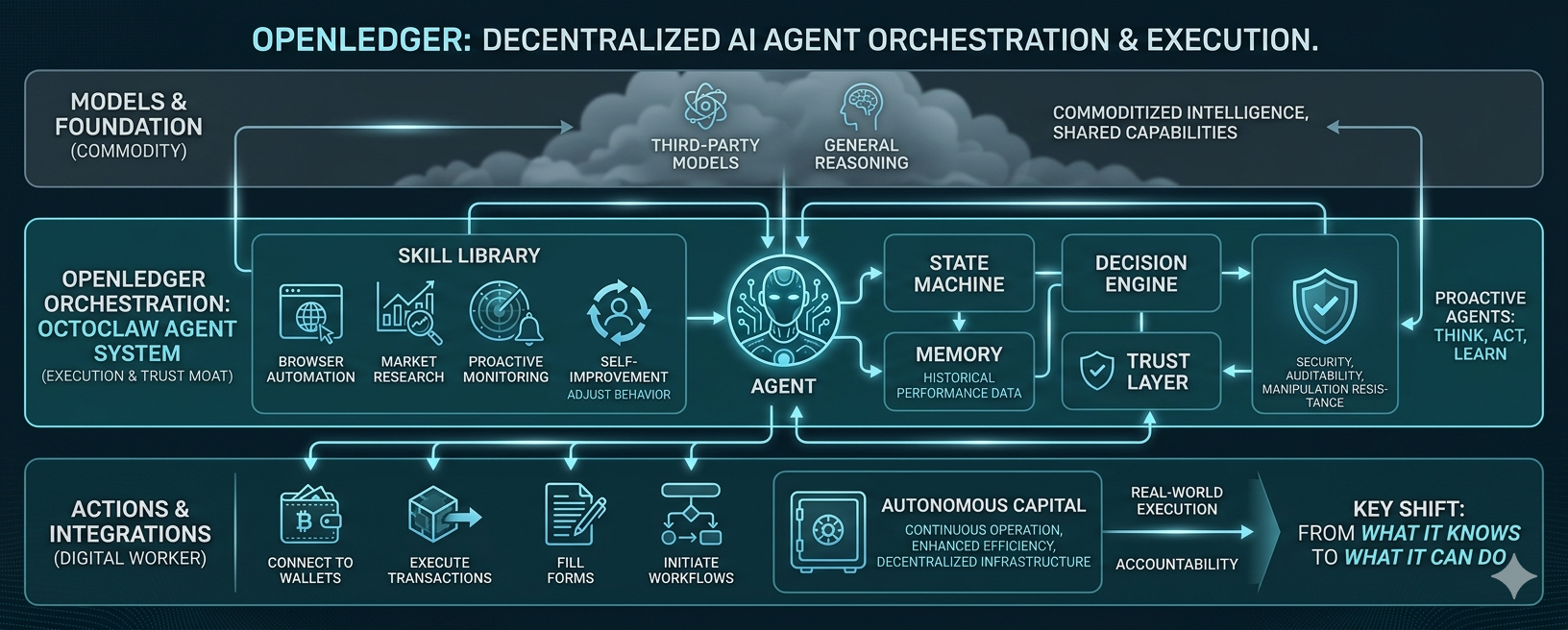
Yeah... Most people in Crypto assume the AI moat lives in the model itself. Whoever has the smartest AI wins. That's the intuitive take. But I'm not sure that's true anymore And I think the industry is slowly waking up to the same realization. Models are becoming commodities Faster than anyone predicted. What's harder to replicate, harder to build, and harder to replace is something Less glamorous: the execution layer. The infrastructure that lets AI actually do things in the world, not just respond to questions.
This is where OctoClaw OpenLedger's agent system Starts to feel genuinely different to me. It's not being built as another assistant you chat with. It's being built as an Orchestration layer. A system where AI agents don't just think, but act. They open browsers, fill forms, monitor markets, detect events, initiate workflows All without waiting to be asked. That shift from reactive to proactive is deceptively important. Most of us have Grown up thinking of AI as a tool you pick up and put down. What OpenLedger Seems to be imagining is AI as something closer to a colleague That keeps working while you sleep.
The skill system is what makes this concrete. Rather than one general model trying to do everything, OctoClaw is designed around discrete, specialized skills Each one handling a specific type of task. Browser automation. Market research. Proactive monitoring. And perhaps the most philosophically interesting one: self-improvement. The idea that an agent could Remember what didn't work, adjust its behavior, and gradually become more effective over time. That's not Software in the traditional sense. That's something closer to a dynamic system that evolves with use.
I find myself genuinely uncertain about what that means at scale. On one hand, the efficiency gains seem obvious. Agents that get better over time, that Operate continuously, that don't fatigue or lose focus that's a powerful thing to put to work in research, analysis, or workflow automation. On the other hand, when you connect systems like this to wallets, vaults, and autonomous capital, the risk profile changes completely. Prompt injection, manipulated execution paths, privilege escalation These aren't hypothetical concerns. They're already happening in simpler systems. The more capable an agent becomes, the more important it is that the orchestration layer is secure, Auditable, and resistant to manipulation.
What I find thoughtful about OpenLedger's positioning is that they seem to understand this tension. The project isn't just Asking "how do we make agents smarter?" It's also asking "how do we make them trustworthy enough to act autonomously?" That's a harder question. And in my experience, the Teams asking harder questions tend to build more durable things.
If this model of skill-based, execution-focused AI Agents becomes common, I think it reshapes some things we've taken for granted. The line between software tool And digital worker gets blurry. The value of a platform shifts from what it knows to what it can do. And trust not intelligence becomes the scarce resource that everyone is quietly Competing for.
I don't know if OpenLedger solves all of this. I'm genuinely uncertain how the self-improving agent piece scales, and I think the Security architecture will face serious stress tests as adoption grows. But the conceptual framing feels right to me. Not "build a smarter chatbot." Build the layer that makes AI Capable of operating in the real world, reliably and safely.
That's a different Kind of ambition. And it's one worth taking seriously.
So I'll leave You with the questions I keep returning to. Are we ready for AI systems that initiate actions on their own and do we have the infrastructure to hold them Accountable when something goes wrong? Is the real competition in This space shifting from model quality to execution trust? And if autonomous Digital workers become real, what does that mean for the systems and the People they're meant to serve?
I don't think the Market has fully processed what's being built here. But I think it's Worth paying attention before it does.