
A few months ago, I thought most “AI blockchain” projects were just packaging the same old infrastructure narrative with a futuristic logo and some chatbot screenshots.
Then I spent time digging into @OpenLedger .
And honestly, the deeper I went, the harder it became to ignore what they’re actually trying to build.
Not another AI meme. Not another empty Layer 1. Not another “decentralized intelligence” slogan with no real product behind it.
What caught my attention is that OpenLedger seems obsessed with one specific problem nobody in Big Tech really wants to solve:
Who actually owns the intelligence created by AI?
Right now, the modern AI economy runs on invisible extraction.
Millions of people generate data every second. Writers train models. Communities shape outputs. Researchers create datasets. Users provide behavioral feedback.
But almost nobody gets compensated when that intelligence becomes profitable.
That’s where OpenLedger feels different.
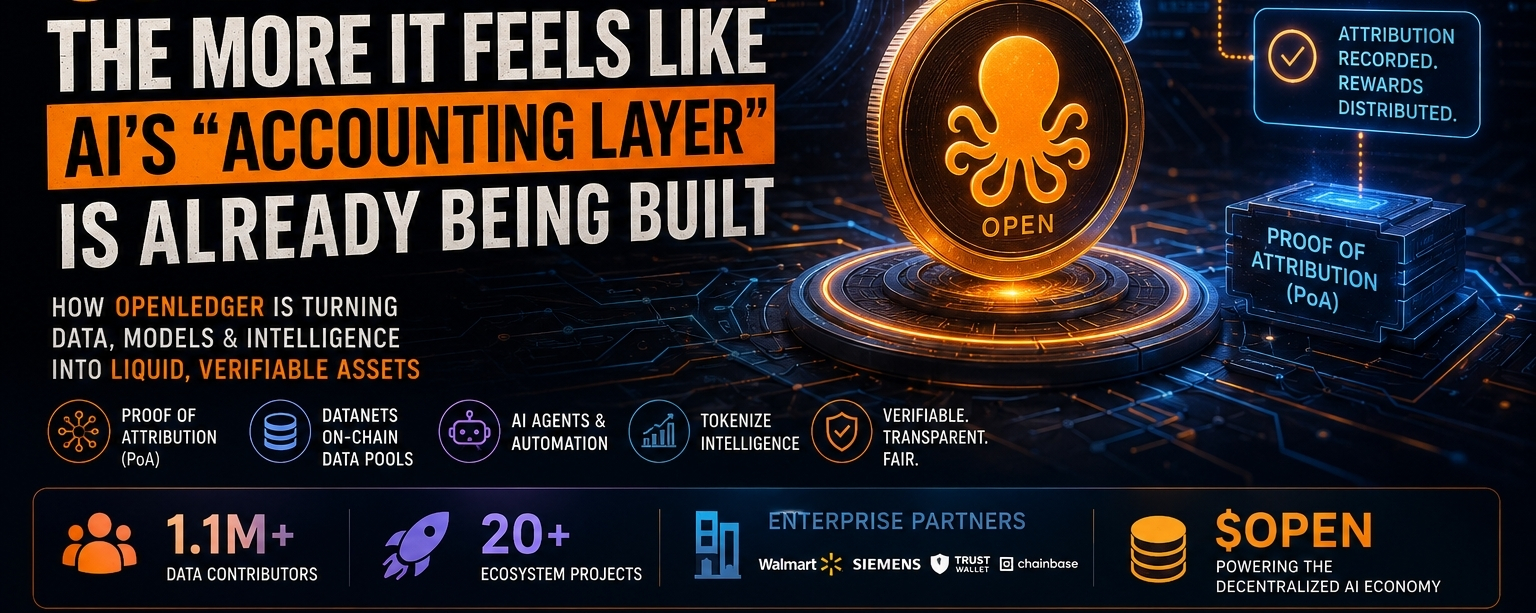
The entire architecture revolves around something they call Proof of Attribution (PoA) a system designed to trace which datasets, models, and contributors influenced an AI output, then automatically route rewards back to those contributors through the blockchain.
The first time I understood that mechanism, I stopped looking at OpenLedger as “another AI coin.”
I started looking at it as a possible economic correction layer for the AI era.
And honestly… that framing changes everything.
Because if AI becomes the defining industry of this decade, then attribution becomes one of the most valuable systems on Earth.
That’s probably why the messaging coming from OpenledgerHQ feels unusually philosophical lately.
While most projects scream about price candles and “next 100x narratives,” OpenLedger keeps talking about intelligence cycles, agent economies, capital allocation, and information systems.
Posts like:
> “Hype starts cycles, intelligence sustains them.”
or
> “Investing should always be agent-powered.”
might sound simple on the surface, but they reveal how the team thinks.
They aren’t positioning OpenLedger as just infrastructure.
They’re positioning it as the coordination layer for autonomous AI economies.
And unlike many narratives in crypto, they’re already shipping products around that idea.
The biggest example right now is OctoClaw.
I tried researching it expecting another unfinished AI dashboard.
Instead, I found a downloadable desktop AI agent system that actually lets users build, automate, and execute workflows across multiple models in real time.
That matters more than people realize.
Most AI projects talk endlessly about “future agents.” OpenLedger released tooling people can directly interact with today.
Market analysis. Whale tracking. Yield strategies. Automated execution. Multi-LLM orchestration. Local deployment.
This is where the project starts separating itself from pure speculation.
The infrastructure is becoming tangible.
And I think that’s why OpenLedger keeps gaining serious mindshare despite the market volatility around OPEN.
Even after the huge Binance debut in 2025 where OPEN exploded toward the $1+ range before cooling down heavily the project never disappeared from conversations.
That’s usually a strong signal.
Narratives fade. Builders stay visible.
Right now $OPEN trades around the $0.18–0.19 area with millions in daily volume, and while price action still reflects broader market uncertainty, the ecosystem activity underneath looks far more important to me than short-term candles.
Mainnet is already live. Datanets are operational. Contributor leaderboards exist. Attribution systems are functioning. Buybacks funded through enterprise revenue already happened. Cross-chain expansion continues. The AI marketplace vision is still progressing.
That’s real execution.
And I think people are underestimating how important OpenLedger’s timing might be.
Governments are beginning to question opaque AI training systems. Creators are becoming increasingly hostile toward uncompensated data scraping. Regulators want transparency. Institutions want accountability. Developers want monetization.
OpenLedger sits directly in the middle of all four trends.
That’s probably why the project keeps emphasizing verifiable intelligence instead of hype-driven AI branding.
Even the technical structure feels intentionally optimized for scale.
Built using the OP Stack and EigenDA, OpenLedger focuses heavily on AI-native throughput while remaining EVM-compatible. Their ecosystem already includes millions of nodes, millions of transactions, and thousands of AI models tested before broader rollout.
And when I look at initiatives like OpenCircle the $25M ecosystem push supporting AI blockchain startups it becomes obvious the team is trying to create an entire economic environment around decentralized intelligence, not just a single token narrative.
Personally, I think the most important thing about OpenLedger is this:
They are trying to transform AI from a closed corporate asset into an open economic network.
That’s a massive idea.
Maybe even bigger than most people currently realize.
Because if AI eventually becomes embedded into everything finance, media, trading, research, automation, governance then systems capable of verifying where intelligence came from could become foundational infrastructure.
In that world, OpenLedger doesn’t compete as “just another Layer 1.”
It becomes the accounting layer for intelligence itself.
And honestly?
That’s one of the few crypto narratives lately that feels genuinely early instead of recycled.
