
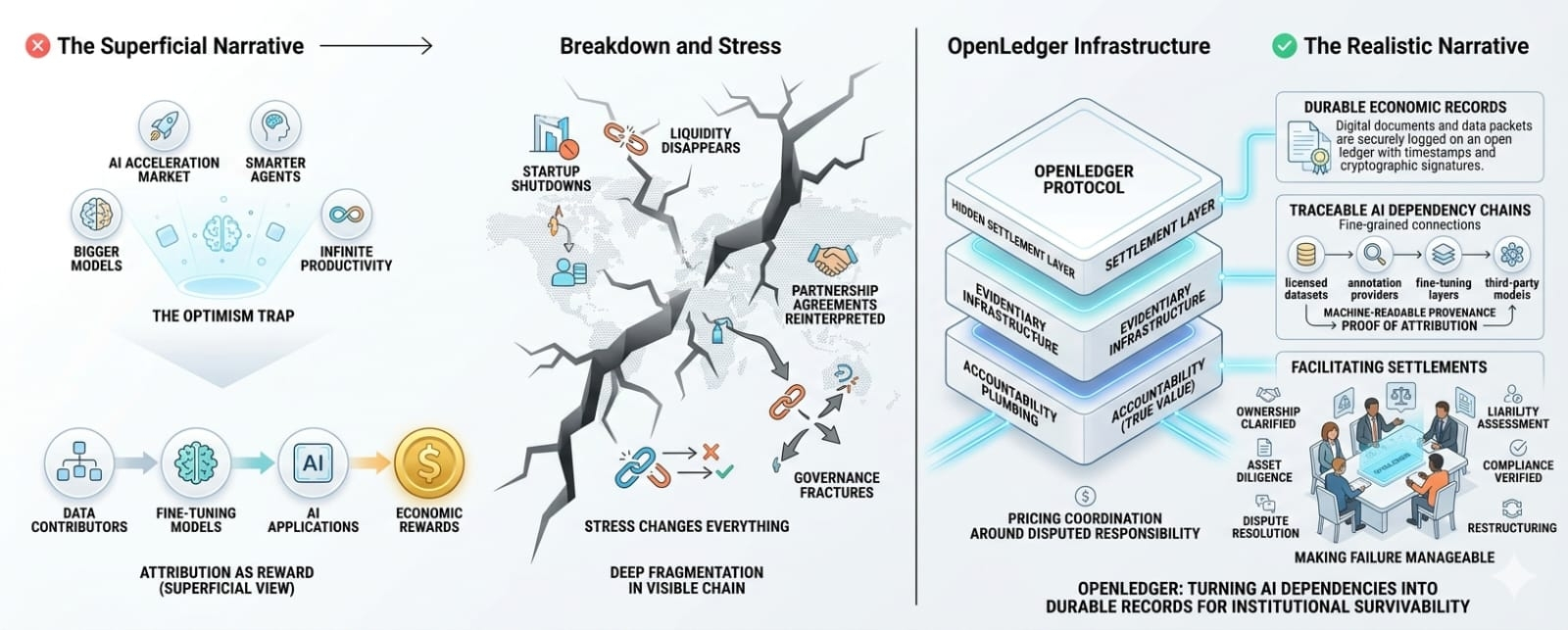
Most AI conversations right now feel trapped inside optimism.
Everything is framed around acceleration. Faster models. Smarter agents. Bigger inference markets. Autonomous workflows. Infinite productivity gains. The entire ecosystem behaves as if intelligence scaling is the only story that matters.
But the longer I watch the infrastructure side of AI evolve, the more I think the real story may emerge somewhere much less exciting.
Failure.
Not dramatic collapse. Just ordinary economic failure.
Because businesses fail constantly.
A startup raises capital, integrates several datasets, fine-tunes external models, hires annotation teams, launches an AI product, gets early adoption, burns through cash, hits legal uncertainty, misses revenue targets, and eventually shuts down. That is not an edge case. That is normal market behavior.
What keeps bothering me is that AI infrastructure discussions almost never account for what happens after that point.
Everyone talks about attribution as if its purpose is rewarding contributors when systems succeed. That always sounded incomplete to me.
Yes, attribution matters for monetization. Yes, creators and data providers want economic visibility. Yes, contributors increasingly want proof their work helped generate commercial value.
But I’m starting to think attribution infrastructure becomes truly important somewhere else entirely.
During disputes.
During restructurings.
During audits.
During acquisition diligence.
During moments when nobody agrees anymore.
That is where OpenLedger started looking more interesting to me.
At first glance, the project looks fairly easy to understand. OpenLedger presents itself as infrastructure for Payable AI, where data, models, and contributors become economically visible instead of disappearing inside opaque systems. The protocol focuses heavily on provenance, attribution tracking, and transparent contribution records.
On the surface, that sounds like another fairness narrative. A cleaner way to distribute value inside AI ecosystems.
But the deeper implication feels much heavier than that.
Because mature economic systems always develop mechanisms for unresolved obligations.
Finance has settlement infrastructure. Corporations have bankruptcy procedures. Supply chains have audit systems. Software licensing has compliance frameworks. Capital markets have clearing layers because nobody trusts memory once money becomes large enough.
AI still behaves as if it can skip that stage entirely.
That feels naive.
Modern AI products are not singular creations anymore. They are dependency chains.
A company might build one AI application, but internally that product could depend on: licensed datasets, third-party APIs, external annotation providers, fine-tuned open-source architectures, retrieval systems, cloud inference providers, synthetic training layers, multiple model adapters, and downstream integrations stacked on top of each other.
From the outside, the product looks unified.
Underneath, it is fragmented.
That fragmentation stays mostly invisible while growth continues and incentives remain aligned.
Stress changes everything.
The crypto industry should already understand this better than anyone. During expansion cycles, coordination feels natural. Assumptions remain unchallenged because everybody benefits from momentum.
The moment liquidity disappears or incentives compress, invisible assumptions suddenly become explicit conflict.
Treasury disputes emerge. Governance fractures appear. Validator economics become contentious. Partnership agreements get reinterpreted. Ownership questions surface.
AI systems will not avoid this simply because the technology feels more advanced.
And this is where OpenLedger’s architecture starts becoming more meaningful.
The project’s core concept revolves around Proof of Attribution, a system designed to preserve machine-readable provenance across datasets, models, inference processes, and contributors. In simple terms, OpenLedger wants AI systems to retain durable records showing where outputs came from and which dependencies shaped them.
Most people interpret this as reward infrastructure.
I increasingly see it as evidentiary infrastructure.
That distinction matters.
Because evidence changes economic negotiations.
Imagine a healthcare AI company building a diagnostic assistant. The system uses licensed medical imaging datasets, external annotation labor, retrieval systems connected to clinical databases, proprietary fine-tuning, and third-party model architectures.
Now imagine the company fails.
What happens then?
Who owns the resulting models? Which datasets materially influenced outputs? Which vendors still retain claims? Which liabilities survive insolvency? Which assets can legally be sold? Which contributions were economically significant? Which contracts become enforceable once money disappears?
These are not technical questions anymore.
They are institutional questions.
And institutions run on documentation.
The strange thing about AI right now is that the industry keeps discussing intelligence while quietly ignoring responsibility plumbing.
That may work temporarily.
It probably does not work at scale.
This is why I think the market may still misunderstand where attribution infrastructure becomes economically necessary.
Not during success.
During breakdown.
During disagreement.
During legal ambiguity.
During restructuring events where nobody trusts verbal memory anymore.
OpenLedger’s real value may eventually come from turning AI dependency chains into durable economic records instead of socially remembered assumptions.
That sounds boring compared to autonomous agent narratives, but boring infrastructure often captures the deepest long-term value.
The hesitation many enterprises have around AI adoption is also frequently misunderstood.
People assume organizations fear insufficient capability.
I don’t think that is the real issue anymore.
Most procurement teams are not worried that AI models are too weak. Capability is improving fast enough already.
What they fear is exposure.
Hidden liability. Data contamination. Unclear ownership chains. Compliance surprises. Unverifiable provenance. Regulatory ambiguity six months later.
Those concerns become increasingly important as governance expectations tighten globally.
The EU AI Act, data protection frameworks, enterprise audit standards, and sector-specific compliance rules are all pushing AI systems toward greater traceability whether the market likes it or not.
That creates a different type of economic demand.
Not demand for intelligence.
Demand for accountability.
And accountability infrastructure is structurally less replaceable than hype cycles.
Of course, OpenLedger does not magically solve these problems.
That is important to say clearly.
Crypto still has a habit of confusing visibility with enforceability.
Putting records on-chain does not automatically resolve legal disputes. It does not override insolvency law, commercial arbitration, jurisdictional conflict, or regulatory interpretation.
A blockchain can preserve evidence beautifully.
It cannot compel off-chain cooperation.
Those are completely different things.
Still, preserved evidence changes the shape of disagreement itself.
And that matters far more than people sometimes realize.
There are also obvious problems with attribution systems themselves.
How much did one dataset truly matter? How do you measure contribution significance? Should every micro-input receive permanent financial rights? How do you prevent attribution systems from collapsing under administrative complexity?
That path becomes absurd very quickly if no thresholds exist.
Any functioning attribution economy will eventually require relevance filtering, weighting systems, materiality standards, and exclusion mechanisms.
Which immediately creates governance problems.
Who decides what mattered?
That question becomes political almost instantly.
And governance problems are usually harder than technical ones.
Still, I cannot shake the feeling that OpenLedger may be approaching a more important market than people currently assume.
If the protocol remains only a rewards layer for contributors, its long-term significance probably stays limited.
But if attribution evolves into infrastructure influencing: compliance trust, settlement priority, institutional procurement, asset diligence, ownership verification, or liability assessment, then the economics become much larger.
Because now the network is no longer pricing AI outputs.
It is pricing coordination around disputed responsibility.
That is a completely different market.
And possibly a more durable one than speculative AI narratives understand yet.
The broader AI ecosystem still feels young because it talks almost exclusively about acceleration.
Mature systems eventually become obsessed with survivability instead.
That transition changes everything.
Infrastructure becomes important not because it helps optimism move faster, but because it helps institutions continue functioning after optimism disappears.
That is why OpenLedger keeps pulling my attention back.
Not because it promises some utopian creator economy.
Not because “everything on-chain” magically fixes trust.
But because it quietly points toward something the AI industry still avoids confronting directly:
economic systems only become real once failure becomes manageable.
