
Look at the price chart first, because that is what most people see. A climb last autumn. A sharper climb in early winter. Then the pullback that lasted through spring. Nothing unusual for a mid‑cap token in this market. Something landed underneath that chart, though, and the chart does not show it.
The usual story writes itself. Data economy. Contributors upload. Models train. Tokens flow. That story is clean. It is also probably wrong.
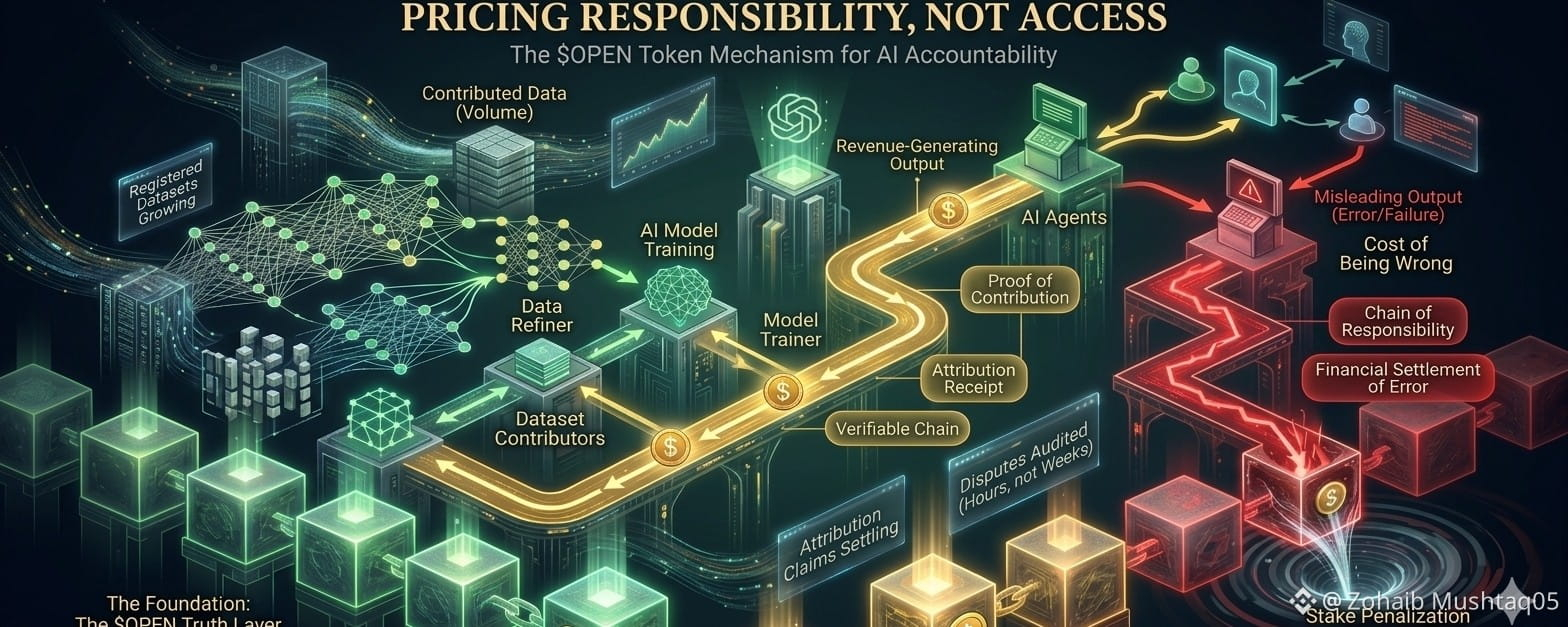
What the token is actually pricing is not access to data. It is the cost of being wrong. Every time a model produces an output, a chain of responsibility runs backward through the datasets and contributors that shaped that output. Who added what. Who improved the model. Who introduced an error. That chain is not a philosophical question. It is a financial settlement.
Spend time watching small teams build models. Not the big labs with infinite budgets, but the messy middle — developers stitching together open weights and custom data. Their problem is rarely a shortage of data. It is a shortage of receipts. They cannot tell which contributor actually helped. They cannot verify that a dataset was clean. And when something fails, there is no ledger to audit.
That is the constraint the usual narratives glide past. Volume does not solve attribution. It makes it worse.
What the token does is turn attribution into a staking mechanism. You stake to run an agent. You earn when your data contributes to a useful output. You lose stake when your data misleads or your agent fails. The mechanism is not gentle. Gentle mechanisms do not survive adversarial environments.
Consider a single transaction. Someone registers a dataset. Another person trains a model using it. The model answers a query that generates revenue. The token moves from the revenue recipient back to the dataset contributor. Not as charity. As a contract. That flow is live. It happens slowly, transaction by transaction, on networks that are no longer testnets.
But the real insight is not the flow. It is what the flow reveals about scarcity. In a world where AI agents transact autonomously, the scarcest resource is not compute. It is not even high‑quality data. It is proof. Proof that a model did not steal. Proof that a contributor added signal instead of noise. Proof that an agent had permission to spend.
That is what the token prices. Accountability.
And accountability has a strange property. It compounds. A small model with one contributor needs little proof. A sprawling network of thousands of models, millions of datasets, and agents trading on each other’s outputs? That network collapses without a truth layer. Every participant needs to know who to trust and who to penalize.
The token is that layer. You stake it. You earn it. You lose it. That is the cycle.
Now watch the market. Most days, nothing dramatic happens. The price moves with the rest of the mid‑cap sector. A tweet from a large exchange bumps it. A broader narrative about AI lifts it. Then it drifts back. Quiet. Almost ignored.
But look closer at what accumulates. The number of registered datasets. The frequency of attribution claims. The volume of disputes settled by the mechanism. Those numbers do not scream. They accumulate. And accumulation is the only thing that has ever mattered for infrastructure that lasts.
A regulatory deadline in a major market recently forced dozens of projects to prove how their models were trained. Most could not. Those that had a verifiable chain of contributions passed the audit in hours. Those that did not spent weeks scrambling. That moment was not a headline. It was a warning.
The upcoming token unlock will test conviction. A chunk of supply becomes available. Some will sell. Some will buy. Ordinary rhythm. But underneath that rhythm, the machine keeps running. Datasets keep getting registered. Agents keep executing. Attribution keeps settling.
And the token keeps pricing something almost no other token prices: the cost of being wrong in a world where being wrong has financial consequences.
That is not a data economy. A data economy prices access. This prices responsibility. The question is not whether the mechanism works. It does. The question is whether the market believes that responsibility has value