
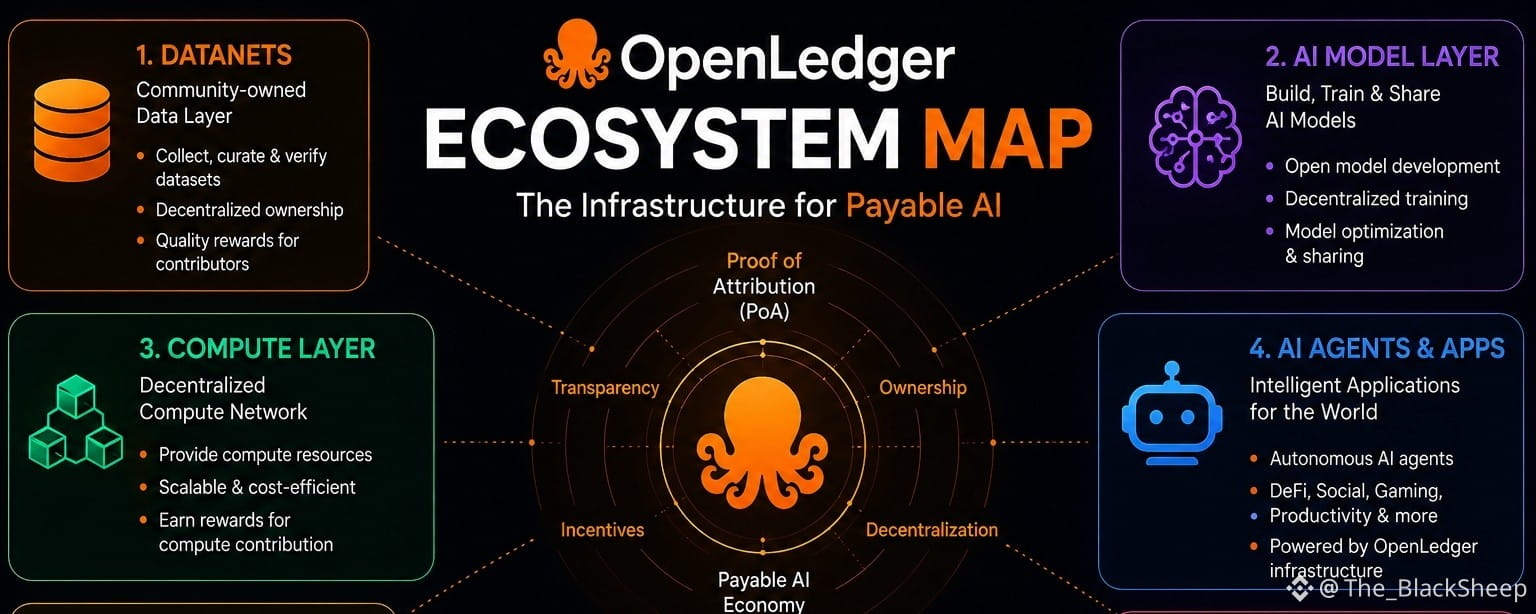
The AI race is no longer only about building smarter models. The bigger battle now revolves around ownership, attribution, infrastructure, and economic coordination. That is where the @OpenLedger ecosystem map becomes interesting because it is attempting to build an entire framework around how AI value is created, tracked, and distributed.
Most people look at AI projects only from the surface level — chatbots, image generators, or AI agents. But beneath every AI application exists a much larger system involving datasets, compute infrastructure, model training, attribution mechanisms, developers, and end-user applications. OpenLedger is positioning itself as the infrastructure connecting all of these layers together.
At the foundation of the ecosystem is data.
AI systems depend heavily on quality datasets, yet contributors providing valuable information are rarely rewarded. OpenLedger introduces the idea of decentralized “Datanets,” where communities can contribute and manage datasets transparently. Instead of data becoming locked inside centralized corporations, datasets can become open, verifiable, and economically valuable within the ecosystem itself.
The next layer is Proof of Attribution (PoA), one of the most important concepts within the OpenLedger architecture. PoA creates a system where contributions can be tracked on-chain. Whether someone contributes data, develops models, provides compute resources, or builds AI applications, their participation can potentially be verified and rewarded transparently.
This creates the foundation for what OpenLedger describes as Payable AI.
In traditional AI systems, contributors create value while centralized entities capture most of the economic upside. OpenLedger aims to shift that model toward a more community-driven economy where incentives are distributed more fairly across the network.
Another critical part of the ecosystem is AI model infrastructure. OpenLedger is building toward an environment where developers can create, deploy, and monetize AI models more openly. As AI agents become increasingly autonomous in the future, systems for attribution and transparent value distribution may become essential.
The ecosystem also connects to compute infrastructure. AI development requires enormous computational resources, and decentralized compute networks are becoming one of the strongest emerging narratives in crypto. OpenLedger’s ecosystem vision aligns with the idea that AI infrastructure itself can become decentralized rather than controlled by a small number of centralized providers.
Applications and AI agents represent another major layer.
Future AI ecosystems will likely include autonomous agents capable of executing tasks, interacting with users, analyzing markets, generating content, and participating in digital economies. OpenLedger’s framework creates a foundation where these systems can operate while maintaining transparent attribution and incentive structures.
This is important because AI is rapidly evolving from a tool into an economic participant.
As that transition happens, questions surrounding ownership and accountability become much more significant. OpenLedger’s ecosystem map attempts to address those concerns early by integrating blockchain transparency directly into AI infrastructure.
The broader narrative surrounding OpenLedger is also strengthened by the convergence of AI and crypto. Artificial intelligence provides automation and scalability, while blockchain introduces transparency, ownership, and coordination mechanisms. Projects operating between both sectors are gaining increasing attention because they are attempting to solve structural problems rather than simply launching speculative products.
What makes the OpenLedger ecosystem compelling is that it does not focus on a single application. Instead, it focuses on building the rails for an entirely new AI economy.
From Datanets and Proof of Attribution to decentralized compute, AI agents, developers, contributors, and applications, the ecosystem map represents an attempt to create a full-stack infrastructure for decentralized intelligence.
The future AI economy may not be owned by a few platforms.
It may be built by ecosystems.
That is the larger vision behind @OpenLedger.